Mastering the Bamboo Earring Swing: Kinetic Dynamics and Lobe Health
Discover the physics behind the perfect bamboo earring swing. Expert analysis on weight distribution, gauge sizing, and preserving earlobe health.

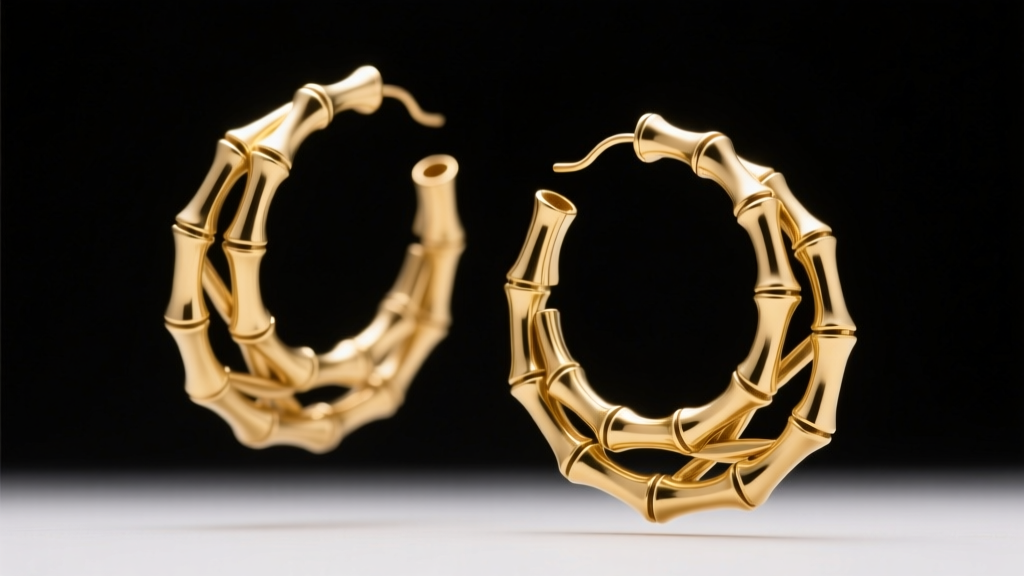
The Physics of the Bamboo Earring Swing
The term "bamboo earring swing" refers to the distinct kinetic signature of large, often bottom-heavy hoop earrings as they move in response to the wearer's momentum. Unlike standard circular huggies or lightweight studs, classic bamboo hoops—particularly the iconic "door-knocker" silhouette—operate under the principles of a physical pendulum. According to HyperPhysics at Georgia State University, the period of a pendulum's swing is dictated by its length and the distribution of its mass. In a standard 50mm circular hoop, the center of mass is relatively centralized, resulting in a quick, erratic flutter. However, in a 60mm x 40mm bamboo-shaped hoop (wider at the bottom), the center of mass is lowered. This increased moment of inertia creates a slower, more deliberate, and highly visible swing arc that has become a hallmark of statement jewelry.
Understanding this kinetic behavior is not merely an aesthetic exercise; it is a critical factor in jewelry design and wearability. The swing arc generates centrifugal force that pulls outward and downward on the earlobe piercing. A heavier hoop with a pronounced bottom swing will exert significantly more shear stress on the fistula (the piercing channel) than a lighter, perfectly circular hoop of the same overall diameter. Therefore, mastering the bamboo earring swing requires a delicate balance between achieving the desired visual momentum and maintaining the structural integrity of the ear tissue.
Material Density: Wood vs. Hollow Metal vs. Solid Brass
The material composition of the earring fundamentally alters its swing dynamics. While the term "bamboo" originally referred to the carved natural wood used in early iterations of the style, modern bamboo earrings are predominantly crafted from metals. The specific gravity of these materials drastically changes the kinetic output.
Natural Bamboo Wood
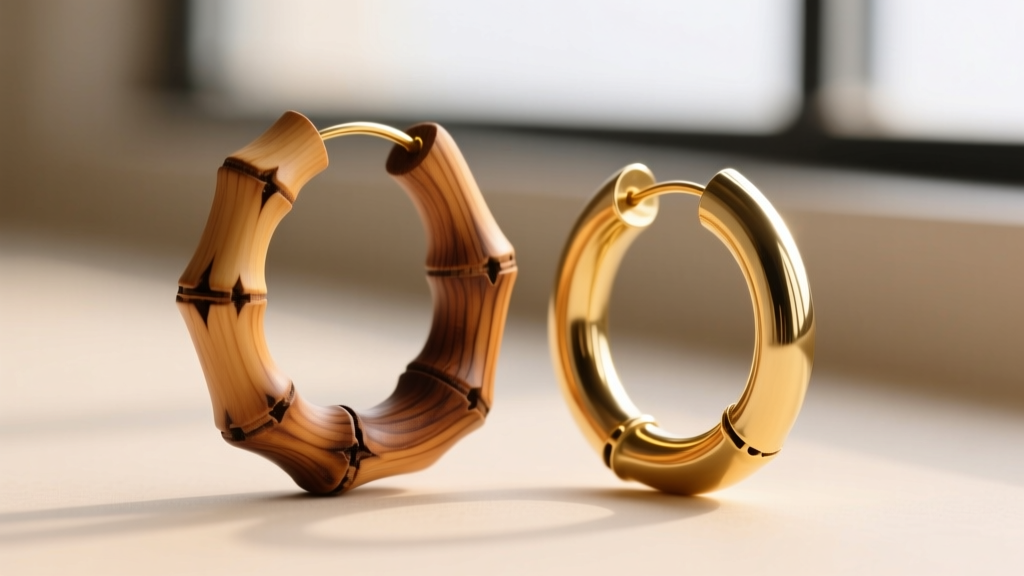
Carved natural bamboo has a density of approximately 0.6 to 0.8 g/cm³. Earrings crafted from this material are exceptionally lightweight. Because they lack significant mass, natural wood bamboo hoops do not generate enough momentum to sustain a long, fluid swing. Instead, their movement is highly reactive and erratic, easily disrupted by minor air currents or slight head turns. While excellent for lobe health due to their negligible weight, they fail to deliver the signature, weighted pendulum swing associated with the style.
Hollow Brass and Gold-Plated Tubing
To achieve the visual volume of a thick bamboo hoop without the prohibitive weight of solid metal, manufacturers utilize hollow brass tubing, often plated in 14k or 18k gold. Brass has a density of roughly 8.5 g/cm³, but the hollow core reduces the overall weight of a 50mm hoop to a manageable 4 to 6 grams per earring. This creates the ideal bamboo earring swing: enough mass to carry momentum through a smooth arc, but light enough to prevent immediate lobe fatigue.
Solid Sterling Silver and Cast Alloys
Solid cast bamboo hoops, typically made from sterling silver (density 10.4 g/cm³) or heavy brass alloys, are substantially heavier, often exceeding 12 to 15 grams per earring. The swing of a solid cast hoop is deeply pronounced and carries significant kinetic energy. While visually striking, the sheer force generated at the apex of the swing places immense stress on the earlobe, necessitating specialized hardware and thicker gauge posts to prevent tissue damage.
Hardware and Hinge Mechanics
The hardware connecting the hoop to the earlobe acts as the fulcrum for the bamboo earring swing. The type of clasp dictates the degrees of freedom the earring has, which in turn influences the swing arc and the stress placed on the piercing.
| Hardware Type | Swing Freedom | Lobe Stress Level | Optimal Gauge Thickness |
|---|---|---|---|
| Saddleback Hinge | Restricted (Pivots on a fixed pin) | Moderate to High | 16g (1.2mm) - 14g (1.6mm) |
| Snap-Back / Clicker | Moderate (Slight lateral play) | Low to Moderate | 18g (1.0mm) - 16g (1.2mm) |
| Continuous / Endless Hoop | High (360-degree rotation) | High (Friction burns possible) | 16g (1.2mm) minimum |
| French Wire (Fishhook) | Maximum (Unrestricted pendulum) | Very High (Pulls forward and down) | 14g (1.6mm) recommended |
For heavy, bottom-weighted bamboo hoops, the saddleback hinge is the industry standard. The hinge sits at the bottom of the hoop, while a thick post snaps securely into a catch at the top. This design restricts lateral twisting, forcing the kinetic energy into a clean, forward-and-back pendulum swing, thereby reducing the unpredictable torque that can tear a piercing.
Preserving Earlobe Integrity Under Kinetic Load
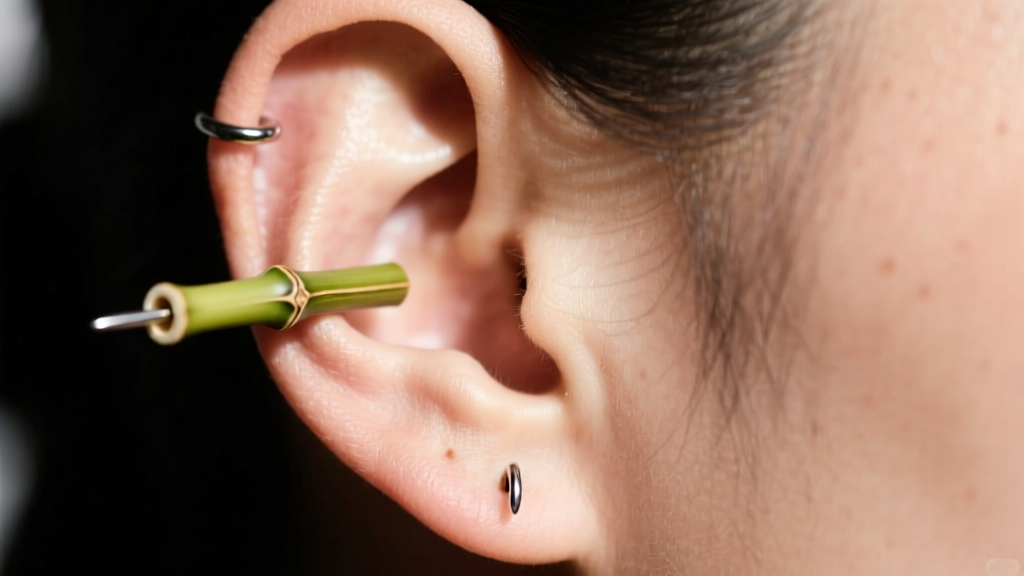
The most common failure mode for enthusiasts of heavy statement hoops is the "cheese cutter effect," where the downward and outward force of the bamboo earring swing causes a thin wire post to slowly slice through the earlobe tissue. The American Academy of Dermatology (AAD) emphasizes that heavy earrings can cause permanent stretching and tearing of the earlobe if the gauge of the wire is insufficient to distribute the load.
Standard fashion earrings are typically crafted at 20-gauge (0.81mm) or 18-gauge (1.0mm). At these thicknesses, the surface area of the wire pressing against the inside of the fistula is too small to safely support a swinging 10-gram bamboo hoop. To mitigate this, expert jewelers scale up the post thickness in direct proportion to the earring's mass and swing radius.
Gauge Sizing and Load Distribution
- 18-Gauge (1.0mm): Suitable only for hollow, lightweight bamboo hoops under 4 grams. The swing arc must be minimal.
- 16-Gauge (1.29mm): The sweet spot for most mid-weight bamboo hoops (5-9 grams). Provides a 25% increase in surface area over 18g, significantly reducing shear stress during movement.
- 14-Gauge (1.63mm): Mandatory for solid cast hoops or oversized door-knockers exceeding 10 grams. This thickness prevents the wire from migrating downward through the tissue during a vigorous swing.
For wearers whose piercings are already stretched to 18g or 20g but who wish to wear heavier 16g bamboo hoops, utilizing silicone earring support patches (often called "lobe wonders") is a critical intervention. These patches adhere to the back of the earlobe, providing a wider, reinforced backing that distributes the kinetic pull of the swing across a broader area of tissue, rather than concentrating it entirely on the fistula.
Optimizing the Swing Arc for Face Shapes
The kinetic movement of a bamboo earring is not just a mechanical phenomenon; it is a dynamic framing tool. Because the bamboo earring swing draws the eye along its path of motion, the dimensions of the hoop should be selected to complement the wearer's underlying bone structure.
For square or angular jawlines, a classic circular bamboo hoop with a uniform swing arc helps to soften sharp features. The continuous, rounded motion creates a visual halo that offsets the rigidity of the jaw. Conversely, for round or oval face shapes, the elongated, bottom-heavy swing of a door-knocker bamboo hoop is highly advantageous. The vertical momentum of the swing draws the observer's eye downward, creating an illusion of length and adding structural definition to softer facial contours.
Ultimately, mastering the bamboo earring swing requires a synthesis of physics, metallurgy, and anatomical awareness. By selecting the appropriate material density, utilizing robust saddleback hardware, and strictly adhering to 16g or 14g wire thicknesses, wearers can enjoy the iconic, fluid momentum of these statement pieces without compromising the long-term health of their earlobes.


