Big Chunky Earrings: Engineering Lightweight Statement Jewelry
Discover the metallurgy, biomechanics, and structural engineering behind big chunky earrings, plus expert tips to prevent earlobe damage and sagging.

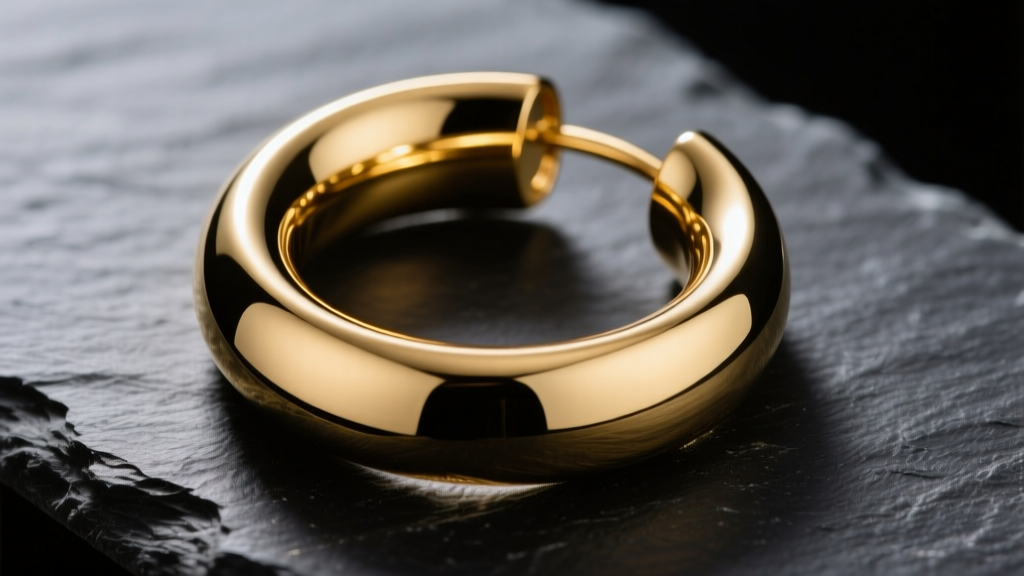
The Physics of Statement: Why Weight Matters in Lobe Piercings
The appeal of big chunky earrings lies in their architectural presence and undeniable visual impact. However, from a biomechanical perspective, the human earlobe is remarkably ill-equipped to handle heavy, swinging masses. The earlobe consists primarily of adipose (fat) tissue and a loose collagen matrix, lacking the dense cartilage found in the upper ear. When you suspend heavy jewelry from this delicate tissue, gravity initiates a slow but destructive process of mechanical creep.
According to guidelines referenced by the Association of Professional Piercers (APP), a standard healed lobe piercing can comfortably support between 7 to 10 grams of static weight. Once an earring exceeds 15 grams, the downward force begins to stretch the fistula (the piercing channel). Over time, this leads to micro-tears in the collagen network, resulting in permanent elongation, the dreaded 'cheese-cutter' effect, and eventual lobe splitting. For jewelry designers and collectors in 2026, the challenge is no longer just about making big chunky earrings look bold; it is about engineering them to defy gravity without compromising structural integrity.
Metallurgy & Manufacturing: How Designers Cheat Gravity
To create voluminous, big chunky earrings that remain under the 15-gram safety threshold, modern jewelers rely on advanced manufacturing techniques that manipulate material density. Solid casting is entirely out of the question for oversized pieces. Instead, the industry utilizes three primary methods to achieve high volume with minimal mass.
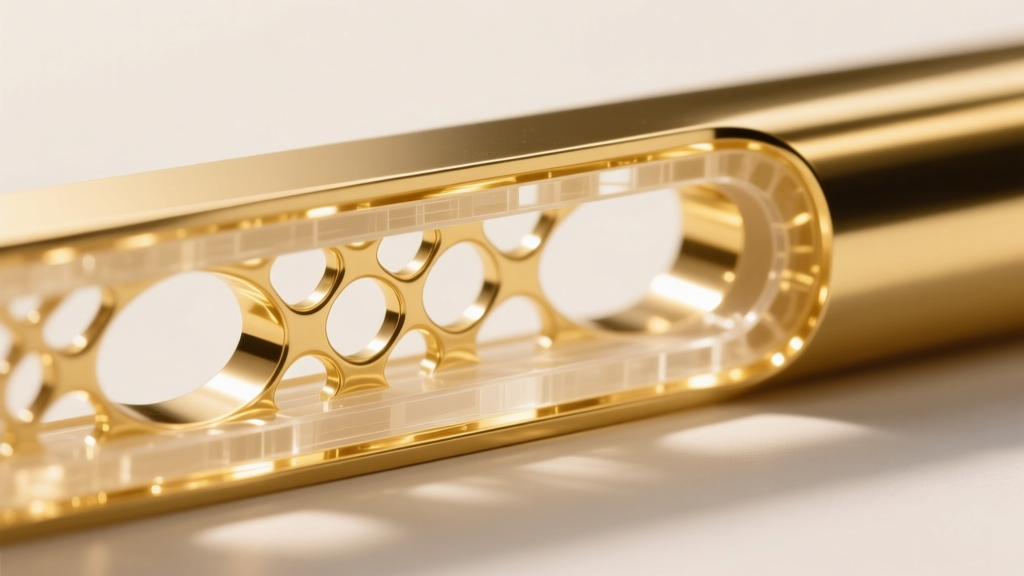
1. Electroforming
Electroforming is the gold standard for massive, lightweight hoops and sculptural drops. A master model is created from wax or 3D-printed resin, which is then painted with a conductive solution (usually graphite or silver nitrate). The model is submerged in an electroplating bath where copper or gold ions are deposited onto the conductive surface layer by layer. Once the metal shell reaches a thickness of roughly 0.2mm to 0.3mm, the piece is heated, melting out the wax core and leaving a hollow, incredibly lightweight metal shell. This technique reduces the effective density of the earring by up to 80% compared to solid casting.
2. Resin Cores with PVD Coating
For ultra-chunky geometric shapes, designers are increasingly turning to high-density polyurethane resins coated via Physical Vapor Deposition (PVD). PVD bonds a microscopic layer of titanium nitride or real gold to the resin in a vacuum chamber. The result is a piece that looks and reflects light like solid metal but weighs a fraction of the amount. Leading jewelry manufacturing suppliers like Rio Grande have heavily expanded their PVD and alternative core material catalogs to meet the surging demand for oversized, lightweight statement pieces.
3. Aerospace Alloys
When a solid feel is required, jewelers pivot to low-density metals. Titanium (Grade 5) and Aluminum alloys offer exceptional strength-to-weight ratios. Aluminum, with a density of just 2.7 g/cm³, is roughly one-third the weight of sterling silver, making it an ideal candidate for thick, chunky huggies and wide-cuff ear cuffs.
| Material | Density (g/cm³) | Max Solid Volume (cm³) | Manufacturing Technique |
|---|---|---|---|
| Solid Brass | 8.4 | 1.78 | Traditional Casting (Too heavy for large pieces) |
| Sterling Silver | 10.4 | 1.44 | Traditional Casting (Too heavy for large pieces) |
| Aluminum Alloy | 2.7 | 5.55 | CNC Milling / Solid Cast |
| Titanium (Grade 5) | 4.4 | 3.40 | 3D Printing / Casting |
| Electroformed Gold | ~1.5 (Effective) | 10.00+ | Electroforming over wax core |
Structural Integrity: Posts, Clutches, and Failure Points
The most common failure mode in big chunky earrings is not the earring body itself, but the hardware connecting it to the ear. When you wear a heavy, oversized drop earring, you are creating a lever. The torque applied to the solder joint where the post meets the earring body is calculated by multiplying the weight of the earring by the distance from the post to the center of mass. A 50mm drop earring generates exponentially more shear stress on the post than a compact 15mm stud of the exact same weight.
The Gauge Problem
Most commercial earrings use 18-gauge (1.02mm) or 20-gauge (0.81mm) posts. Under the leverage of a chunky, off-center hoop, an 18G brass or silver post will bend, warp, or snap at the solder joint. For any big chunky earring exceeding 12 grams, experts mandate a minimum of 16-gauge (1.29mm) or ideally 14-gauge (1.63mm) posts. Furthermore, the solder joint must be reinforced with laser welding rather than traditional torch soldering, which can leave brittle spots due to uneven heat distribution.
Clasp Mechanics for Heavy Loads
Standard friction backs (butterfly clutches) are entirely inadequate for heavy earrings. The narrow contact area concentrates the earring's downward pull onto a tiny 2mm point on the back of the earlobe, causing pain and tissue necrosis. Instead, oversized earrings must utilize:
- Omega Backs: These feature a wide, curved paddle that distributes the weight across a 15mm surface area on the rear of the lobe, dramatically reducing localized pressure.
- Leverbacks with Locking Mechanisms: For chunky hoops, a secure locking leverback prevents the earring from pulling forward and tearing through the bottom of the piercing channel.
- Screw Backs: Precision-threaded 14G or 12G screw backs provide the most secure grip, preventing the clutch from sliding off under the weight of the swing.
Biomechanical Support: Wearing Heavy Earrings Safely
Even with advanced lightweight engineering, some big chunky earrings—especially those featuring natural gemstones or solid architectural metals—will inherently push the boundaries of lobe tolerance. In these scenarios, external biomechanical support is non-negotiable.
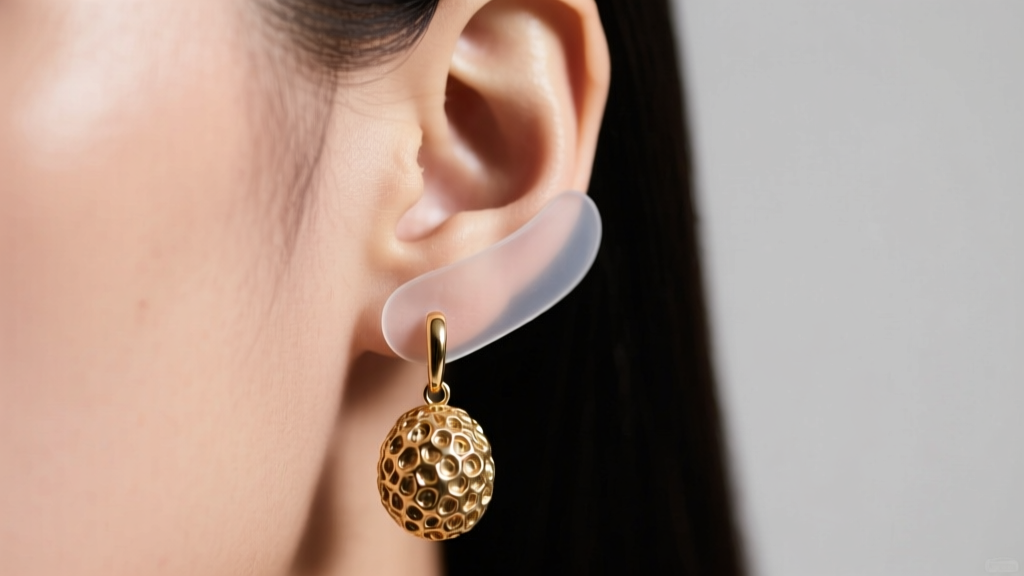
Silicone Support Discs and Patches
The most effective, non-invasive solution is the use of medical-grade silicone support patches (often sold as earlobe support discs). These adhesive patches feature a pre-punched hole that aligns with your piercing. The earring post passes through the patch, and the wide silicone base (often 20mm in diameter) acts as a structural splint. It distributes the gravitational load across the upper cheek and the broader base of the ear, completely bypassing the delicate fistula. For recurring wear of heavy statement pieces, applying a silicone patch is the single best way to prevent irreversible collagen stretching.
The 'Two-Handed' Rule
A critical behavioral adjustment for collectors of heavy jewelry is the two-handed removal method. Never pull a heavy earring out by the post alone, as the lateral friction can tear the channel. Always support the decorative front of the earring with your non-dominant hand, bearing the weight, while your dominant hand unclasps the backing and gently slides the post out.
Expert Troubleshooting: Fixing Sag and Post Bend
If you have already experienced the consequences of wearing heavy, poorly engineered earrings, there are technical solutions to restore both the jewelry and the tissue.
Bent Posts: If a 16G or 14G post has bent under torque, do not simply bend it back cold. Repeated cold-working of metals like sterling silver or brass causes work-hardening, making the metal brittle and prone to snapping. A professional jeweler will use a micro-torch to anneal (heat and soften) the post before straightening it, or ideally, laser-cut the damaged post and weld on a fresh, heavy-duty titanium replacement.
Stretched Piercings: For lobes that have elongated but not fully split, dermatologists and plastic surgeons can utilize hyaluronic acid dermal fillers to temporarily plump the tissue and shrink the fistula diameter. However, for permanent structural repair, a minor in-office surgical procedure called an earlobe reduction or fistulectomy is required to excise the stretched tissue and suture a fresh, tight channel. As noted by resources from the American Academy of Dermatology, allowing the tissue to heal fully for at least six months post-surgery is critical before reintroducing any jewelry, and strictly limiting future wear to engineered, lightweight pieces.
Ultimately, the secret to pulling off big chunky earrings in 2026 isn't just about having tough earlobes; it's about understanding the intersection of material science, mechanical leverage, and tissue biology. By demanding hollow construction, proper gauge thickness, and utilizing external support systems, you can wear massive statement jewelry daily without sacrificing the long-term health of your piercings.


