Expert Care and Cleaning for Long Gold Dangle Earrings
Learn how to clean, store, and protect long gold dangle earrings. Discover expert tips on preventing earlobe sag, tangling, and gold degradation.


The Physics of Dangles: Why They Require Special Care
Long gold dangle earrings are a staple of kinetic jewelry design. Unlike studs or huggies that sit flush against the anatomy, dangles operate on a pendulum axis. Every time you turn your head, walk, or brush your hair, the kinetic energy transfers directly to the ear wire and the earlobe piercing. This constant motion creates unique vulnerabilities: structural fatigue at the jump rings, accelerated wear on the ear wire, and a high propensity for chain tangling. Furthermore, the leverage exerted by a 5-gram to 15-gram dangle earring concentrates immense downward force on a millimeter of earlobe tissue. As of 2026, jewelry conservationists and dermatologists emphasize that maintaining these pieces requires a specialized approach that bridges metallurgy, anatomy, and proper chemical cleaning protocols.
Understanding Gold Karats and Structural Integrity
Not all gold is created equal, especially when subjected to the kinetic stress of a dangle earring. Pure gold (24k) is exceptionally soft, measuring roughly 60 on the Vickers hardness scale. While beautiful, a 24k gold ear wire will permanently bend under the weight of a long dangle. Therefore, understanding the alloy composition of your long gold dangle earrings is the first step in proper care.
| Gold Karat | Purity | Vickers Hardness (Approx.) | Best Application in Dangles | Care Vulnerability |
|---|---|---|---|---|
| 14k Gold | 58.3% | 140 - 160 HV | Ear wires, structural jump rings, clasps | Prone to tarnish if alloyed with high copper; susceptible to chlorine pitting. |
| 18k Gold | 75.0% | 110 - 130 HV | Main body, filigree work, charm links | Can scratch easily; requires gentle polishing to maintain high-gloss finishes. |
| 22k/24k Gold | 91% - 99% | 60 - 90 HV | Decorative beads, non-load-bearing accents | Extreme risk of bending, warping, and structural failure if used for ear wires. |
According to the Gemological Institute of America (GIA), the alloys mixed with pure gold to create 14k and 18k variations (such as copper, silver, and zinc) dictate how the metal reacts to environmental chemicals. For instance, 14k yellow gold contains a higher copper content, making it more susceptible to oxidation and darkening if exposed to sulfur-rich environments or harsh cosmetics.
Protecting Your Earlobes from Tearing and Sagging
The most common failure point for long gold dangle earrings is not the metal itself, but the human tissue holding it. The standard earlobe piercing is usually done at 20-gauge (0.81mm) or 22-gauge (0.64mm). When you hang a long, heavy dangle from a thin 22-gauge wire, it acts like a cheese wire against your fistula (the piercing channel), leading to micro-tears, migration, and eventual earlobe splitting.

The Gauge Rule for Dangles
For any long gold dangle earring weighing more than 4 grams, you should swap the standard ear wire for an 18-gauge (1.02mm) or 16-gauge (1.29mm) wire. This thicker metal distributes the kinetic load across a wider surface area of the earlobe, drastically reducing the risk of tissue migration.
Silicone Support Patches
If you prefer lightweight dangles but still want to prevent gradual sagging, utilize clear silicone earring support patches (often referred to as lobe patches). Adhered to the back of the earlobe, these patches provide a rigid backstop that disperses the downward pull of the earring across the entire lobe rather than just the piercing hole. The American Academy of Dermatology (AAD) notes that minimizing continuous tension on ear piercings is critical to preventing permanent tissue elongation and contact dermatitis caused by trapped moisture and bacteria in stretched fistulas.
The Safe Cleaning Protocol for Intricate Gold Dangles
Because long gold dangle earrings often feature intricate links, hollow tubing, or delicate chain segments, they trap sebum, dead skin cells, and hair product residue more easily than solid studs. However, aggressive cleaning methods can destroy them.
CRITICAL WARNING: Never use ultrasonic cleaners on hollow gold dangles or earrings featuring tension-set gemstones. The high-frequency vibrations can easily dent hollow gold components and shake loose delicate stone settings.
Step-by-Step 'Soak and Swish' Method
- Prepare the Solution: Fill a small glass bowl with warm distilled water. Avoid tap water, as the chlorine and fluoride can cause microscopic pitting in the copper alloys of 14k gold over time. Add three drops of phosphate-free, mild dish soap.
- The Soak: Submerge the long gold dangle earrings for exactly 10 to 15 minutes. This softens hardened sebum and cosmetic buildup trapped in the jump rings.
- The Agitation: Gently swish the earrings in the water. For stubborn buildup in filigree links, use a soft-bristled infant toothbrush. Brush in a single direction, following the grain of the metal, to avoid creating micro-scratches on high-polish 18k gold surfaces.
- The Rinse and Dry: Rinse thoroughly under a gentle stream of distilled water. Pat dry with a lint-free microfiber cloth. Allow them to air dry completely on a paper towel before storing to prevent moisture-induced skin irritation upon the next wear.
Detangling and Storage Mechanics
The kinetic nature of dangle earrings makes them notorious for tangling, especially if they incorporate fine gold chains. Throwing them into a communal jewelry box guarantees a frustrating knotting scenario that can permanently stretch or snap delicate gold links.
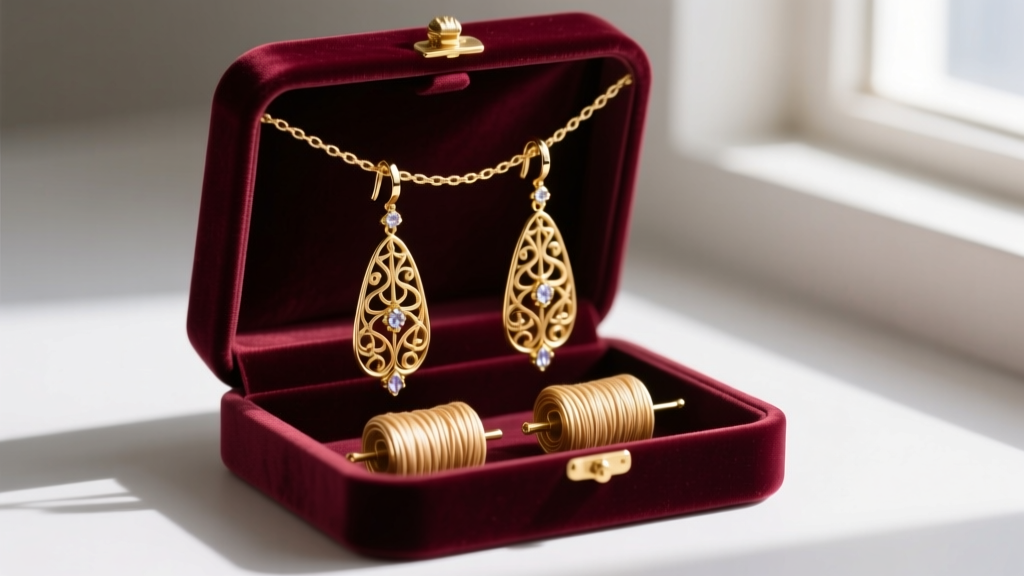
The Straw Trick for Chain Dangles
If your long gold dangle earrings feature chain segments, use the "straw trick" for storage. Unclasp the earring, thread the chain through a small piece of a plastic cocktail straw, and re-clasp it. This rigid sleeve prevents the chain from folding back on itself, making micro-knots physically impossible during transit or storage.
Individual Anti-Tarnish Pouches
Store each earring in its own soft, anti-tarnish flannel pouch. This not only prevents the ear wires from scratching the delicate body of the dangle but also limits exposure to ambient humidity and sulfur in the air, which are the primary catalysts for gold alloy tarnishing.
Routine Maintenance Checklist
To ensure your long gold dangle earrings remain structurally sound and visually brilliant, adopt this quick maintenance routine:
- Weekly: Wipe down the ear wires with a cotton swab dipped in rubbing alcohol to remove skin oils and prevent bacterial buildup near the piercing site.
- Monthly: Inspect all jump rings (the tiny loops connecting the dangle to the ear wire). Use two pairs of smooth-jawed pliers to ensure the cuts in the jump rings are perfectly flush. A microscopic gap will eventually catch on hair and pull the earring apart.
- Bi-Annually: Check the thickness of the ear wire at the point where it rests inside the earlobe. Friction can wear the metal down over years of use; if it looks visibly thinned, have a jeweler replace the wire before it snaps.
By respecting the metallurgy of gold and the anatomy of the earlobe, you can preserve the elegance and structural integrity of your long gold dangle earrings for decades, turning a beautiful accessory into a lasting heirloom.


