Dangle Earrings Red Gemstone Buying Guide & Sizing Tips
Discover how to choose the perfect dangle earrings. Red gemstone durability, gauge sizing, metal pairings, and face shape tips for 2026.

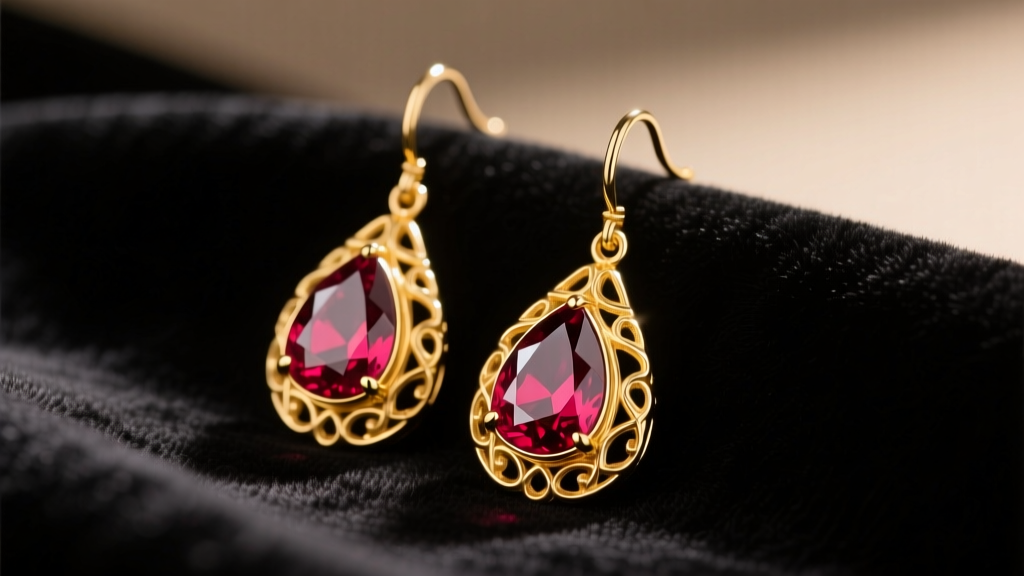
When curating a fine jewelry collection, the search for the perfect statement piece often leads to a specific, passionate aesthetic. Many collectors searching for dangle earrings red gemstones quickly realize that not all crimson gems behave the same way when suspended from the earlobe. Red stones carry an inherent visual weight and cultural significance—symbolizing vitality, love, and power—but translating that beauty into a comfortable, durable dangle earring requires a deep understanding of mineralogy, jewelry engineering, and facial proportions.
Unlike stud earrings that rest flush against the ear, dangle earrings are subject to momentum, gravity, and the constant friction of hair and clothing. In this comprehensive 2026 buying guide, we break down the exact specifications you need to evaluate before investing in red gemstone dangles, from Mohs hardness and specific gravity to wire gauge and setting security.
Decoding Red Gemstones: Hardness, Specific Gravity, and Price
The term 'red gemstone' encompasses a wide variety of minerals, each with drastically different physical properties. When a stone is set in a dangle earring, it becomes a pendulum. It will swing, catch on sweaters, and occasionally strike against hard surfaces. Therefore, durability is paramount. Below is a comparative breakdown of the most popular red gemstones used in fine dangle earrings.
| Gemstone | Mohs Hardness | Specific Gravity (SG) | Durability for Dangles | Avg. Price per Carat (2026) |
|---|---|---|---|---|
| Burmese Ruby | 9.0 | 4.00 | Excellent (High impact resistance) | $3,000 - $15,000+ |
| Red Spinel | 8.0 | 3.54 - 3.63 | Very Good (No cleavage planes) | $500 - $3,500 |
| Pyrope Garnet | 7.0 - 7.5 | 3.70 - 3.90 | Good (Can chip on hard impacts) | $50 - $300 |
| Red Tourmaline (Rubellite) | 7.0 - 7.5 | 3.00 - 3.20 | Fair to Good (Highly included) | $400 - $1,500 |
| Carnelian (Quartz) | 6.5 - 7.0 | 2.58 - 2.64 | Fair (Prone to scratching) | $2 - $20 |
Notice the Specific Gravity (SG) column. SG dictates how heavy a stone is relative to its size. A 12mm oval Pyrope Garnet will feel significantly heavier on the earlobe than a 12mm Red Tourmaline, even if they share similar Mohs hardness ratings. For elongated dangle designs, jewelers often favor Red Spinel or Tourmaline to keep the overall gram weight manageable, preventing earlobe fatigue and stretching over time. For authoritative data on gemstone physical properties, the Gemological Institute of America (GIA) remains the gold standard.
Structural Integrity: Wire Gauge and Earring Backs
The most common failure point in dangle earrings is not the stone itself, but the wire that passes through the ear piercing. The standard ear piercing is done at 20-gauge (0.81mm) or 18-gauge (1.02mm). However, many mass-market dangle earrings use flimsy 22-gauge (0.64mm) French wires to save on precious metal costs.
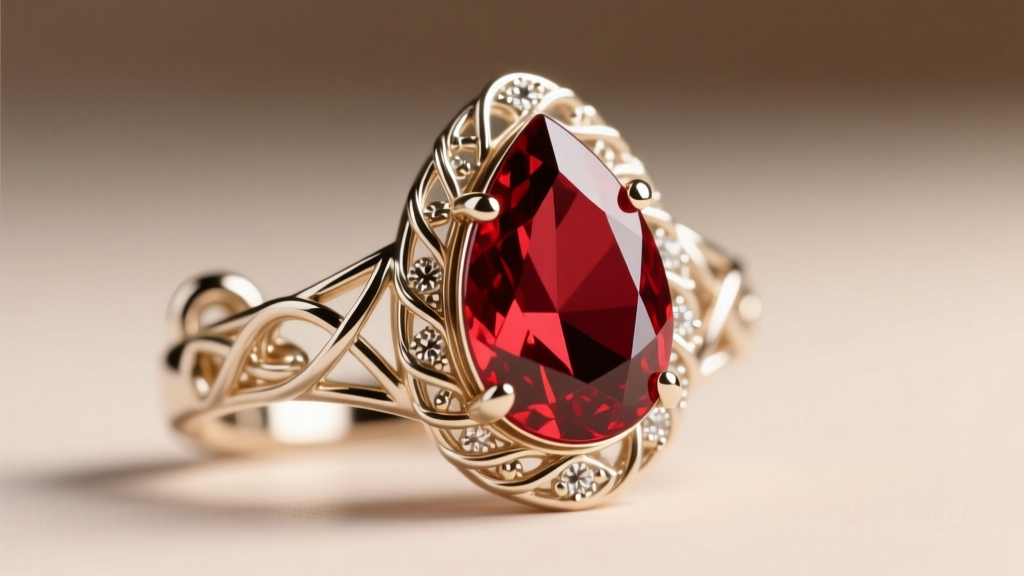
Choosing the Right Wire and Backing
- 20-Gauge French Wire (Fishhook): Acceptable for lightweight stones (under 2.5 grams total weight). Crucial Tip: Always use silicone O-ring stoppers. Standard butterfly backs do not fit French wires, and the earring will easily slip out if the wire is bumped forward.
- 18-Gauge Leverback: The absolute best choice for heavy red gemstone dangles (3 grams and above). The mechanical hinge locks securely behind the earlobe, distributing the weight more evenly and preventing loss. According to Jewelers of America, leverbacks drastically reduce the risk of losing heirloom pieces during active wear.
- Omega Backs / Clip-Ons: If you have non-pierced ears or extremely heavy statement dangles (10+ grams), custom Omega backs provide a wide surface area that grips the earlobe without piercing it, preventing the 'torn lobe' effect.
Setting Security: Prong vs. Bezel for Swinging Stones
Because dangle earrings swing and rotate, the setting must protect the gemstone's girdle (the outer edge). Traditional four-prong or six-prong settings leave the girdle exposed. If a ruby dangle swings and hits a marble countertop, an exposed girdle can easily chip, even with a Mohs hardness of 9.
For active lifestyles, seek out semi-bezel or full-bezel settings. A bezel wraps a thin ribbon of metal entirely around the stone's perimeter. While it reduces the amount of light entering the sides of the stone slightly, it provides a structural bumper that absorbs shock. If you prefer the brilliance of prong settings, ensure the jeweler uses 'V-prongs' on any pointed corners (such as pear or marquise cuts) to shield the most vulnerable tips of the red gemstone.
Proportion & Face Shape Dynamics
Red is a high-impact color that draws the eye immediately. The length and volume of your dangle earrings should complement your facial geometry rather than overwhelm it.
Sizing Framework by Face Shape
- Round Faces: Opt for long, linear dangles (1.5 to 2.5 inches) featuring emerald-cut or baguette red stones. The vertical lines elongate the face. Avoid short, chunky chandelier styles that add horizontal width.
- Square / Angular Faces: Choose dangles with curved elements, such as pear-shaped rubies or oval red spinels set in flowing, asymmetrical designs. The movement and rounded edges soften a strong jawline.
- Heart-Shaped Faces: Look for dangles that are wider at the bottom than the top (teardrop or chandelier styles). This adds visual weight to the lower half of the face, balancing a narrower chin.
- Oval Faces: You have the most versatility. However, medium-length dangles (1 to 1.5 inches) featuring clustered red garnets will highlight your natural symmetry without dragging your features downward.
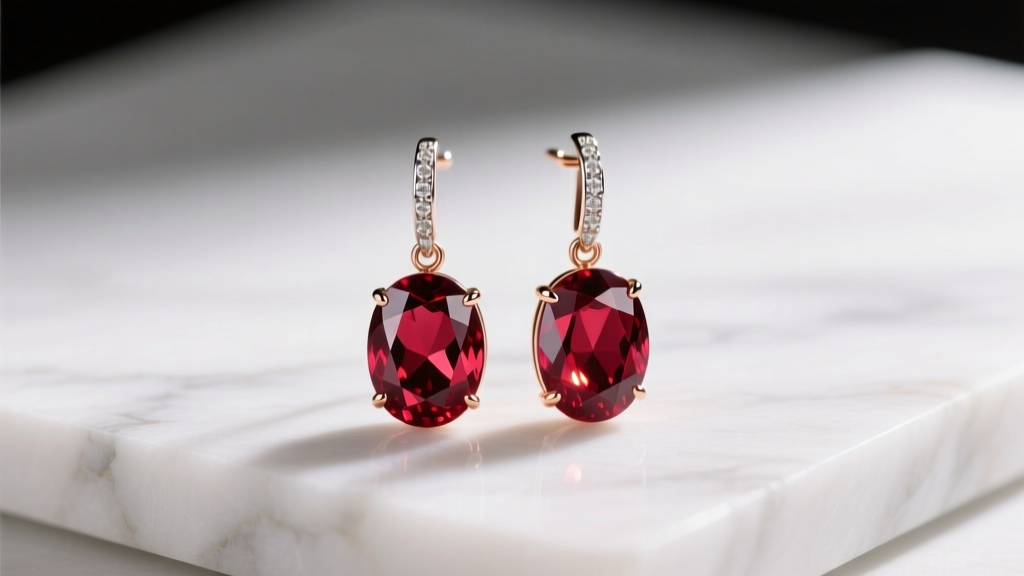
Metal Alloys and Color Theory for Red Stones
The metal alloy you choose acts as a reflective backdrop, altering the perceived hue and saturation of the red gemstone.
- 18k Yellow Gold: The traditional pairing for rubies and garnets. The warm, buttery tones of yellow gold enhance the 'pigeon blood' red of Burmese rubies and the deep, earthy crimson of Pyrope garnets. It creates a vintage, regal aesthetic.
- Platinum or 18k White Gold: Provides a stark, high-contrast backdrop. White metals make red spinels and rubellites appear cooler, sharper, and more modern. Rhodium-plated white gold will reflect maximum light back into the stone, increasing perceived brilliance.
- 14k Rose Gold: Contains copper, giving it a pinkish hue. Rose gold pairs beautifully with lighter, more pastel red stones like Rubellite tourmaline or pale Carnelian, creating a romantic, monochromatic gradient effect.
Treatments, Authenticity, and What to Ask the Jeweler
Before finalizing your purchase, you must understand the treatment history of the red gemstone. The vast majority of rubies on the market are heat-treated to dissolve silk inclusions and improve color saturation. This is a permanent, stable, and widely accepted practice that does not compromise the structural integrity of the stone.
However, you must be wary of glass-filled (fracture-filled) rubies. These are low-quality stones injected with lead-glass to make them appear transparent. Glass-filled rubies are highly unstable; the glass can melt or degrade if exposed to the heat of a jeweler's torch during a simple resizing or repair. Furthermore, harsh chemicals like lemon juice or household cleaners can etch the glass filling. Always ask for a lab report from a reputable institution like the GIA or AGS (American Gem Society) that explicitly states the type of treatment. If a ruby dangle earring is priced suspiciously low (e.g., $50 for a '2-carat natural ruby'), it is almost certainly glass-filled or a synthetic lab-created stone.
Maintenance and Cleaning Protocols
Red gemstone dangles accumulate skin oils, hairspray, and perfume, which dull their brilliance. Because dangles have moving parts (the jump rings connecting the stone to the wire), maintenance requires extra care.
- Inspect the Jump Rings: Every three months, use a jeweler's loupe to check the small metal loops connecting the dangle to the ear wire. Constant swinging causes metal-on-metal friction, eventually wearing a groove into the ring until it snaps.
- Safe Cleaning: For rubies, spinels, and garnets, a soft toothbrush with warm water and mild dish soap is perfectly safe. Never use ultrasonic cleaners on Red Tourmaline (Rubellite) or heavily included Garnets, as the high-frequency vibrations can shatter internal fracture lines.
- Storage: Store dangle earrings hanging from a specialized jewelry tree or laid flat in individual soft pouches. Tossing them into a communal jewelry box will result in the metal wires bending and the red stones scratching adjacent diamonds or sapphires.
By prioritizing structural engineering, understanding specific gravity, and selecting the right setting for your lifestyle, your red gemstone dangle earrings will remain a secure, breathtaking focal point in your wardrobe for decades to come.


