Every Different Type of Earrings: Gauges, Alloys and Closure Tech
Master the anatomy behind every different type of earrings. We analyze gauge tolerances, ASTM metal grades, and closure mechanics for lobe and cartilage.

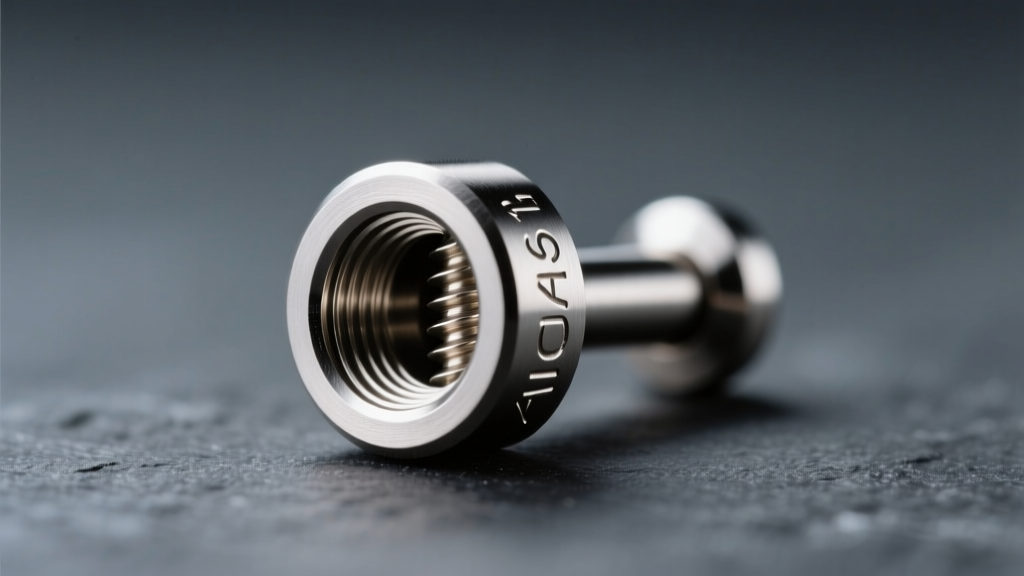
Most mainstream style guides treat the different type of earrings as mere aesthetic choices, focusing entirely on silhouette and trend. However, as jewelry metallurgists and piercing biomechanics experts, we know that selecting the right earring is a complex intersection of human anatomy, material science, and mechanical engineering. A poorly chosen alloy can trigger severe contact dermatitis, while an incorrect gauge tolerance can lead to tissue migration, hypertrophic scarring, or the dreaded 'cheese-cutter effect.'
In this expert deep dive, we bypass the fashion fluff to examine the technical specifications that dictate how every different type of earrings interacts with your ear tissue. From ASTM-certified implant grades to the physics of threadless tension closures, this is the definitive technical manual for ear adornment.
Biomechanical Tolerances: Lobe vs. Cartilage Architecture
The human ear is not a uniform canvas; it is a complex topography of varying tissue densities. Understanding these biological differences is the first step in selecting the correct jewelry specifications.
The Earlobe: Vascular and Forgiving
The earlobe is composed primarily of adipose (fat) and collagenous connective tissue, boasting a robust vascular network. This high blood flow allows for rapid healing (typically 6 to 8 weeks) and high elasticity. Because of this forgiving nature, lobe piercings can accommodate a massive range of jewelry styles, from delicate 20-gauge (0.81mm) threadless studs to heavy, large-gauge dangles. However, wearing heavy dangles in thin 20G wire over long periods will inevitably cause mechanical stretching and lobe tearing due to gravity-induced shear stress.
Cartilage: Avascular and Unforgiving
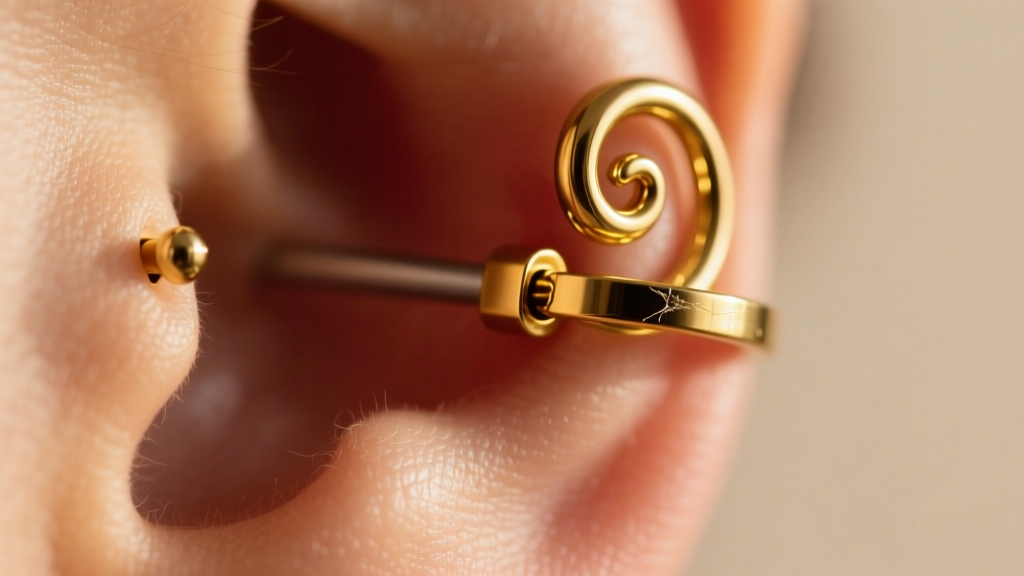
Cartilage zones (helix, conch, tragus, daith) are entirely avascular, relying on surrounding perichondrium for nutrient exchange. Healing takes 6 to 12 months, and the tissue is highly prone to inflammation. According to the Association of Professional Piercers (APP), cartilage piercings require a minimum thickness of 16-gauge (1.29mm) or 14-gauge (1.63mm). Using standard 20G or 18G wire in a fresh helix creates a high-pressure focal point that can literally slice through the tissue over time—a biomechanical failure known as the cheese-cutter effect.
Metallurgical Reality: Decoding ASTM Standards
The term 'hypoallergenic' is a marketing buzzword with no legal or medical definition. When evaluating the different type of earrings, you must look for specific metallurgical standards to ensure biocompatibility. The Mayo Clinic notes that nickel allergy is the most common cause of allergic contact dermatitis, making strict alloy control non-negotiable.
Implant-Grade Titanium (ASTM F136)
The gold standard for initial piercings and sensitive ears is Ti-6Al-4V ELI (Extra Low Interstitial) titanium, certified under ASTM International standard F136. This alloy contains zero nickel, boasts a high strength-to-weight ratio, and can be anodized to create a vibrant, non-toxic oxide layer. Beware of 'titanium-colored' steel; always demand mill certificates from your jeweler proving F136 compliance.
Niobium: The Malleable Alternative
Niobium is an elemental metal (not an alloy), meaning it cannot contain hidden nickel impurities. It is highly malleable, making it the premier choice for seamless rings that must be bent open and closed by hand. While softer than titanium, its biocompatibility is virtually identical.
The 'Surgical Steel' Trap (ASTM F138)
Many commercial brands sell 316L stainless steel (ASTM F138) as 'surgical steel.' While excellent for medical tools, 316L contains 8% to 12% nickel. The nickel ions can leach into the skin when exposed to sweat and sebum, triggering severe allergic reactions in sensitized individuals. For long-term wear, especially in cartilage, avoid F138 steel entirely.
Closure Engineering & Mechanical Failure Modes
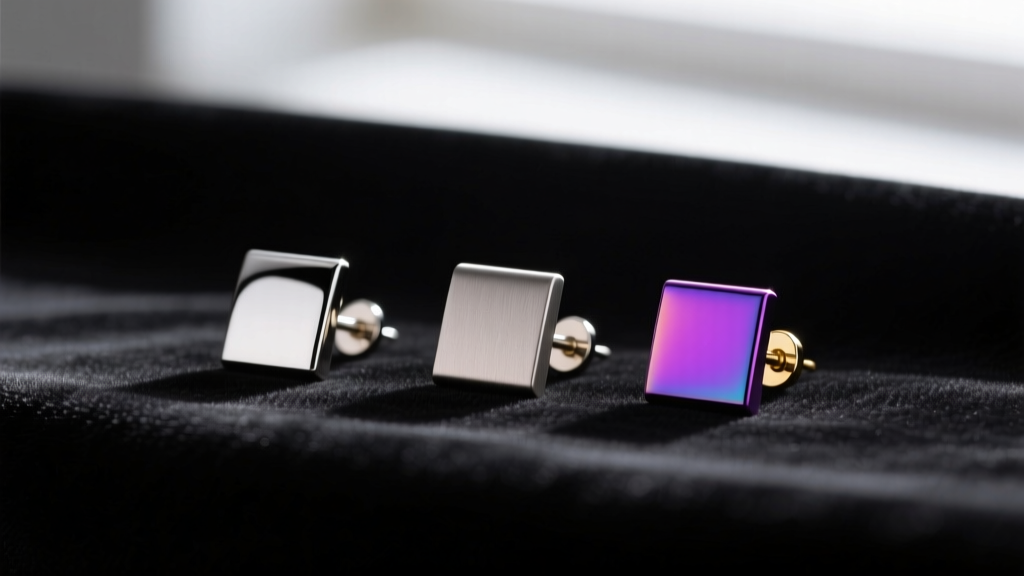
The mechanism that secures the earring is just as critical as the metal itself. Poorly engineered closures cause micro-tears during insertion and harbor bacteria in their crevices.
- External Threading: The screw threads are cut into the post that passes through the piercing. This is an outdated, dangerous design. The sharp threads act like a cheese grater, tearing the delicate fistula (healing tunnel) upon every insertion. Verdict: Avoid completely.
- Internal Threading: The threads are machined into the decorative end or the receiving tube, leaving the post perfectly smooth. This allows for frictionless insertion, protecting the tissue. Verdict: The professional standard for threaded jewelry.
- Threadless (Push-Pin): Utilizes a slightly bent pin on the decorative end that slides into a hollow post. The tension of the bent pin against the inner wall of the post creates a secure, friction-based lock. Verdict: Superior security and zero threading damage; ideal for labrets and cartilage studs.
- Clickers (Hinge & Clasp): Features a precision-machined hinge and a tension clasp that 'clicks' shut. Excellent for daith and helix hoops, but if the gauge is slightly off (e.g., a 17G clicker in a 16G piercing), the clasp will fail under lateral pressure.
Matrix: Mapping Styles to Anatomy and Gauges
To synthesize this data, we have mapped the most common different type of earrings to their optimal biomechanical environments. Use this matrix to audit your current jewelry box.
| Earring Style | Optimal Gauge Range | Best Anatomical Placement | Preferred Closure | Primary Risk Factor |
|---|---|---|---|---|
| Threadless Studs | 16G (1.29mm) - 14G (1.63mm) | Helix, Conch, Tragus, Lobe | Push-Pin Tension | Pin bending too far and losing tension |
| Huggies | 18G (1.02mm) - 16G (1.29mm) | Healed Lobes, Lower Helix | Hinge & Clasp | Pressure necrosis if inner diameter is <6mm |
| Seamless Hoops | 20G (0.81mm) - 16G (1.29mm) | Healed Cartilage, Nostril | Tension Bend (Niobium) | Tissue irritation from twisting open/closed |
| Ear Cuffs | N/A (Non-pierced) | Outer Helix Ridge | Friction Clip | Cartilage deformation if clamped too tightly |
| Heavy Dangles | 12G (2.05mm) - 8G (3.26mm) | Mature, Healed Earlobes Only | French Wire / Leverback | Lobe migration and tearing from shear stress |
Troubleshooting: Hypertrophic Scarring and Pressure Necrosis
Even with perfect ASTM F136 titanium, mechanical errors in jewelry selection will cause biological rejection. Two of the most common issues we see in clinical jewelry consulting are hypertrophic scarring and pressure necrosis.
The 'Hoops in Fresh Cartilage' Error
A hoop or ring in a newly pierced helix or conch is a primary catalyst for irritation bumps (hypertrophic scarring). Because a ring moves freely, it introduces friction, drags external bacteria into the fistula, and rests at an angle that puts uneven pressure on the healing channel. The technical fix: Wear a flat-back, internally threaded or threadless labret stud (typically 5/16" or 8mm in length) to accommodate initial swelling, downsizing to a 1/4" (6mm) post once the swelling subsides. Do not introduce a hoop until month 9 at the earliest.
Huggie-Induced Pressure Necrosis
Huggies are designed to 'hug' the earlobe tightly. However, when worn on a cartilage ridge (like the helix), the rigid, small inner diameter (often 5mm or 6mm) restricts lymphatic drainage and blood flow. This leads to pressure necrosis—tissue death caused by prolonged ischemia. If you must wear a huggie on the helix, ensure the inner diameter is at least 8mm to 10mm to allow for a 1-2mm gap between the metal and the tissue, accommodating natural fluctuations in ear swelling due to temperature and hydration.
Final Calibration
Understanding the technical nuances behind the different type of earrings transforms jewelry from a simple accessory into a precisely engineered wearable device. By demanding ASTM-certified alloys, respecting the biomechanical limits of cartilage versus lobe tissue, and insisting on internal or threadless closure mechanisms, you ensure your ear adornments are as safe and durable as they are beautiful. Stop treating your piercings as mere holes for wire; treat them as complex biological interfaces that demand metallurgical respect.


