2026 Gift Guide: How to Choose the Perfect Raspberry Earrings
Discover the perfect raspberry earrings for every occasion in our 2026 gift guide. Learn about gemstone grades, enamel motifs, and styling tips.

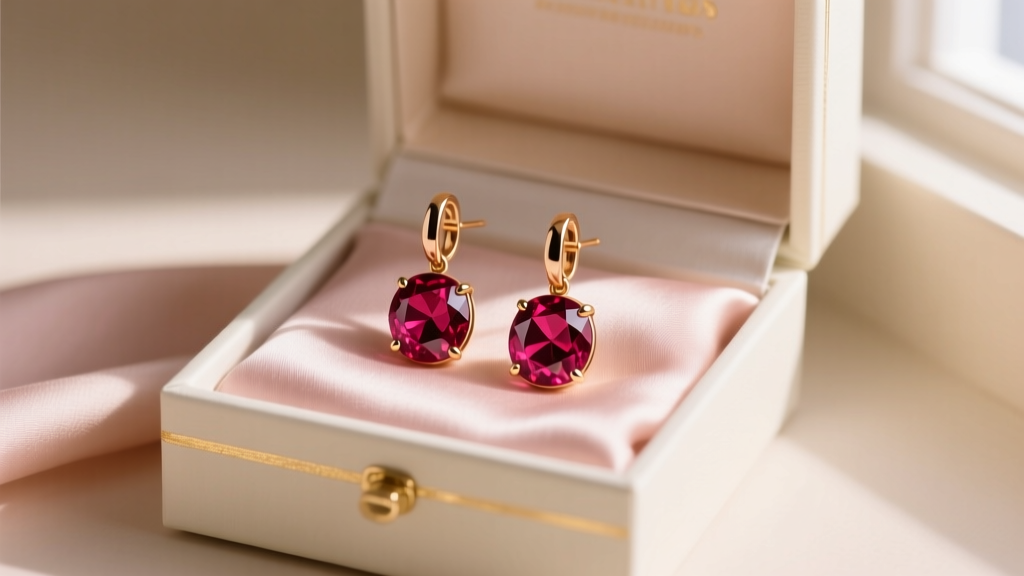
The Allure of Raspberry Tones and Motifs in 2026
As we navigate the 2026 jewelry landscape, the industry has seen a massive pivot toward 'botanical luxury' and rich, saturated berry tones. When shoppers search for raspberry earrings, they are typically hunting for one of two distinct categories: the vibrant, pinkish-red gemstone hue, or the literal, playful botanical fruit motif. Both offer exceptional gifting potential, but they require entirely different buying strategies, material considerations, and occasion-matching frameworks.
Gifting jewelry is an exercise in precision. A poorly chosen clasp can ruin a heavy drop earring, and the wrong gemstone can scratch within a month of daily wear. This comprehensive guide breaks down the gemological, metallurgical, and stylistic nuances of raspberry earrings, ensuring your next gift is both structurally sound and aesthetically breathtaking.
Decoding the Search: Gemstone Hue vs. Botanical Motif
To select the right piece, you must first understand what defines the 'raspberry' aesthetic in fine jewelry. The market is split between high-end gemstones that mimic the fruit's color and artisanal metalwork that mimics its shape.
The Hue: Rubellite Tourmaline & Rhodolite Garnet
If your recipient prefers classic elegance, you are looking for gemstones that deliver that signature raspberry red-pink saturation. According to the Gemological Institute of America (GIA), true Rubellite Tourmaline is the gold standard for this color. Unlike standard pink tourmaline, rubellite must retain its vivid red or purplish-red saturation under both daylight and incandescent lighting. Expect to pay between $150 and $600 per carat for eye-clean, well-cut rubellite. It sits at a 7 to 7.5 on the Mohs hardness scale, making it suitable for earrings, which endure less impact than rings.
For a more budget-friendly but equally stunning alternative, Rhodolite Garnet offers a purplish-raspberry undertone with exceptional brilliance. The GIA notes that rhodolite is a mix of pyrope and almandine garnets, offering a Mohs hardness of 7 to 7.5. It is highly durable, typically eye-clean, and ranges from $50 to $150 per carat, making it an excellent choice for larger statement studs or chandelier drops.
The Motif: Champlevé Enamel & Gold Granulation
For the recipient who appreciates artisanal, nature-inspired design, the raspberry motif is a masterclass in jewelry crafting. High-end botanical earrings often utilize champlevé enamel, where troughs are carved into 14k or 18k gold and filled with vitreous glass powder, then fired at roughly 1450°F (790°C). This creates a durable, vivid pink-and-red raspberry body. Jewelers often use gold granulation—fusing microscopic spheres of gold to the surface—to mimic the bumpy texture of raspberry drupelets. These pieces are wearable art, often produced by independent studios or heritage houses like Fabergé or specialized enamelists.
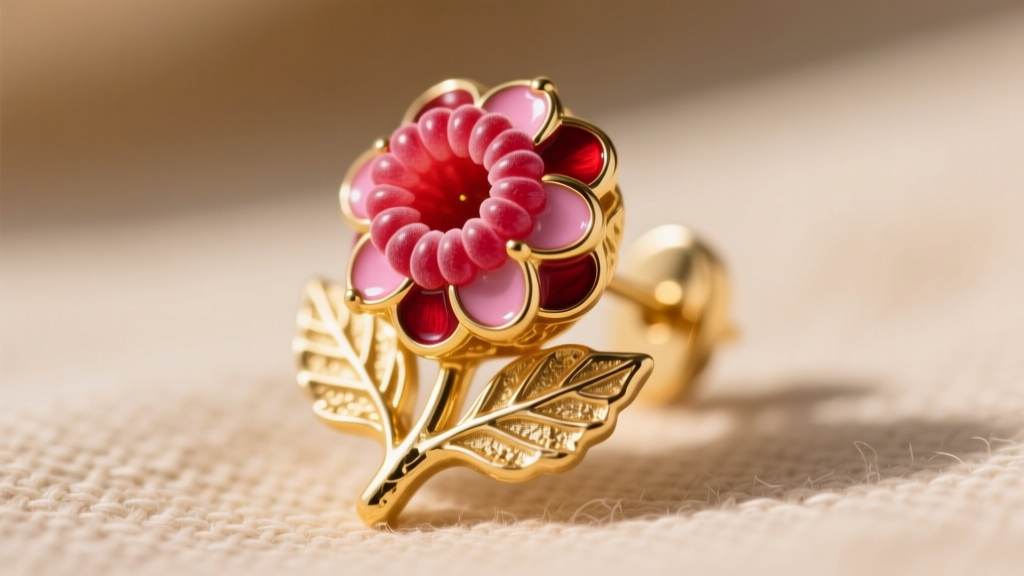
Occasion Matching: The 2026 Raspberry Gifting Matrix
Matching the style of the earring to the occasion is critical. A playful enamel fruit motif sends a very different message than a pair of sleek rubellite drops. Use this decision matrix to align your gift with the milestone.
| Occasion | Ideal Earring Style | Material / Stone Focus | Estimated Budget |
|---|---|---|---|
| 15th Anniversary | Articulated Drop or Dangle | Rubellite Tourmaline in 18k Rose Gold | $1,200 - $3,500 |
| College Graduation | Bezel-Set Studs or Small Huggies | Rhodolite Garnet in 14k Yellow Gold | $250 - $600 |
| Valentine's Day | Botanical Motif Ear Cuffs or Climbers | Champlevé Enamel & Granulation | $400 - $900 |
| Milestone Birthday (21st/30th) | Statement Hoops with Gemstone Inlays | Pink Sapphires & Raspberry Enamel | $800 - $2,000 |
Pro-Tip for Gifting: If you are gifting drop earrings for an anniversary, always ensure they feature a hinged leverback or a secure French wire with a silicone stopper. Heavy gemstone drops are easily lost if the recipient accidentally snags them on a sweater.
Technical Buyer’s Guide: Gauges, Settings, and Metals
Behind every beautiful earring is a structural engineering reality. Overlooking these technical details is the most common failure mode in jewelry gifting.
- Post Gauges & Thickness: Standard lobe piercings are typically 20-gauge (0.81mm) or 18-gauge (1.02mm). If you are gifting heavy raspberry garnet drops, insist on an 18-gauge or even 16-gauge (1.29mm) post to prevent the metal from bending under the stone's weight. For cartilage piercings (helix, tragus, conch), 16-gauge is the industry standard to prevent the 'cheese cutter' effect, where thin wire migrates through the tissue.
- Setting Styles: For enamel raspberry motifs, a bezel or flush setting is mandatory to protect the fragile glass edges from chipping. For rubellite and rhodolite, a 4-prong or 6-prong setting in platinum or 18k gold maximizes light return and showcases the stone's raspberry saturation.
- Metal Pairing: The purplish-pink undertones of raspberry stones are dramatically enhanced by 18k rose gold. The copper alloys in rose gold harmonize with the red spectrum of the gemstone, whereas white gold or platinum can sometimes make the pink tones appear cooler or slightly washed out.
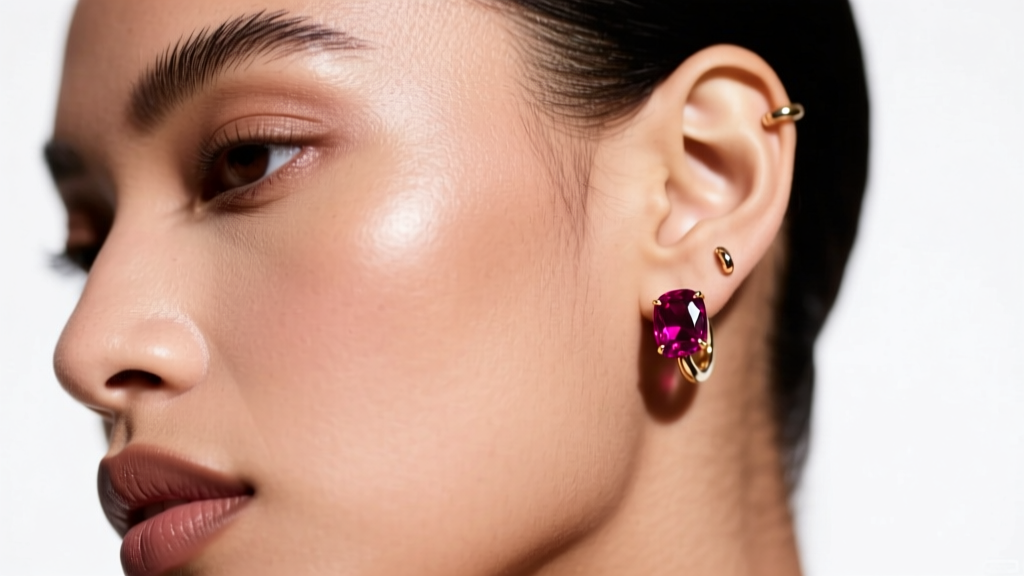
Face Shape & Cartilage vs. Lobe Placement
The visual impact of raspberry earrings changes drastically based on where they are worn and the recipient's facial geometry.
For Round Faces: Avoid large, circular raspberry hoops or round stud clusters, which will exaggerate facial roundness. Instead, gift angular raspberry drop earrings or elongated pear-cut rubellite dangles. The vertical lines draw the eye downward, creating a slimming, balancing effect.
For Square Faces: Soften strong jawlines with curved designs. Raspberry huggie earrings or circular enamel fruit motifs worn snugly on the lobe add softness. Alternatively, a continuous raspberry gemstone hoop worn in a mid-helix cartilage piercing draws attention upward and softens the profile.
Cartilage Styling (The 2026 Trend): Ear curation is still dominating in 2026. Gifting a 16-gauge raspberry rubellite clicker ring for a helix piercing, or a delicate raspberry enamel ear cuff for the scapha, offers a highly personalized, modern gifting angle that feels much more bespoke than traditional lobe studs.
Care and Maintenance for Raspberry Pigments and Stones
To ensure your gift lasts a lifetime, include a care guide with your presentation. Raspberry jewelry requires specific maintenance protocols depending on the material.
Ultrasonic Dangers: Never clean rubellite tourmaline or enamel earrings in an ultrasonic cleaner. Tourmaline is prone to liquid inclusions and internal fractures; the high-frequency vibrations of an ultrasonic bath can cause the stone to shatter. Similarly, the heat and vibrations can cause vitreous enamel to crack or craze.
The Safe Cleaning Protocol: For both gemstones and enamel, use a solution of lukewarm water and a few drops of mild, phosphate-free dish soap. Soak the earrings for three minutes, then gently agitate with a baby-soft toothbrush. Pay special attention to the back of the setting, where skin oils and lotions accumulate, dulling the raspberry sparkle. Dry thoroughly with a lint-free microfiber cloth before storing in a separate, soft-lined compartment to prevent the gold from scratching the enamel or the garnet.
By understanding the intersection of gemology, metallurgy, and personal style, you can confidently select raspberry earrings that are not just beautiful, but structurally optimized and perfectly matched to the recipient's life and milestones.


