Rumi Earrings: 2026 Technical Guide to Artisanal Motifs & Metals
Explore the metallurgy, casting techniques, and gauge specifications of Rumi earrings. A 2026 technical guide for collectors and jewelers.

The Architecture of Poetic Jewelry
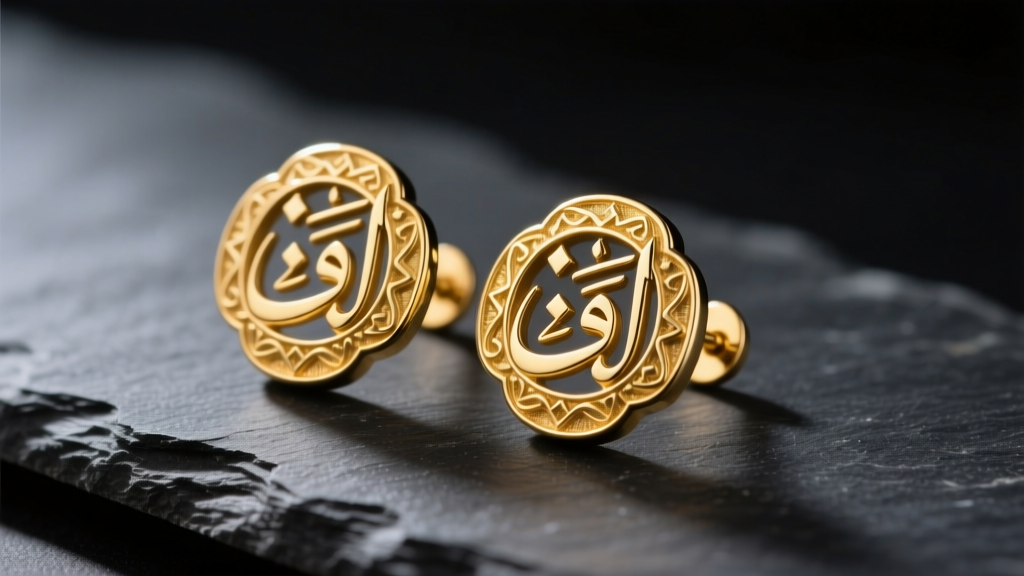
In the contemporary fine jewelry landscape, Rumi earrings have emerged as a highly specialized category that bridges 13th-century Sufi poetry with 21st-century metallurgical engineering. Characterized by intricate Arabic and Persian calligraphy, whirling dervish silhouettes, and sacred geometric patterns, these earrings demand a level of manufacturing precision that pushes the boundaries of traditional jewelry making. As we navigate the 2026 market, the demand for spiritually significant, artisanal motifs has driven jewelers to adopt advanced CAD (Computer-Aided Design) tolerances and specialized alloy blends to ensure these delicate designs survive daily wear.
Translating the flowing, continuous loops of Rumi’s poetry into a wearable metal format presents unique structural challenges. Unlike standard geometric studs, calligraphic dangles feature extreme variations in mass distribution, requiring precise center-of-gravity calculations to prevent the earring from flipping upside down on the earlobe. According to industry analyses published by JCK Online, the resurgence of artisanal, meaning-driven jewelry has forced manufacturers to refine their lost-wax casting and laser-sintering techniques to accommodate these complex, asymmetric designs.
Laser Cutting vs. Lost-Wax Casting
When producing Rumi earrings, the choice of manufacturing method dictates the final resolution of the calligraphy. Traditional lost-wax casting, while excellent for three-dimensional organic shapes, often struggles with the razor-thin serifs and sweeping diacritical marks of Persian script. The wax models can warp, and molten metal may fail to fill micro-crevices under 0.2mm, leading to porosity.
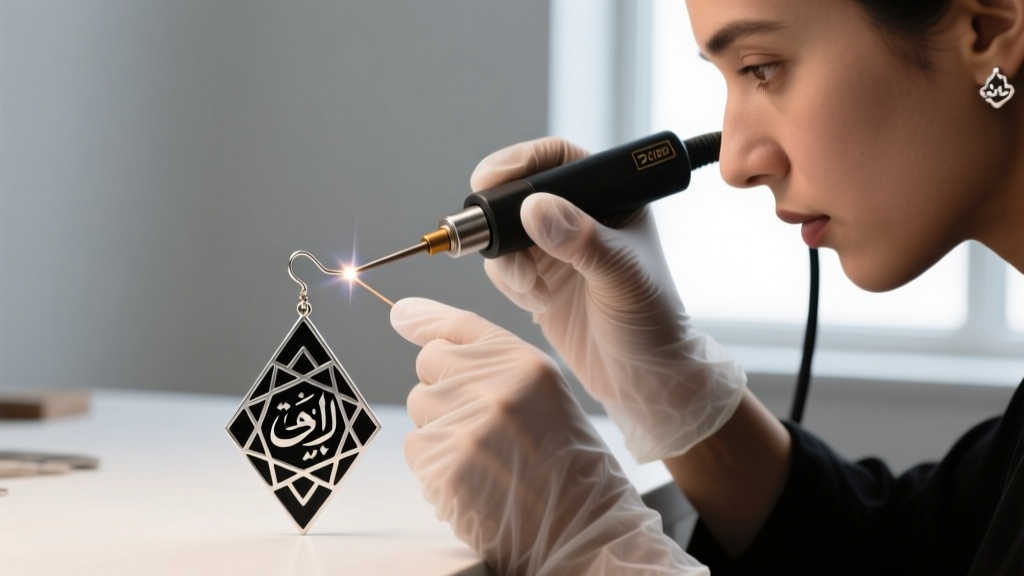
Conversely, precision laser cutting from sheet metal allows for tolerances as tight as 0.05mm. However, laser cutting limits the design to a uniform 2D plane. To achieve the coveted 3D undulating effect of a whirling dervish skirt, master jewelers now utilize a hybrid approach: 3D printing the master model in high-resolution castable resin (with layer heights of 25 microns), followed by vacuum-assisted investment casting to ensure the molten gold or silver reaches every microscopic curve of the script.
Metallurgy & Material Grades for Intricate Motifs
The structural integrity of Rumi earrings is heavily dependent on the Vickers Hardness (HV) of the chosen alloy. Because calligraphic motifs feature long, unsupported spans of metal, softer alloys will quickly bend or deform when caught on clothing.
| Alloy | Vickers Hardness (HV) | Best Application | Patina Potential |
|---|---|---|---|
| 925 Sterling Silver | 65 - 75 (Annealed) | Oxidized dangles, budget-friendly lines | Excellent (Liver of Sulfur) |
| Argentium 960 Silver | 80 - 90 (Work-hardened) | Tarnish-resistant intricate filigree | Moderate |
| 14k Yellow Gold | 130 - 150 | Everyday wear, high-stress jump rings | Poor (Requires chemical patinas) |
| 18k Yellow Gold | 110 - 125 | Luxury collector pieces, rich color | Poor |
For collectors seeking the highest level of detail, 14k gold is often the superior choice over 18k gold for Rumi dangles. The higher copper and silver content in 14k gold increases its tensile strength, allowing jewelers to mill the calligraphy down to 0.8mm thickness without risking structural failure. For silver enthusiasts, standard 925 sterling silver is highly reactive to liver of sulfur, allowing artisans to create deep, dark backgrounds that make the polished gold or silver calligraphy pop. However, the Gemological Institute of America (GIA) notes that Argentium silver is increasingly preferred for high-end pieces due to its germanium content, which drastically reduces the maintenance required to keep intricate grooves free of tarnish.
Ergonomics: Gauge, Weight, and Ear Wire Mechanics
A beautifully cast Rumi earring is useless if it causes earlobe fatigue or falls out. The physics of the pendulum effect means that a long calligraphic drop will swing with every head movement, placing immense shear stress on the ear wire and the connecting jump ring.
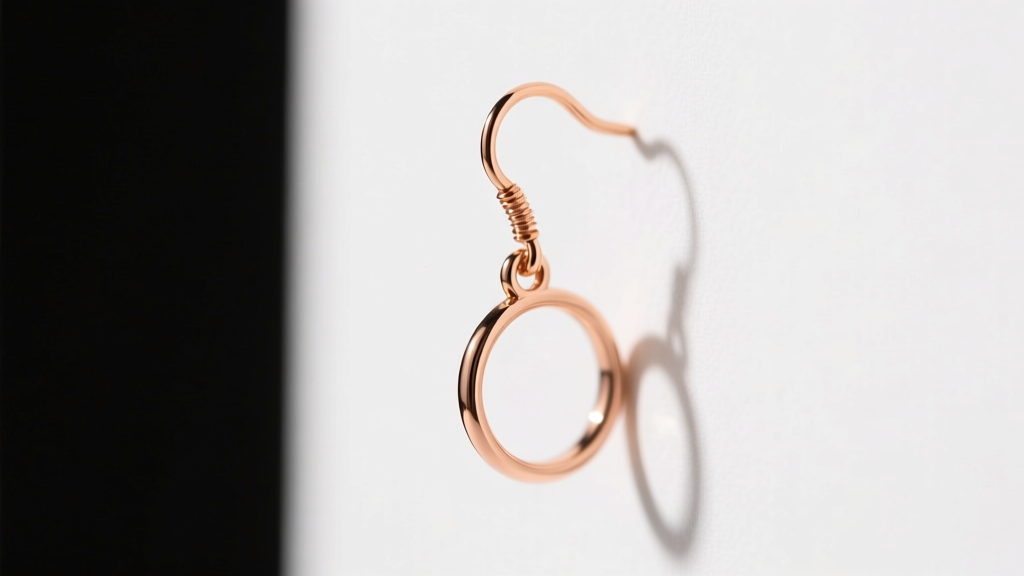
- Ear Wire Gauge: Standard French wires are typically 20-gauge (0.81mm). For Rumi earrings exceeding 4 grams, upgrading to an 18-gauge (1.02mm) half-hard wire is mandatory to prevent the hook from straightening out.
- Jump Ring Integrity: The connection point between the motif and the wire must utilize a soldered jump ring. Open jump rings, even thick ones, will eventually pull apart under the dynamic load of a swinging dangle.
- Weight Distribution: Master designers incorporate a subtle forward curve into the top bail of the earring. This shifts the center of gravity, ensuring the calligraphy faces forward rather than resting parallel to the wearer's jawline.
"The true test of a calligraphic earring isn't how it looks on a velvet display pad; it's how it hangs on the ear in motion. If the geometry doesn't account for the earlobe's natural 15-degree forward tilt, the poetry will never face the world." — Master Jeweler & CAD Specialist
Surface Finishing: The Art of the Patina
To achieve the legible contrast required for Rumi’s poetry, jewelers rely heavily on chemical patinas. The most common agent is Liver of Sulfur (potassium sulfide). The process requires meticulous temperature control. The solution must be heated to exactly 140°F (60°C). If the silver is dipped for too long, the patina will flake; if too short, it will turn a muddy brown rather than a deep, opaque black.
After oxidation, the earring is mounted on a magnetic tumbler with stainless steel shot and a mild detergent. This selectively polishes the high points of the calligraphy while leaving the recessed background pitch black. Finally, the piece is sealed with a micro-crystalline wax to prevent the sulfur from continuing to react with atmospheric moisture. Sourcing high-quality findings and chemicals from established suppliers like Rio Grande ensures consistent chemical reactions and hypoallergenic results.
Troubleshooting Common Failure Modes
Even expertly crafted Rumi earrings can suffer from specific mechanical failures. Understanding these modes is crucial for both jewelers and informed collectors:
1. Stress Fractures at the Serifs: Sharp 90-degree angles in digital CAD models translate to stress concentrators in cast metal. Designers must apply a minimum 0.15mm fillet radius to all interior corners of the calligraphy to distribute mechanical stress and prevent micro-cracking.
2. Porosity in Thick Nodes: Where multiple calligraphic strokes intersect, the metal mass increases. During cooling, the exterior solidifies faster than the interior, leading to subsurface shrinkage porosity. Proper sprue placement and directional cooling in the casting tree are required to mitigate this.
3. Ear Wire Fatigue: Repeated bending of the ear wire during insertion and removal causes work-hardening and eventual snapping. Utilizing dead-soft wire for the loop and half-hard wire for the hook provides the optimal balance of comfort and durability.
2026 Market Pricing & Authenticity Verification
As the market for spiritual and poetic jewelry matures in 2026, pricing for authentic Rumi earrings has stratified based on manufacturing origin and material purity. Mass-produced, stamped brass or silver-plated versions often flood the lower market ($20–$60), easily identifiable by their uniform thickness, lack of soldered jump rings, and painted-on faux-oxidation that rubs off within weeks.
Authentic, artisanal Rumi earrings cast in solid 14k gold or Argentium silver typically range from $250 to $850. When evaluating a piece, inspect the reverse side of the calligraphy. High-end pieces will feature a slightly domed or hollowed back (a technique known as "butterflying" or weight-reduction carving) to reduce the overall gram weight without sacrificing the visual footprint of the poetry. Furthermore, authentic pieces will bear a laser-engraved hallmark and the maker's mark, often discreetly integrated into the final dot of a calligraphic letter.
Ultimately, Rumi earrings represent a triumph of modern metallurgical precision applied to ancient artistic expression. By understanding the gauge requirements, alloy hardness, and casting techniques involved, collectors can invest in pieces that are not only spiritually resonant but mechanically engineered to last a lifetime.