Crafting Cow Print Earrings: Enamel, PVD Coating & Resin Inlays
Discover the technical differences in cow print earrings, from PVD-coated titanium to hand-inlaid resin. Learn gauge specs and biocompatibility.

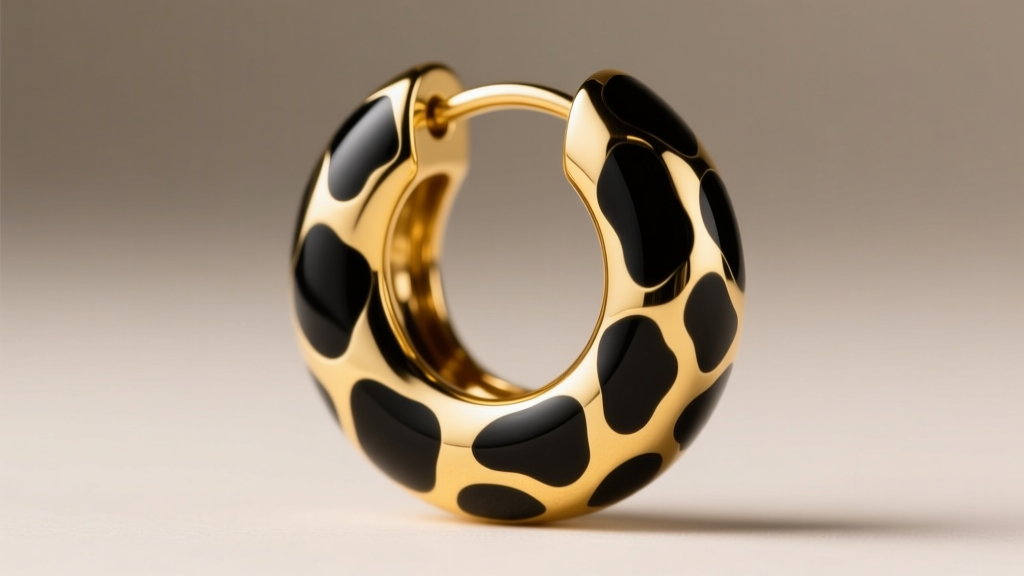
The Material Evolution of Cow Print Earrings
Historically relegated to the realm of fast-fashion novelty and stamped zinc alloys, the cow print aesthetic has undergone a radical transformation in the fine jewelry and professional body modification sectors. As of 2026, discerning collectors and professional piercers demand more than just a surface-level pattern; they require structural integrity, biocompatibility, and advanced material science. Crafting high-end cow print earrings requires a deep understanding of how contrasting pigments—typically stark white or metallic gold against deep black—interact with various substrate metals and organic compounds. This technical deep dive explores the manufacturing methodologies, material grades, and structural considerations that separate artisanal cow print earrings from mass-produced costume jewelry.
Manufacturing Techniques: How the Print is Applied
The primary challenge in creating animal print jewelry is achieving sharp, high-contrast boundaries between colors without bleeding, while ensuring the pigments remain bonded to the metal substrate under the stress of daily wear. Jewelers and body jewelry manufacturers rely on three primary techniques to achieve this.
Vitreous Enamel vs. Cold Enamel (Epoxy)
True vitreous enamel is the gold standard for opaque, high-contrast color blocking in fine jewelry. The process involves packing finely milled silica-based glass powder into recessed cells (cloisonné) or carved channels (champlevé) on a gold or silver base. The piece is then fired in a kiln at temperatures between 760°C and 815°C. For cow print earrings, the black and white enamel powders must be fired separately due to differing melting points and chemical compositions. The result is a glass-like, scratch-resistant surface that will never yellow or fade. Conversely, 'cold enamel' is a two-part epoxy resin. While cheaper and easier to apply in mass production, epoxy is highly susceptible to UV degradation, micro-scratches, and eventual delamination from the metal substrate.
PVD (Physical Vapor Deposition) on Titanium
For the professional body jewelry market, particularly for cartilage and lobe piercings, Physical Vapor Deposition (PVD) is the preferred method for applying black cow print spots onto a mirror-polished titanium base. PVD involves vaporizing a target material (like titanium nitride or diamond-like carbon) in a vacuum chamber, allowing it to condense as a microscopically thin, incredibly hard coating on the jewelry. To create the cow print pattern, manufacturers use precision laser-cut stencils or CNC-milled masks to shield specific areas of the titanium during the vapor deposition process. The underlying titanium retains its natural silver-grey or anodized color, while the exposed areas receive a jet-black, biocompatible PVD coating that is measured in microns (typically 0.5 to 2.0 µm thick).
Resin Inlay and Crushed Stone Matrix
Artisanal jewelers often utilize UV-cured resins combined with suspended pigments or crushed stone matrices to create organic, randomized cow print patterns. High-grade polyurethane or acrylic resins are tinted with lightfast pigments and poured into laser-engraved cavities. To prevent the 'yellowing' failure mode common in cheap resin jewelry, master jewelers incorporate Hindered Amine Light Stabilizers (HALS) into the chemical mixture, ensuring the white or cream-colored 'hide' portions of the print remain vibrant despite years of UV exposure.
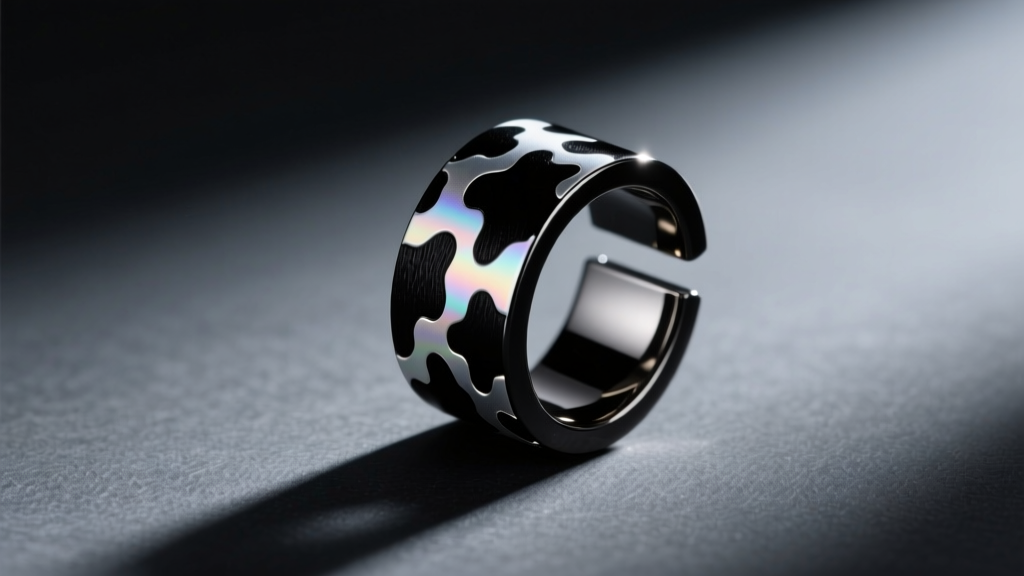
Biocompatibility and Contact Dermatitis Risks
The most critical failure point in novelty earrings is contact dermatitis caused by nickel sensitization. Cheap cow print earrings are frequently cast from 'pot metal' (a zinc-copper alloy) and flash-plated with a microscopic layer of silver or gold. The black paint or enamel used for the spots often contains heavy metal driers or is applied over a nickel-containing primer. When the plating wears through—a process accelerated by the friction of putting on and taking off the earrings—the wearer's skin is exposed to nickel salts, triggering severe allergic reactions.
Expert-grade cow print earrings eliminate this risk by utilizing implant-grade substrates. The Association of Professional Piercers recommends ASTM F136 compliant Ti-6Al-4V ELI (implant-grade titanium) or ASTM F138 compliant 316L surgical steel for initial piercings and long-term wear. When PVD coating is applied to mirror-polished titanium (with a surface roughness Ra of less than 0.2 µm), the resulting jewelry is entirely nickel-free, highly biocompatible, and safe for even the most reactive skin types.
Gauge Sizing, Weight, and Structural Integrity
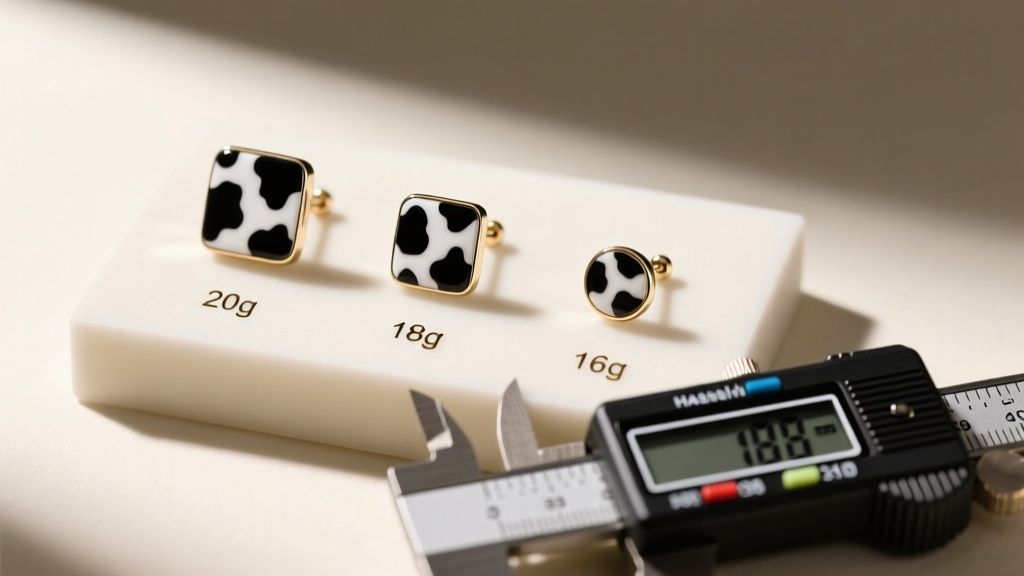
The structural design of cow print earrings must account for the gauge (thickness) of the post or wire, which directly impacts the weight distribution and the health of the piercing channel. A heavy, oversized cow print dangle earring on a thin 22-gauge post will cause 'cheese-cutter' migration, slowly tearing through the earlobe tissue over time.
| Gauge Size | Millimeter (mm) | Primary Application | Max Recommended Drop Weight |
|---|---|---|---|
| 20G | 0.81mm | Standard lobe studs, lightweight huggies | 3.5 grams |
| 18G | 1.02mm | Cartilage (helix/tragus), medium drops | 5.0 grams |
| 16G | 1.29mm | Heavy dangles, industrial bars, stretched lobes | 8.0 grams |
| 14G | 1.63mm | Daith, rook, heavy statement pieces | 12.0+ grams |
When designing cow print dangles or large hoops, the jeweler must calculate the center of gravity. If the decorative face of the earring is too heavy relative to the post, the earring will droop forward, placing uneven pressure on the posterior of the piercing channel. Expert manufacturers counterbalance heavy enamel or resin faces by utilizing thicker, heavier backing mechanisms or by hollowing out the reverse side of the metal substrate using CNC milling to reduce overall mass without sacrificing visual footprint.
Maintenance Protocols and Failure Modes
Even the most meticulously crafted cow print earrings require specific maintenance protocols to prevent material degradation. Understanding the failure modes of different manufacturing techniques is essential for both the jeweler and the consumer.
- PVD Delamination: If the titanium substrate is not polished to a mirror finish prior to PVD coating, microscopic peaks and valleys in the metal will cause poor adhesion. Over time, friction from hair or clothing can cause the black PVD spots to flake or peel. Properly executed PVD on an Ra < 0.2 µm surface is virtually permanent.
- Epoxy Yellowing and Shrinkage: Cold enamel (epoxy) undergoes a slight volumetric shrinkage as it cures. In wide 'white' areas of a cow print design, this can lead to a concave surface that traps sebum and dead skin cells. Furthermore, without UV stabilizers, the epoxy will amber over 12 to 18 months of daily wear.
- Vitreous Enamel Chipping: While highly scratch-resistant, glass-based enamel is brittle. A hard impact against a granite countertop or bathroom sink can cause the black or white glass to chip or craze. Jewelers mitigate this by ensuring the metal bezel walls surrounding the enamel are slightly raised (by 0.1mm) to absorb impact shock.
Market Tiers and Sourcing Guidelines
When sourcing or commissioning cow print earrings, buyers should categorize the market into three distinct tiers based on material science and manufacturing precision:
- Tier 1: Fast Fashion / Novelty ($5 - $25): Stamped zinc alloy, nickel flash plating, hand-painted acrylics or cheap epoxy. High risk of contact dermatitis. The print is often applied via pad-printing or decals, which wear off within weeks.
- Tier 2: Commercial Body Jewelry ($40 - $90): 316L surgical steel or basic titanium with PVD black spots or laser-etched patterns. Safe for healed piercings, though surface roughness may not meet APP standards for fresh piercings.
- Tier 3: Fine & Artisanal ($150 - $500+): 14k/18k solid gold or ASTM F136 implant-grade titanium. Utilizes kiln-fired vitreous enamel, precision CNC-milled resin inlays, or high-end PVD. These pieces are heirloom-quality, biocompatible, and structurally engineered for lifelong wear.
By prioritizing substrate purity, advanced color-application techniques, and precise gauge engineering, the modern jeweler elevates the cow print motif from a fleeting trend into a durable, sophisticated statement of material mastery.


