Trinity Earrings: A Metallurgical Guide to Tri-Gold Alloys
Discover the metallurgical properties of trinity earrings. Compare 18K yellow, white, and rose gold alloys, joint friction, and hardware.

The Metallurgy of Trinity Earrings: Beyond the Aesthetic
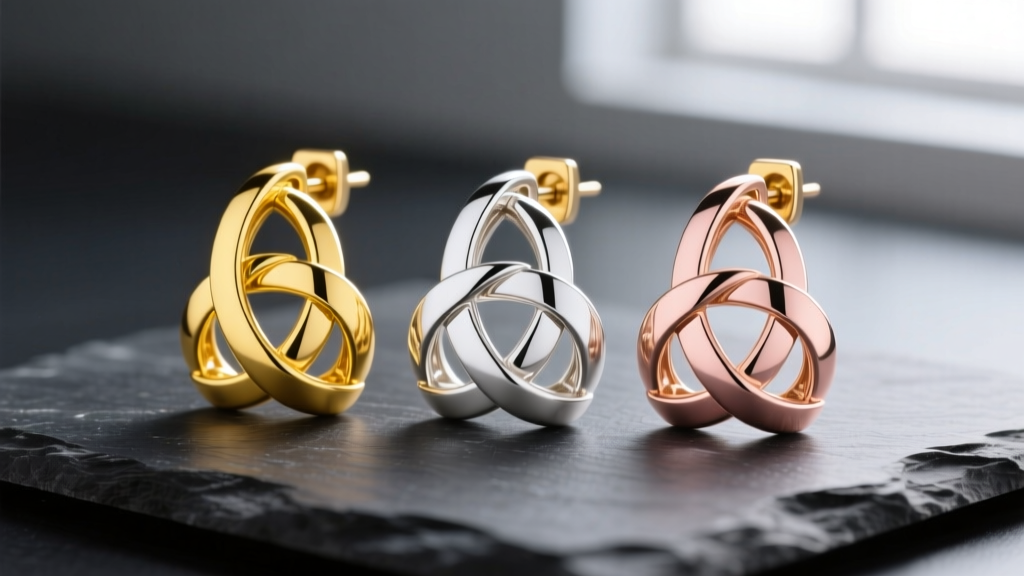
The iconic trinity earrings design—characterized by three interlocking bands of yellow, white, and rose gold—is a masterclass in both jewelry design and applied metallurgy. Originally popularized by Cartier in the 1920s, the tri-gold motif has become a staple in fine jewelry. However, as of 2026, discerning collectors and everyday wearers alike must look beyond the aesthetic appeal to understand the material science that dictates the longevity, comfort, and structural integrity of these pieces.
Unlike solid-cast studs or simple wire hoops, trinity earrings feature moving parts. The three rings pivot and glide against one another, creating continuous micro-friction at the joints. This mechanical stress means that the specific alloy compositions, Vickers hardness ratings, and surface treatments of the three gold types are not just cosmetic choices; they are critical engineering variables. In this comprehensive guide, we break down the exact metallurgical properties of the tri-gold configuration and explain how these materials interact over decades of wear.
Alloy Breakdown: Yellow, White, and Rose Gold Properties
To achieve the 18-karat (75% pure gold) standard required for high-end trinity earrings, master jewelers alloy pure 24K gold with specific trace metals. Each color variation introduces unique physical properties that affect how the earring behaves under stress.
18K Yellow Gold: The Malleable Anchor
Traditional 18K yellow gold is typically alloyed with 12.5% silver and 12.5% copper. This specific ratio preserves the warm, rich hue of pure gold while providing just enough structural rigidity for jewelry making. On the Vickers hardness scale, 18K yellow gold sits at approximately 125 HV. Because it lacks the extreme hardness of copper-heavy or nickel-heavy alloys, yellow gold is highly malleable. In the context of trinity earrings, the yellow gold band often acts as the 'sacrificial' ring at the friction joints, absorbing micro-scratches and preventing the more brittle alloys from cracking under torsional stress.
18K White Gold: The Rhodium Factor
White gold is created by alloying pure gold with white metals like palladium, nickel, or manganese, alongside small amounts of zinc for casting fluidity. However, the underlying alloy naturally retains a faint yellowish-grey tint. To achieve the brilliant, mirror-like chrome finish associated with trinity earrings, the white gold band is electroplated with a microscopic layer of rhodium (typically 0.75 to 1.5 microns thick). While rhodium is exceptionally hard and highly reflective, it is subject to wear. According to the Gemological Institute of America (GIA), rhodium plating on high-friction areas will inevitably wear thin, requiring periodic re-plating to maintain the stark visual contrast against the yellow and rose bands.
18K Rose Gold: The Copper Variable
The distinct blush of rose gold comes from a high copper content—often up to 22.25% copper and 2.75% silver in an 18K mixture. Copper is a hardening agent, pushing the Vickers hardness of 18K rose gold up to 140 HV or higher. This makes the rose gold band the most scratch-resistant of the trinity trio. However, copper is also prone to surface oxidation and can cause contact dermatitis in a small percentage of the population with copper or nickel sensitivities. Over time, the rose gold band may develop a subtle, darker patina, which many vintage collectors prize for the depth it adds to the interlocking design.
Friction and Wear: How Trinity Joints Degrade
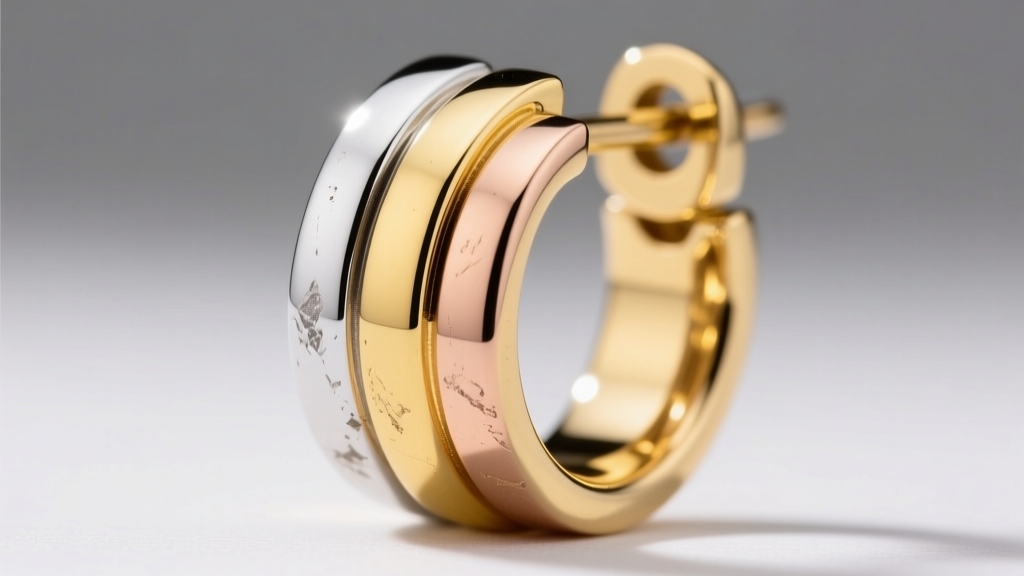
The defining feature of trinity earrings is also their primary point of mechanical vulnerability: the interlocking joints. Every time the wearer moves, the three bands pivot. This creates a localized zone of tribological stress (friction and wear).
Because the three bands are composed of different alloys with varying hardness levels, they wear at different rates. The harder rose gold and rhodium-plated white gold bands can act as mild abrasives against the softer yellow gold band. Over a period of 5 to 10 years of daily wear, it is common to see the yellow gold band thin slightly at the contact points. Furthermore, the rhodium plating on the white gold band will wear away fastest exactly where the rings rub together, revealing the warm-grey palladium or nickel alloy beneath. This is not a defect, but a predictable metallurgical reality of multi-alloy moving parts.
Material Comparison Matrix
Understanding the precise differences between the three alloys helps in setting expectations for maintenance and longevity. Below is a comparative matrix of standard 18K trinity alloys used by elite European jewelers.
| Alloy Type | Primary Alloying Metals | Vickers Hardness (HV) | Wear Characteristic | Allergy Risk |
|---|---|---|---|---|
| 18K Yellow Gold | Silver (12.5%), Copper (12.5%) | ~125 HV | Absorbs scratches; highly malleable | Very Low |
| 18K White Gold | Palladium/Nickel, Zinc | ~130 HV (Base) | Rhodium plating wears at friction joints | Moderate (if Nickel) |
| 18K Rose Gold | Copper (22.25%), Silver (2.75%) | ~140 HV | Highly scratch-resistant; may patina | Low-Moderate (Copper) |
Sizing, Gauges, and Structural Integrity
Because trinity earrings feature three overlapping bands of solid 18K gold, they are inherently heavier and bulkier than standard solitaire studs. A typical pair of medium-sized trinity drop or stud earrings can weigh between 6 and 12 grams per ear. This weight necessitates specialized hardware to prevent the earring from drooping or tearing the earlobe over time.
Standard 20-gauge (0.81mm) posts are entirely insufficient for this weight. High-quality trinity earrings should feature an 18-gauge (1.02mm) or even a 16-gauge (1.29mm) post to resist bending. Furthermore, standard butterfly friction backs often fail to support the forward-heavy center of gravity of an interlocking ring design. For secure wear, look for earrings equipped with La Pousette (push-pull locking) clasps, screw-backs, or heavy-duty silicone ear nuts that provide a wider surface area to distribute the weight across the back of the earlobe.
Care and Maintenance for Multi-Alloy Earrings
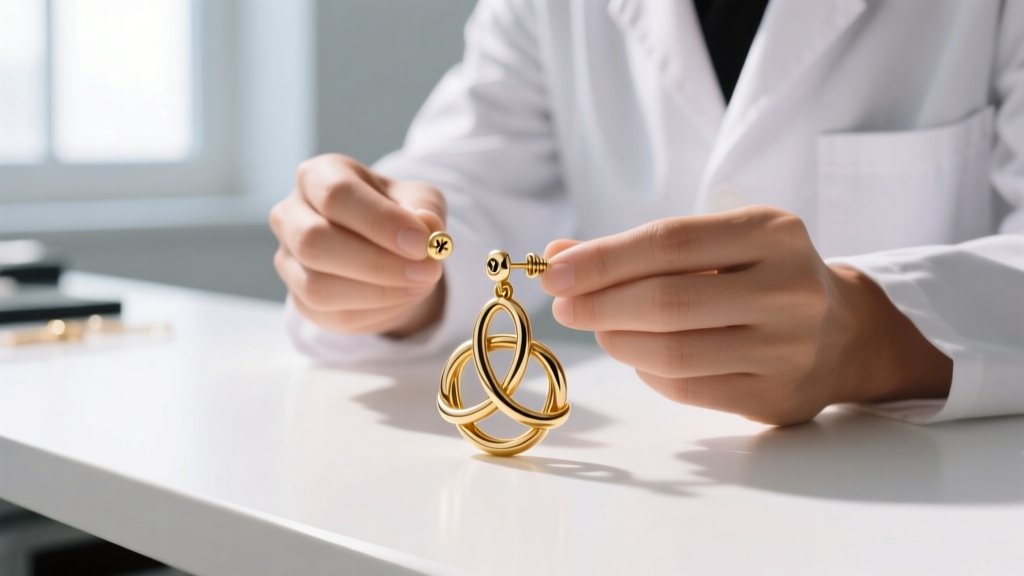
Cleaning trinity earrings requires a nuanced approach to avoid damaging the distinct surface finishes of the three alloys. While pure gold and copper alloys are relatively resilient, the rhodium plating on the white gold band requires gentle care.
- Avoid Ultrasonic Cleaners: High-frequency ultrasonic waves, combined with harsh chemical solutions, can accelerate the degradation of rhodium plating at the friction joints. Stick to manual cleaning.
- Mild Surfactants Only: Use a few drops of pH-neutral dish soap in lukewarm water. Gently agitate the interlocking rings to dislodge sebum and skin cells that accumulate in the joints, which can act as a grinding paste if left untreated.
- Polishing Restrictions: If you take your trinity earrings to a jeweler for a buff, explicitly instruct them not to aggressively polish the white gold band unless they are simultaneously re-plating it with rhodium. Polishing will strip the remaining rhodium, leaving you with a two-tone yellow and grey earring.
Pricing, Hallmarks, and Authenticity
The market for trinity earrings spans from high-end heritage houses to bespoke independent jewelers. Authentic Cartier Trinity earrings typically start around $1,500 for small model studs and can exceed $4,000 for pave diamond variations. However, independent master jewelers offer exceptional tri-gold alternatives in the $600 to $1,200 range, often utilizing superior 18G hardware that heritage brands sometimes overlook in favor of traditional 19G sizing.
When evaluating the material authenticity of trinity earrings, always inspect the inner bands for proper hallmarks. According to the World Gold Council, legitimate 18K gold must bear a '750' stamp, indicating 750 parts per thousand of pure gold. In regions like France, look for the eagle's head hallmark, while the UK utilizes the crown and '750' combo. Ensuring these stamps are present on all three interlocking bands—or at least the primary structural band—is your ultimate guarantee of the metallurgical quality you are investing in.
Final Verdict: Choosing Your Trinity Configuration
Trinity earrings remain a triumph of material contrast and kinetic jewelry design. By understanding that the yellow gold will absorb impact, the rose gold will resist scratches, and the white gold will require eventual rhodium maintenance, you can wear these pieces with confidence. Whether you opt for a heritage brand or a custom-forged set from a local goldsmith, prioritizing 18K purity, robust 18-gauge posts, and secure locking clutches will ensure your tri-gold earrings remain a structural and aesthetic masterpiece for generations.


