Troubleshooting Double Ring Jewelry: Fit and Breakage
Solve common double ring jewelry problems. Learn expert fixes for sizing discrepancies, knuckle clearance, bridge breakage, and metal fatigue.

The Biomechanics of Double Finger Rings: Why They Fail
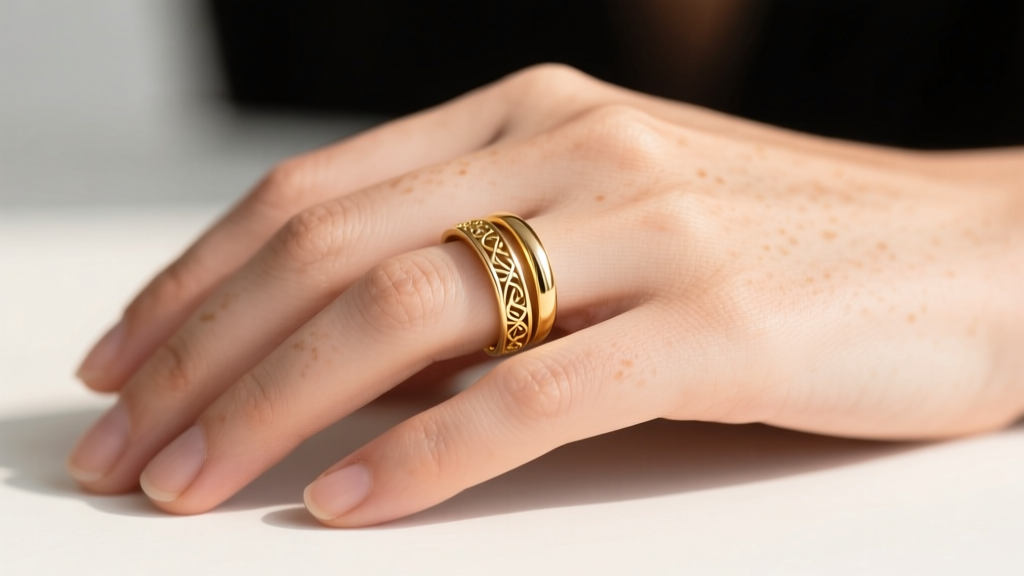
Double ring jewelry—often referred to as spanner rings, knuckle-to-knuckle bands, or dual-finger rings—presents a unique set of engineering challenges that standard single-band rings simply do not face. When a single piece of metal spans across two adjacent fingers (most commonly the index and middle, or middle and ring fingers), it must contend with the independent biomechanical flexion of the human hand. Unlike a single band that rotates freely around a single digit, a rigid double ring acts as a lever. Every time you grip an object, type, or simply close your hand, your fingers bend at different angles and at different times. This creates immense shear stress and torque on the connecting bridge. As of 2026, the most common complaints we see in our repair queue regarding double ring jewelry involve warped bridges, snapped solder joints, and severe sizing discrepancies. In this comprehensive troubleshooting guide, we will break down the exact metallurgical and ergonomic solutions required to fix, fit, and preserve your double finger rings.
Sizing Discrepancies: Solving the Two-Finger Dilemma
The most frequent point of failure occurs before the ring is even worn: improper sizing. Human fingers are rarely symmetrical, and adjacent fingers often differ in size by a half or even a full US ring size. According to Jewelers of America, attempting to force a rigid double ring onto two differently sized fingers will immediately torque the bridge, leading to permanent deformation.
The Sizing Troubleshooting Matrix
Use the following framework to determine the correct sizing strategy based on the discrepancy between the two target fingers:
| Size Discrepancy | Primary Issue | Expert Solution / Modification |
|---|---|---|
| 0 (Exact Match) | Knuckle clearance variance | Use a standard rigid bridge; ensure both shanks have a comfort-fit (domed) interior. |
| 0.25 to 0.5 Size | Mild lateral torque on the bridge | Size the primary band to the larger finger. Use a clear silicone tension insert or sizing bead in the smaller band. |
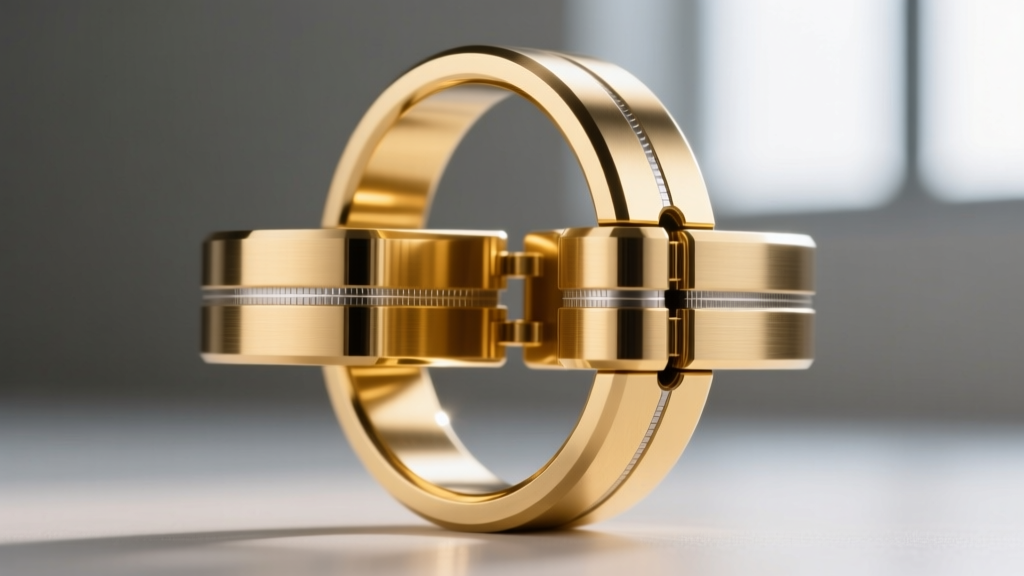
| 0.75 to 1.0 Size | Severe torque; high risk of bridge snapping | Mandatory articulated hinge installation. The bridge must be split and joined with a micro-hinge to allow independent flexion. |
| 1.25+ Sizes | Wearability failure; skin pinching | Do not wear a rigid spanner. Convert to a chain-linked double ring or a flexible tension-spring bridge. |
Bridge Stress & Metal Fatigue: Preventing Snaps
When a double ring bends out of shape or snaps at the bridge, the culprit is almost always metal fatigue combined with inadequate material thickness. The Gemological Institute of America (GIA) extensively documents the working properties of precious metals, noting that hardness and malleability dictate how a metal handles repetitive stress.
Metallurgical Bridge Specifications
If you are designing, buying, or repairing double ring jewelry, the bridge must meet minimum thickness requirements based on the metal's Vickers Hardness (HV) and tensile strength. A bridge that is too thin will warp; a bridge that is too thick will act as a rigid splint, causing immense discomfort.
| Metal Alloy | Vickers Hardness (HV) | Minimum Bridge Thickness | Fatigue Risk Profile |
|---|---|---|---|
| Sterling Silver (925) | 60 - 120 (Work Hardened) | 2.0mm | High. Prone to work hardening and brittle snapping if bent back and forth. |
| 14k Yellow Gold | 120 - 140 | 1.5mm | Medium. Excellent balance of durability and slight flexibility. |
| 18k Yellow Gold | 110 - 125 | 1.8mm | Medium-High. Softer than 14k; requires a wider, flatter bridge profile to distribute stress. |
| Platinum 950 (Ru/Ir) | 110 - 130 | 1.2mm | Low. High density and malleability allow it to bend without snapping (work hardens slowly). |
| Grade 5 Titanium (6Al-4V) | 330 - 350 | 1.0mm | Very Low. Extremely rigid; must be designed with an articulated hinge as it will not bend to accommodate hand movement. |
Expert Troubleshooting Tip: If your sterling silver double ring has warped, do not repeatedly bend it back into shape with pliers. Sterling silver undergoes 'work hardening.' Bending it back and forth will cause the crystalline structure to lock, resulting in a catastrophic, irreparable snap. Instead, take it to a jeweler to be annealed (heated and quenched) to restore its malleability before reshaping.
Knuckle Clearance & Ergonomic Troubleshooting
A major issue with double ring jewelry is getting the rings past the knuckles of both fingers simultaneously. If your knuckles are significantly larger than the base of your fingers, a standard double ring will either get stuck on the knuckles or spin uncontrollably once it clears them.
The Open-Back Shank Solution
To solve the knuckle-clearance problem without sizing the ring uncomfortably large, look for or request a modification to the shank (the part of the ring that wraps around the finger).
- Euro-Shank / Flat Bottom: Replacing the round bottom of the ring with a flat or slightly squared bottom increases the surface area against the palm, preventing spinning once the ring clears the knuckle.
- Hinged Shanks: For severe knuckle-to-base discrepancies, a jeweler can install a micro-hinge at the 6 o'clock position of one or both bands. This allows the ring to open like a clamshell, bypassing the knuckle entirely and locking securely at the base.
- Open-Back Designs: Some modern double rings feature an open gallery at the bottom of the shank, allowing the metal to compress slightly as it slides over the knuckle joint.
Surface Scratching & Adjacent Finger Friction
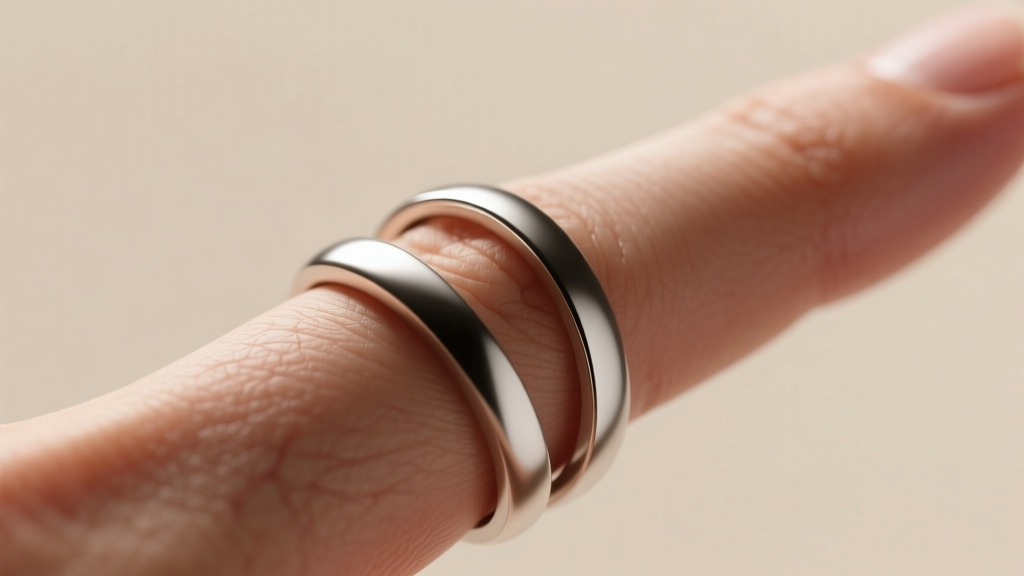
When two fingers are bound together by a bridge, the natural skin-on-skin friction between the fingers is replaced by skin-on-metal friction. This frequently leads to chafing, moisture trapping, and localized skin irritation, particularly in humid climates or during physical exertion.
Troubleshooting Friction:
- Chamfer the Edges: The interior edges of the bridge must be heavily chamfered (beveled). A sharp 90-degree edge on the underside of the bridge will act like a blade against the webbing of your fingers. Request a 'soft-touch' interior polish from your jeweler.
- Moisture Wicking Channels: High-end double ring jewelry often features microscopic milgrain or shallow channels on the underside of the bridge. These break the surface tension of sweat, preventing the ring from suctioning to the skin and causing maceration.
- Rhodium Plating: If you are experiencing contact dermatitis or friction burns from a silver or white gold bridge, a thick flash of rhodium plating can create a smoother, hypoallergenic, and harder surface that glides against the skin rather than dragging.
Expert Repair vs. Replacement Framework
When your double ring jewelry inevitably suffers damage due to the high-stress nature of its design, how do you decide between repairing it or replacing it? Use this decision matrix:
When to Repair
- Micro-Fissures in the Bridge: As of 2026, laser micro-welding is the industry standard for repairing hairline cracks in double ring bridges. Unlike traditional torch soldering, which requires heating the entire ring and risking gemstone damage, laser welding targets a sub-millimeter area with precise heat, fusing the metal without altering the temper of the surrounding band.
- Warped Shanks: If the individual bands have become oval-shaped from gripping, a jeweler can easily re-round them on a steel mandrel, provided the bridge is annealed first to prevent snapping.
When to Replace or Redesign
- Multiple Solder Joint Failures: If a chain-linked or multi-piece double ring has broken at the solder joints more than twice, the metal is suffering from chronic fatigue. The piece should be melted down and recast with a thicker gauge.
- Severe Galvanic Corrosion: If the ring is a mixed-metal piece (e.g., a silver bridge soldered to gold bands) and the joints are showing signs of galvanic corrosion (green/black pitting), the structural integrity is compromised. It must be redesigned as a single-alloy piece.
Double ring jewelry is a bold, avant-garde statement, but it demands respect for the physics of the human hand. By understanding sizing matrices, metallurgical limits, and ergonomic modifications, you can troubleshoot any issue and ensure your spanner rings remain comfortable, intact, and visually striking for years to come.