Is Your 14k Italy Necklace Real? Troubleshooting & Testing Guide
Suspect your 14k Italy necklace is fake? Learn expert troubleshooting steps, hallmark verification, and acid testing to authenticate Italian gold.

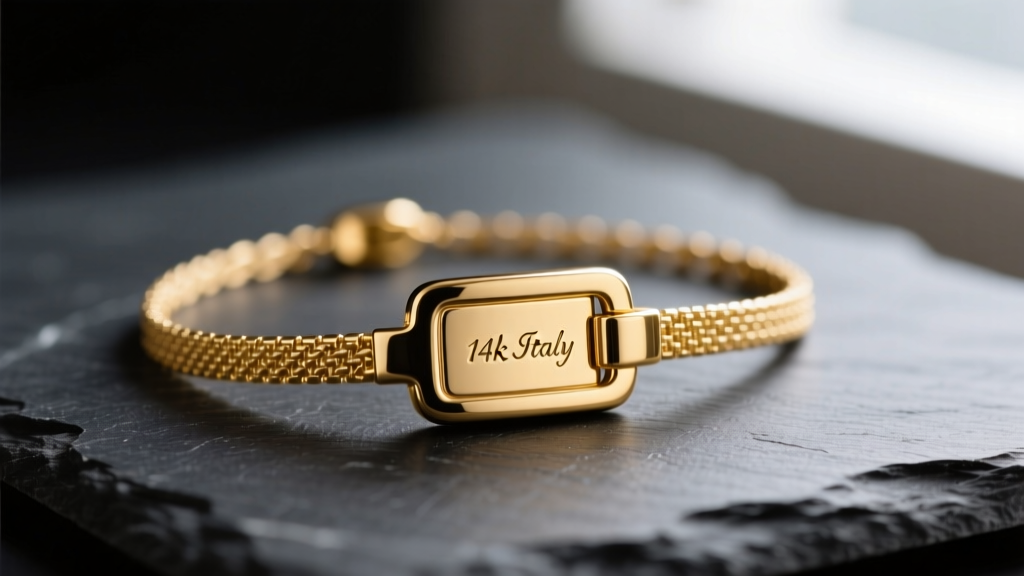
The "14k Italy" Stamp: What It Actually Means
Finding a "14k Italy" stamp on a necklace is incredibly common, but it is also one of the most frequently counterfeited hallmarks in the global jewelry market. To troubleshoot whether your piece is genuine, you first need to understand Italian gold marking laws. Under Italian law (specifically Title IX, Law 996 of 1968, and subsequent updates in 1999), precious metals must carry two distinct marks: the standard millesimal fineness mark (e.g., 585 for 14k gold) and a polygonal maker's mark containing a star, a registration number, and the province of origin (e.g., AR for Arezzo, VI for Vicenza).
If your necklace only says "14k Italy" without a corresponding 585 stamp or a maker's mark, it is not necessarily fake, but it is likely an export piece manufactured before strict enforcement, or worse, a modern counterfeit. According to the Federal Trade Commission's Jewelry Guides, gold sold in the US must be accurately marked for karatage, but imported vintage pieces often bypass modern hallmarking standards. Therefore, relying solely on the text stamp is a critical failure point in authentication.
Visual Troubleshooting: Spotting the Counterfeits
Before resorting to destructive testing, conduct a rigorous visual inspection using a 10x or 20x jeweler's loupe. Counterfeit chains often fail at the micro-level of manufacturing.
1. Inspect the Clasp and Jump Rings
Genuine Italian chains, such as rope, figaro, or cuban links, typically feature high-quality lobster clasps or spring rings made of solid gold or gold-plated brass with steel internal springs. If the clasp feels exceptionally light, hollow, or if the jump rings show visible seams that haven't been laser-welded or soldered flush, proceed with caution. Look for discoloration around the high-friction areas of the clasp. If you see a silver or copper hue bleeding through the gold, the piece is heavily plated over a base metal.
2. The Link Uniformity Test
Italian chain manufacturing is world-renowned for its precision. Machine-made chains from regions like Vicenza exhibit flawless link uniformity. Hold the chain taut and14k gold will remain largely unaffected, showing only a very faint, almost invisible discoloration or a slight brownish tint due to the alloy metals (like copper or silver) reacting. If the streak dissolves instantly into a milky white or greenish color, the piece is gold-plated or gold-filled, and the acid has reached the base metal beneath.
Cleaning Up
Immediately wipe the testing stone and the chain link with a damp cloth and baking soda to neutralize any residual acid. Never leave nitric acid on gold jewelry, as prolonged exposure can damage the alloyed metals and cause pitting.
Troubleshooting Chain Breakage and Tarnish on Authentic Pieces
Sometimes, troubleshooting isn't about authenticity, but about performance. Many consumers panic when their authenticated 14k Italy necklace tarnishes or breaks, assuming it must be fake. Here is the metallurgical reality.
Why Real 14k Gold Tarnishes
Pure 24k gold does not tarnish. However, 14k gold is 58.5% pure gold and 41.5% alloy metals, typically a mix of copper, silver, and zinc. When exposed to sulfur compounds in the air, chlorine in swimming pools, or the natural pH of your skin, these alloy metals oxidize. If your 14k Italy necklace develops a dark film, it is actually a strong indicator of authenticity. To troubleshoot this, clean the chain in a solution of warm water and a few drops of mild, phosphate-free dish soap, gently brushing with a soft baby toothbrush. Avoid ultrasonic cleaners if the chain has hollow links, as the vibrations can collapse them.
Dealing with Micro-Fractures and Breakage
Italian rope and snake chains are notoriously difficult to repair once broken. Snake chains, in particular, are constructed from tightly interlocked metal rings that form a continuous, flexible tube. When a snake chain kinks or snaps, traditional torch soldering will ruin the flexibility of the surrounding links. The only viable troubleshooting method for a broken Italian snake or complex rope chain is laser welding. A professional jeweler will use a laser welder to fuse the microscopic link back together without transferring heat to the adjacent metal, preserving the chain's drape and structural integrity.

14k Italy piece, request a full spectrometer analysis to get an exact breakdown of the alloy composition. This is especially critical if you are troubleshooting an inherited estate piece or considering a high-value purchase from a secondary market seller.
By combining visual hallmark analysis, structural inspection, and precise chemical testing, you can confidently troubleshoot and authenticate any 14k Italy necklace, ensuring your investment is backed by genuine Italian craftsmanship.


