How to Assemble and Style a Millennium Puzzle Necklace
Learn how to assemble, clean, and style a millennium puzzle necklace. Master chain gauges, clasp security, and layering for interlocking pendants.


The Anatomy of a Millennium Puzzle Necklace
The millennium puzzle necklace is a striking category of statement jewelry characterized by complex, interlocking geometric components, movable hinges, and hidden structural layers. Originally popularized by pop-culture artifacts and anime iconography, high-end artisan jewelers have adapted the concept into sophisticated mechanical pendants. Unlike standard flat pendants, these pieces feature three-dimensional depth, moving parts, and significant weight, requiring specialized assembly and care.
Before attempting to assemble or wear one, it is crucial to understand the metallurgical composition of your specific piece. Mass-market replicas are typically cast from Zamak (a zinc-aluminum alloy) and plated with thin layers of gold or silver. While affordable, Zamak is brittle and prone to snapping under stress. Premium versions are machined from 316L surgical stainless steel or 925 sterling silver, often finished with PVD (Physical Vapor Deposition) coatings for tarnish resistance. Because the interlocking pieces create deep crevices and friction points, the structural integrity of the chain and jump rings is paramount.
Step-by-Step: Assembling Your Puzzle Pendant
Due to their intricate construction, millennium puzzle pendants are significantly heavier than standard jewelry, often weighing between 30 and 80 grams. A standard cable chain will easily snap under this pendulum-like weight. Follow these steps to properly rig your necklace for daily wear.
Step 1: Selecting the Correct Chain Gauge and Type
According to jewelry crafting experts at The Spruce Crafts, the chain type dictates the tensile strength and drape of the necklace. For a heavy puzzle pendant, avoid delicate chains like box or standard cable chains.
- Franco Chains (3.0mm - 5.0mm): The V-shaped interlocking links distribute weight evenly and resist kinking, making them the absolute best choice for heavy, multi-part pendants.
- Wheat Chains (2.5mm - 4.0mm): Braided oval links offer excellent tensile strength and a vintage aesthetic that pairs well with antiqued silver puzzle pieces.
- Cuban Link Chains (4.0mm+): Ideal for a bold, streetwear-inspired look, though the flat links can sometimes catch on the intricate bail of the puzzle pendant.
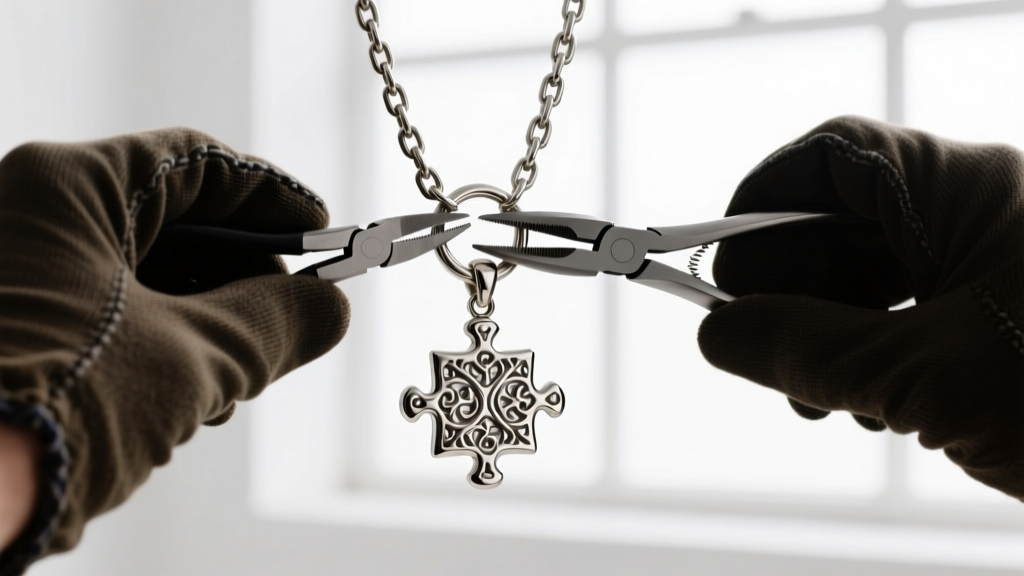
Step 2: Securing the Jump Rings
The bail (the loop at the top of the puzzle) must be connected to the chain via a heavy-duty jump ring. Never use a jump ring thinner than 16-gauge (1.3mm wire thickness). When opening the jump ring, use two pairs of flat-nose pliers and employ a twisting motion (pushing one end away from you and pulling the other toward you). Never pull the ring apart horizontally, as this warps the circle and weakens the metal, allowing the heavy pendant to slip through the gap.
Step 3: Choosing a Fail-Safe Clasp
Magnetic clasps and spring-ring clasps are strictly prohibited for millennium puzzle necklaces. The kinetic swinging motion of a heavy pendant will easily overcome a magnetic seal. Always use a heavy-duty lobster clasp (at least 12mm in length) or a box clasp with a safety latch to ensure the necklace remains secure around your neck.
Maintenance: Cleaning Intricate Crevices
The interlocking nature of a puzzle pendant traps dead skin cells, lotions, and environmental dust. However, you must be incredibly careful with cleaning methods. Ultrasonic cleaners, while excellent for solid diamond rings, can be disastrous for puzzle necklaces. The high-frequency vibrations can loosen glued inlays (like enamel or resin eyes) and cause friction wear between the interlocking metal plates, stripping away PVD or gold plating.
| Cleaning Method | Suitability | Risk Factors |
|---|---|---|
| Ultrasonic Cleaner | Not Recommended | Vibrations loosen glue, cause friction wear on plating in crevices. |
| Chemical Silver Dip | Use with Caution | Can strip antiqued oxidized finishes intentionally left in puzzle grooves. |
| Mild Soap & Soft Brush | Highly Recommended | Safe for all metals and platings; requires manual effort. |
| Compressed Air | Excellent for Drying | Safe; prevents water spots in deep mechanical hinges. |
For routine cleaning, the Gemological Institute of America (GIA) recommends a simple solution of warm water and a few drops of mild, phosphate-free dish soap. Use a baby toothbrush with extra-soft bristles to gently agitate the crevices between the puzzle plates. Rinse with distilled water and use compressed air to blow moisture out of the internal hinges to prevent rust on non-stainless components.
Styling Guide: How to Wear Complex Pendants
A millennium puzzle necklace is a dominant focal point. Styling it requires balancing its visual weight and physical length to prevent it from looking like a costume piece.

Layering and Length Placement
Because the pendant is thick and three-dimensional, it will tangle with shorter, delicate chains. If you are building a necklace stack, the puzzle pendant must serve as the terminal (lowest) layer.
- Layer 1 (16-18 inches): A simple, thin 2.0mm herringbone or snake chain resting on the collarbone.
- Layer 2 (20-22 inches): A medium-weight chain with a small, minimalist geometric pendant (like a simple bar or signet).
- Layer 3 (24-28 inches): Your millennium puzzle necklace on a heavy Franco chain, allowing it to rest on the sternum without colliding with the upper layers.
Neckline Pairings
The intricate geometry of the pendant demands a clean canvas. Solid black or charcoal turtlenecks provide the highest contrast, making gold or polished silver puzzle pieces pop. For open collars or V-necks, ensure the chain length is adjusted so the pendant sits exactly in the center of the exposed skin, acting as a visual anchor for the outfit. Avoid busy, patterned shirts, as the visual noise will clash with the mechanical complexity of the jewelry.
Expert Styling Tip: If your puzzle pendant features moving parts or hinges, apply a microscopic drop of dry PTFE (Teflon) lubricant to the joints using a toothpick. Never use oil-based lubricants like WD-40 or sewing machine oil, as they will attract dust and create a dark, abrasive sludge that will eventually freeze the moving parts and stain your clothing.
Troubleshooting Common Puzzle Pendant Issues
Even high-quality puzzle necklaces require occasional mechanical troubleshooting. Here is how to handle the most common issues reported by collectors and daily wearers:
Stiff or Seized Hinges
If the interlocking plates become difficult to move, do not force them, as this can snap the internal pins. Apply a dry graphite powder or PTFE spray directly into the seam. Work the hinge back and forth gently until the lubricant penetrates the friction point.
Tarnish in Deep Grooves
For sterling silver puzzle pieces, tarnish often builds up in the deep recesses where a polishing cloth cannot reach. Wrap a small piece of silver polishing cloth around the tip of a wooden toothpick and gently run it through the grooves. Avoid metal picks, which will scratch the silver and leave permanent gouges in the geometric patterns.
Pendant Flipping Upside Down
Due to the top-heavy nature of some complex puzzle bails, the pendant may constantly flip backward, showing the flat rear plate instead of the intricate front. To counter this, thread the chain through the bail twice if the hole diameter permits, or use a small, rubber jewelry o-ring inside the bail to create friction against the chain, keeping the pendant facing forward.
By understanding the specific mechanical and metallurgical needs of a millennium puzzle necklace, you can transform it from a fragile novelty item into a durable, everyday statement piece that commands attention and withstands the test of time.


