The Ultimate Buddhist Necklace Material Guide: Wood, Seed & Stone
Compare top Buddhist necklace materials like Bodhi seed, sandalwood, and rudraksha. Learn about durability, patina, and bead properties for daily wear.

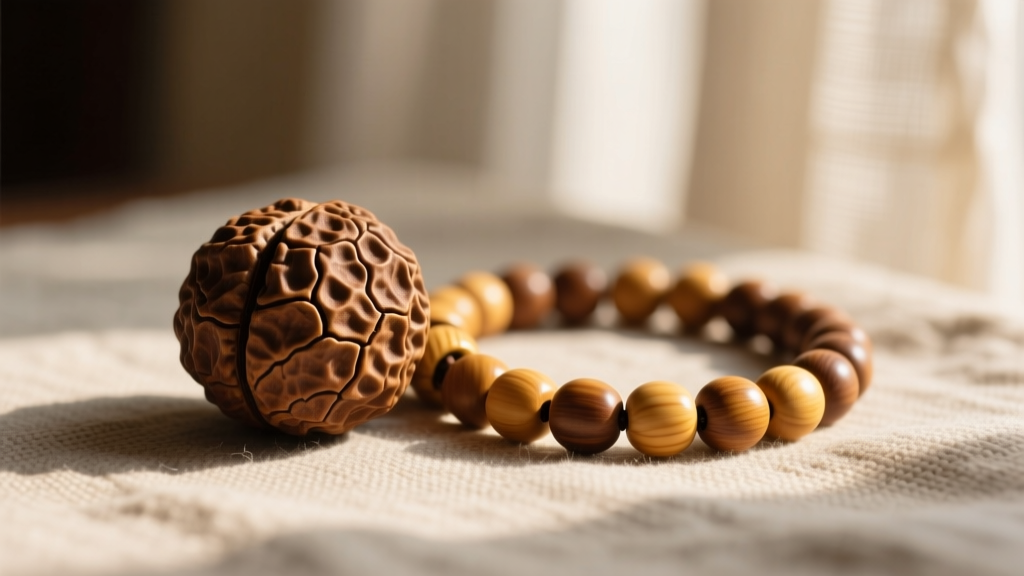
A traditional Buddhist necklace, commonly known as a mala, is far more than a simple piece of jewelry. Comprising exactly 108 beads, a central guru bead (meru), and often four marker beads, it is a precision tool for meditation, mantra counting, and spiritual grounding. However, from a material science and jewelry design perspective, the Buddhist necklace is a complex assembly of organic and inorganic elements subjected to continuous friction, skin oils, and environmental fluctuations. Choosing the right material dictates not only the spiritual resonance of the piece but also its structural longevity, weight distribution, and patina evolution over decades of use.
In this comprehensive guide, we deconstruct the physical and botanical properties of the most revered Buddhist necklace materials, providing actionable data on hardness, density, and stringing requirements for collectors and practitioners alike.
The Organic Foundations: Seeds and Nuts
Seed-based malas are the most traditional and widely used Buddhist necklaces. Their porous nature allows them to absorb the oils from the wearer's skin, creating a deeply personalized, glassy patina over time. However, this same porosity makes them vulnerable to rapid humidity changes and microbial degradation if improperly stored.
Rudraksha (Elaeocarpus ganitrus)
Rudraksha seeds are the cornerstone of Shaivite and broader Buddhist prayer beads. The physical properties of a Rudraksha bead are dictated by its density and internal locules (mukhis). A standard 5-mukhi bead has a Janka hardness equivalent of roughly 1,200 lbf, making it remarkably resistant to surface scratching. However, the seed's interior is spongy.
Authentication & Failure Modes: The market is flooded with glued or carved fake Rudraksha. While the traditional 'water sink test' is commonly cited, it is scientifically flawed; a genuine but older, desiccated Rudraksha may float due to trapped air pockets, while a heavy, resin-filled fake will sink. The most reliable non-destructive test is examining the natural clefts under 10x magnification for continuous, unbroken seed walls, or using X-ray fluorescence to detect internal adhesives.
Bodhi Seed and Lotus Seed
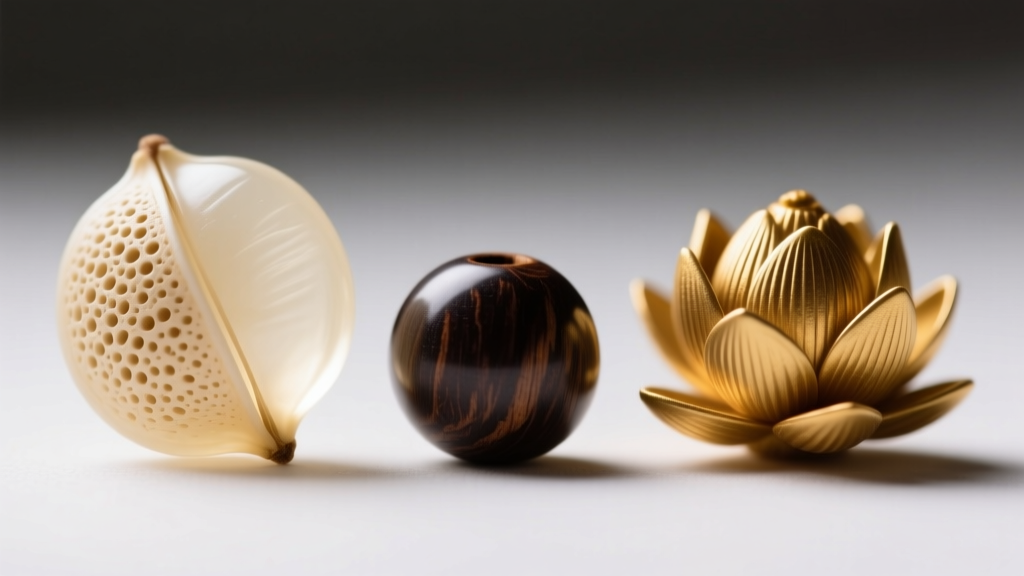
Commercially sold 'Bodhi seeds' are rarely from the actual Ficus religiosa (Bodhi tree), whose seeds are minuscule. Instead, the jewelry trade utilizes the endosperm of the Tagua palm (Phytelephas aequatorialis) or the seeds of the Ziziphus lotus.
Tagua-based Bodhi beads have a specific gravity of approximately 1.4, making them feel surprisingly heavy and cool to the touch, similar to animal ivory. They possess a Mohs hardness of 2.5, meaning they can be scratched by a copper coin. Over 3 to 5 years of daily handling, the naturally white Tagua bead will oxidize and absorb sebum, transitioning through shades of amber to a deep, translucent mahogany. Lotus seeds, conversely, are much lighter (specific gravity ~0.8) and feature a highly textured, cratered surface that traps dirt, requiring periodic ultrasonic cleaning to prevent the buildup of dead skin cells in the pores.
Aromatic Woods: Sandalwood and Agarwood
Wooden Buddhist necklaces offer olfactory benefits, releasing terpenes and essential oils that aid in meditative focus. Yet, wood is an anisotropic material, meaning it expands and contracts at different rates depending on the grain direction, posing unique challenges for bead drilling and stringing.
Sandalwood (Santalum album)
True Mysore sandalwood is prized for its high concentration of santalol (typically 4% to 6% by volume in premium heartwood). According to The Wood Database, Santalum album has a Janka hardness of 1,000 lbf and a dry density of 610 kg/m³.
Degradation Protocol: The primary failure mode of a sandalwood Buddhist necklace is scent depletion and surface desiccation. Continuous exposure to UV light and low-humidity environments (below 30% RH) will cause the beads to develop micro-fissures along the radial grain. To preserve the aromatic oils, sandalwood malas should be stored in airtight glass vessels with a lightly dampened cotton swab when not in use, and never worn during high-sweat activities, as the alkaline nature of heavy perspiration can neutralize the wood's natural acidic terpenes.
Agarwood (Aquilaria malaccensis)
Agarwood (Oud) is not a true wood but a dense, resin-saturated pathological response to fungal infection in the Aquilaria tree. High-grade 'Kyara' agarwood beads contain over 30% resin by weight, giving them a specific gravity that can exceed 1.0 (meaning they sink in water). Because the resin is incredibly brittle, agarwood beads are prone to chipping at the drill holes if the mala is dropped on a hard surface. They require a soft, knotless stringing material to prevent internal abrasion.
Mineral and Gemstone Malas: Weight and Thermal Properties
Gemstone Buddhist necklaces are favored for their durability and thermal conductivity. Unlike organic seeds, stones do not absorb oils, making them hygienic and structurally stable across all climates. However, their high density introduces significant mechanical stress on the stringing material.
Lapis Lazuli and Nephrite Jade
Lapis Lazuli, a metamorphic rock composed primarily of lazurite, calcite, and pyrite, sits at a 5 to 6 on the Mohs scale. The presence of calcite (Mohs 3) creates soft spots within the bead, making the drill holes susceptible to widening over time due to cord friction.
Nephrite Jade, with a Mohs hardness of 6 to 6.5 and an interlocking fibrous crystal structure, is virtually indestructible in a mala application. According to the Gemological Institute of America (GIA), nephrite's exceptional toughness makes it ideal for beads that will strike against one another during vigorous mantra counting. The primary drawback of stone malas is their thermal mass; an 8mm lapis lazuli 108-bead necklace weighs approximately 95 grams, which can cause cervical fatigue during extended, hour-long meditation sessions compared to a 20-gram Rudraksha mala.
Stringing Materials: The Hidden Failure Point
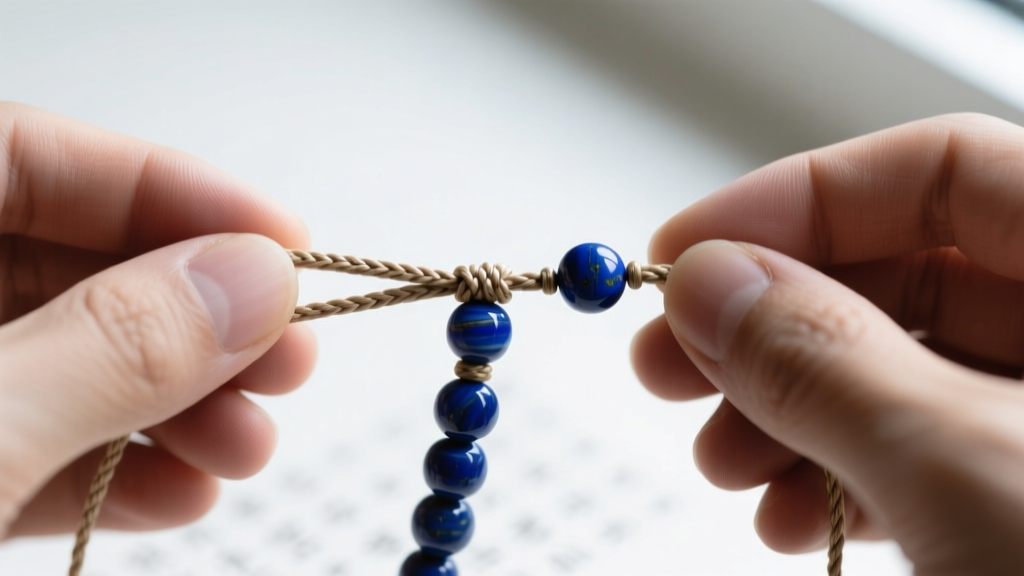
The most critical, yet frequently overlooked, component of a Buddhist necklace is the cord. A 108-bead mala features over 216 individual drill-hole edges that act as microscopic saws against the stringing material. Choosing the wrong cord guarantees catastrophic failure.
- Traditional Silk (Size F or G): Offers unparalleled drape and traditional authenticity. However, silk is a protein fiber that degrades rapidly when exposed to the lactic acid and urea in human sweat. A daily-worn silk-strung mala requires complete restringing every 12 to 18 months.
- Braided Nylon (0.8mm to 1.0mm): The modern standard for heavy gemstone and dense seed malas. Nylon boasts a tensile strength exceeding 40 lbs and is highly resistant to UV and chemical degradation. Its stiffness, however, can make the mala feel rigid until it is broken in.
- Elastomer/Elastic Cord: Strictly avoid for traditional malas. Elastic degrades under the continuous tension of 108 beads and the friction of the guru bead knot, leading to sudden, unpredictable snapping.
Comprehensive Material Comparison Matrix
The table below synthesizes the physical properties of common Buddhist necklace materials to help you select the optimal bead type for your specific wear habits and environmental conditions.
| Material | Hardness / Density | Patina Potential | Moisture Sensitivity | Ideal Stringing Cord |
|---|---|---|---|---|
| Rudraksha (5-mukhi) | ~1,200 lbf / Medium | High (Darkens significantly) | High (Prone to mold) | 0.8mm Braided Nylon |
| Tagua Bodhi Seed | Mohs 2.5 / High SG | Extreme (White to Mahogany) | Medium (Cracks if dried) | Size G Silk or Nylon |
| Mysore Sandalwood | 1,000 lbf / Low SG | Low (Maintains color) | High (Loses scent/oils) | Size F Silk |
| Nephrite Jade | Mohs 6.5 / High SG | None (Polished surface) | Zero (Impervious) | 1.0mm Braided Nylon |
| Agarwood (Kyara) | Variable / High SG | Medium (Resin oxidation) | Low (Stable but brittle) | Soft Micro-cord |
Care, Patina, and Longevity Protocols
Maintaining a Buddhist necklace requires understanding the chemical interaction between the bead material and the environment. For organic seeds and woods, the 'patina' is essentially a polymerized layer of human sebum and environmental dust. To accelerate a smooth, glassy patina on Rudraksha or Bodhi seeds, practitioners often use a clean, dry cotton cloth to vigorously polish the beads daily, distributing the oils evenly without trapping grit in the pores.
Conversely, gemstone malas like Lapis Lazuli or Turquoise require strict chemical isolation. Turquoise is a porous hydrous copper aluminum phosphate; exposure to cosmetics, lotions, or even acidic sweat can alter its chemical structure, causing the vibrant blue stone to permanently shift to a dull green. Always wipe stone malas with a damp microfiber cloth after use and store them in a soft, acid-free tissue pouch to prevent the heavy beads from abrading one another during transit.
Ultimately, the 'best' material for a Buddhist necklace depends entirely on the user's intent. If the goal is a lightweight, traditional tool that evolves visually with the practitioner, organic seeds are unmatched. If the priority is heirloom durability, hygienic maintenance, and structural permanence, high-toughness gemstones strung on modern braided nylon offer the superior physical profile.


