How to Clean and Maintain a Labradorite Beaded Necklace
Learn how to safely clean, store, and maintain your labradorite beaded necklace to preserve its iridescent labradorescence and structural integrity.

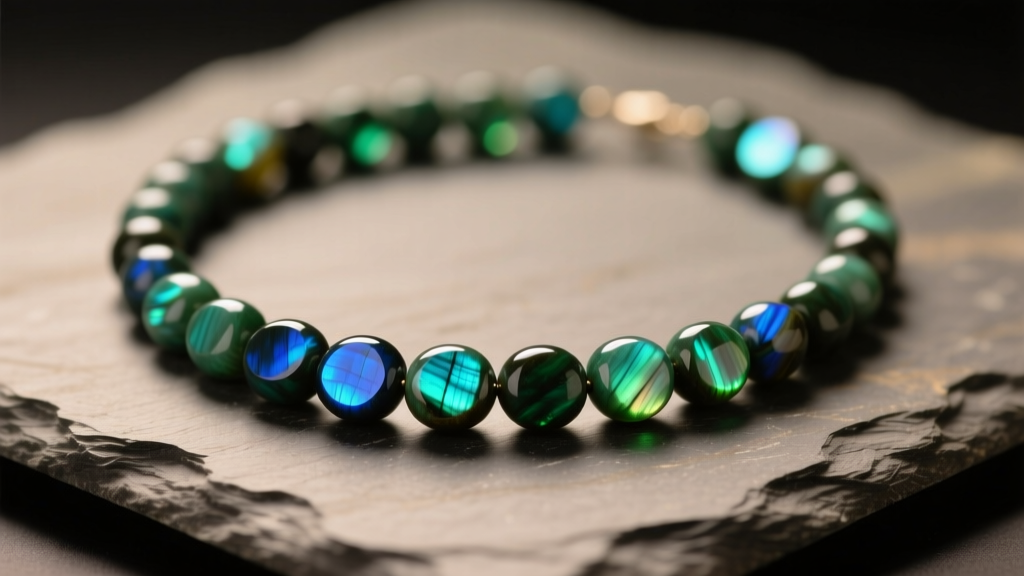
A labradorite beaded necklace is a striking investment, celebrated for its mesmerizing labradorescence—the optical phenomenon where the stone flashes vivid hues of blue, green, and gold when caught in the light. However, preserving this iridescent display requires more than a simple wipe-down. As a plagioclase feldspar mineral, labradorite possesses unique structural vulnerabilities that demand specific care protocols. Whether you are wearing a multi-strand statement piece or a delicate single-strand 6mm bead necklace, understanding the mineralogy of your jewelry is the first step in ensuring its longevity. This comprehensive guide details the exact cleaning methods, structural maintenance routines, and storage practices required to keep your labradorite beads pristine for decades.
Understanding Labradorite's Vulnerabilities
Before applying any cleaning solution or storing your necklace, it is critical to understand the physical properties of labradorite. According to the Mindat mineral database, labradorite ranks between 6 and 6.5 on the Mohs hardness scale. While this makes it reasonably durable for everyday wear, it is significantly softer than quartz (which ranks at 7). Because household dust often contains microscopic quartz particles, simply wiping a dry, dusty labradorite bead with a cloth can result in micro-scratches that permanently dull the stone's polished surface and suppress its optical flash.
Furthermore, labradorite exhibits perfect cleavage in one direction and good cleavage in another. Cleavage refers to the tendency of a mineral to break along flat, structural planes. In a beaded necklace, the drill holes represent the most structurally compromised areas of the stone. A sharp knock against a granite countertop or a drop onto a tile floor can cause the bead to chip or split entirely along these cleavage planes, particularly near the drill channel. This structural reality dictates that your cleaning and handling methods must be exceptionally gentle, avoiding any high-impact or high-vibration environments.
The Right Way to Clean Labradorite Beads
The most common mistake jewelry owners make is using commercial jewelry dips or ultrasonic cleaners. Ultrasonic machines use high-frequency sound waves to create microscopic cavitation bubbles in a liquid solution. When these bubbles collapse against the stone, they generate localized shockwaves. For a gemstone with perfect cleavage like labradorite, these vibrations can exploit internal fault lines, causing the beads to fracture from the inside out. Similarly, steam cleaners expose the stone to rapid thermal expansion, which can lead to thermal shock and cracking.
Step-by-Step Wet Cleaning Method
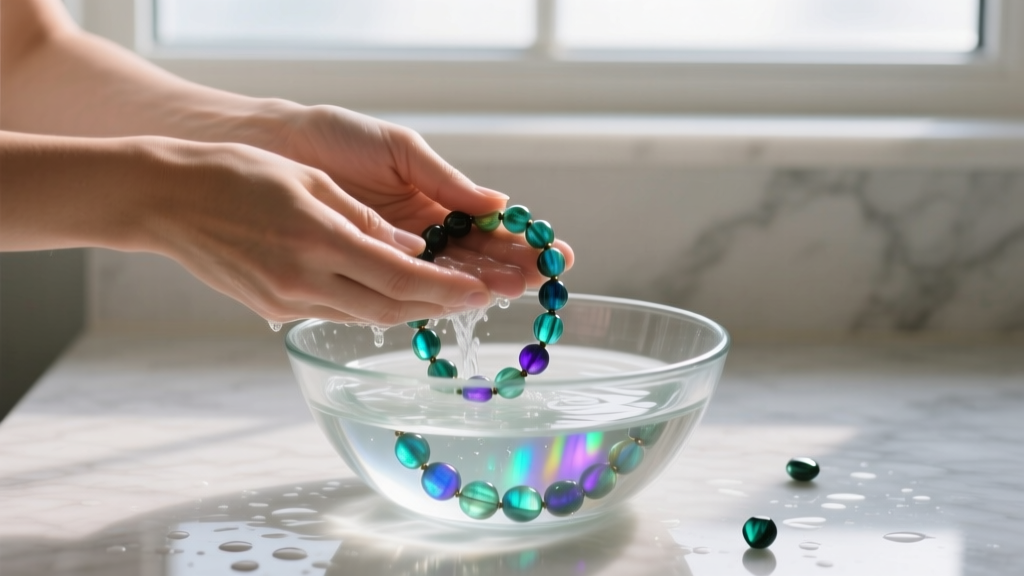
To safely remove sebum, lotion buildup, and environmental grime, you must use a manual, low-impact wet cleaning method. Follow these exact steps to restore your necklace's brilliance without risking structural damage:
- Prepare the Solution: Fill a glass bowl with lukewarm distilled water. Avoid tap water, as the dissolved chlorine, calcium, and magnesium can leave a microscopic mineral film on the beads, clouding the labradorescence. Add two drops of a mild, phosphate-free dish soap (such as original Dawn) or a pH-neutral castile soap.
- Soak Briefly: Submerge the labradorite beaded necklace in the solution for no more than 3 to 5 minutes. Prolonged soaking can degrade the stringing material and weaken the adhesive inside the drill holes if the beads were glued during stringing.
- Agitate Gently: Swish the necklace gently through the water. For stubborn grime trapped near the clasp or between tightly packed beads, use a clean, ultra-soft baby hairbrush or a dedicated makeup blending brush to lightly sweep the crevices.
- Rinse and Dry: Rinse the necklace under a gentle stream of distilled water. Lay it flat on a clean, lint-free microfiber towel to air dry completely before storing. Never hang a wet beaded necklace, as the weight of the water can stretch the stringing material.
Chemicals to Strictly Avoid
Labradorite is highly sensitive to harsh chemicals. Never expose your necklace to bleach, ammonia, vinegar, or acidic jewelry cleaning solutions. Acids can etch the microscopic twinning lamellae inside the stone—the very structures responsible for the labradorescence. Once these internal layers are chemically etched, the iridescent flash is permanently destroyed. The Gemological Institute of America (GIA) consistently advises against using any ultrasonic or chemical cleaning methods for feldspar gems, reinforcing the necessity of mild, manual cleaning.
Stringing and Structural Maintenance
The longevity of a labradorite beaded necklace relies just as much on its stringing material as the stones themselves. Labradorite beads are relatively heavy, especially in 8mm to 10mm sizes, and they feature sharp edges at the drill holes that can saw through weak threads over time. Inspecting and maintaining the stringing infrastructure is a vital part of your care routine.
Choosing the Right Stringing Material
If your necklace requires restringing, or if you are evaluating a new purchase, the internal wire or cord must be matched to the bead weight and drill hole size (typically 0.8mm to 1.0mm for standard labradorite beads). Below is a comparison of professional stringing materials:
| Stringing Material | Best Application | Pros | Cons |
|---|---|---|---|
| 49-Strand Beading Wire (0.018") | 6mm - 10mm Beads | Exceptional tensile strength; highly flexible; resists kinking. | Requires specialized crimping tools and wire guardians. |
| Size F Nylon Cord | Knotted Designs | Allows for knotting between beads to prevent friction and loss. | Can stretch over time under the weight of heavy stone beads. |
| Silk Thread (Size 6) | Pearls / Soft Gems | Traditional aesthetic; elegant knotting. | Degrades rapidly with moisture and skin oils; poor for heavy stones. |
For a standard labradorite beaded necklace, a 49-strand micro-fused stainless steel wire with a nylon jacket (such as Soft Flex or Accu-Flex) in a 0.015" or 0.018" diameter is the industry gold standard. It provides the drape of silk with the breaking strength of steel. Always ensure the wire is secured with sterling silver or gold-filled crimp beads and a wire guardian at the clasp loop to prevent metal-on-metal fatigue.
Proper Storage to Prevent Scratching
How you store your necklace when it is not being worn is just as critical as how you clean it. Because labradorite is softer than many other popular gemstones (like sapphire, ruby, or diamond), storing it in a communal jewelry box is a recipe for disaster. A diamond ring or a quartz crystal resting against your labradorite beads will easily scratch their polished surfaces, creating dull, white scuff marks that ruin the stone's optical properties.
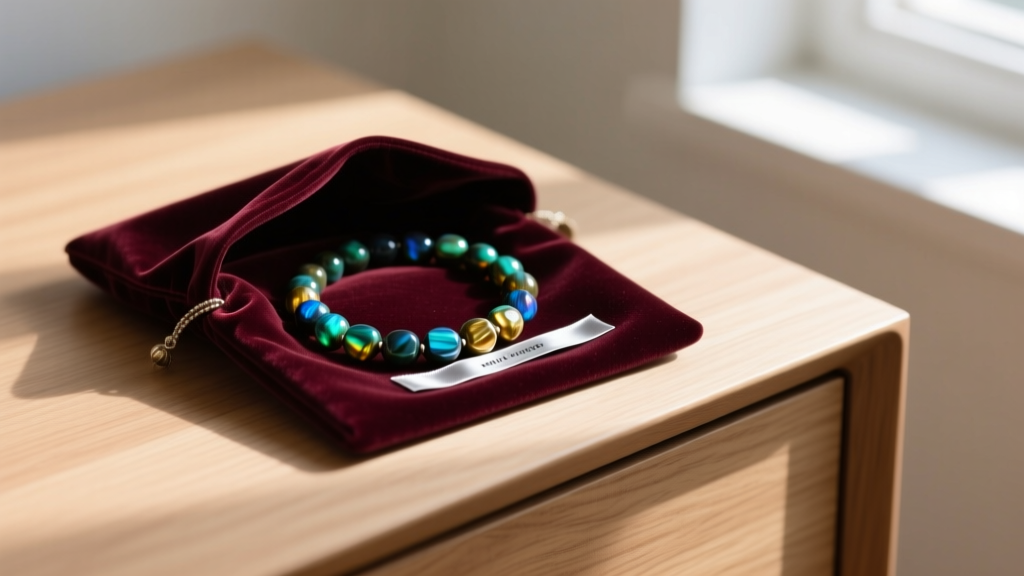
Always store your labradorite beaded necklace individually in a soft, untreated flannel or velvet pouch. If the necklace features a sterling silver clasp or silver bead accents, place a small anti-tarnish strip (such as 3M Anti-Tarnish Tabs) inside the pouch. This will absorb sulfur compounds from the air, preventing the silver from oxidizing and transferring black tarnish residue onto the porous drill holes of the labradorite beads. Store the pouch in a cool, dark drawer; while labradorite is relatively colorfast, prolonged exposure to direct, intense UV sunlight can cause thermal stress or fade secondary mineral inclusions over many years.
Restoring the Polish and Labradorescence
If your labradorite beads have become cloudy or lost their high-gloss polish due to years of micro-scratches and skin oil accumulation, a simple wash may not be enough. The cloudiness is often a result of a microscopic layer of hardened sebum and lotion trapped in the natural fissures of the stone.
To restore the polish at home, you can use a specialized gemstone polishing cloth infused with a mild, non-abrasive jeweler's rouge. Gently rub each bead individually, rotating the cloth to ensure you are lifting the grime rather than grinding it into the stone's cleavage planes. For severe dulling, the necklace must be taken to a professional lapidary. A lapidary can carefully unstring the beads and tumble them in a rotary tumbler with ceramic media and a mild cerium oxide polishing compound, restoring the factory-gloss finish without damaging the stone's structural integrity.
Troubleshooting Common Issues
Issue: Dirt trapped in the drill holes.
The narrow channels of the drill holes act as magnets for dead skin cells and cosmetic powders. If a wet wash doesn't clear them, take a dry, clean interdental brush (the soft, cone-shaped brushes used for braces or retainers) and gently insert it into the drill hole from both sides. Twist lightly to dislodge the compacted debris.
Issue: Tarnished clasp near the beads.
If your sterling silver clasp has turned black, you cannot dip the necklace in a silver cleaning solution without risking chemical damage to the adjacent labradorite beads. Instead, use a treated silver polishing cloth. Fold the cloth tightly and use a fingernail to press the cloth into the crevices of the clasp, ensuring the cloth acts as a physical barrier between the chemical polishing agents and the vulnerable feldspar beads.
Issue: The necklace feels stiff or kinked.
If your beading wire has developed a permanent kink, the structural integrity of the nylon jacket has been compromised. Do not attempt to bend it back into place, as this will weaken the internal steel strands. The necklace must be professionally restrung immediately to prevent an unexpected breakage and the subsequent loss of your valuable labradorite beads.


