Diamond Necklace Movie Styles: Sourcing and Fit Troubleshooting
Troubleshoot weight, clasp failures, and stone sourcing when recreating iconic diamond necklace movie replicas for real-world wear.

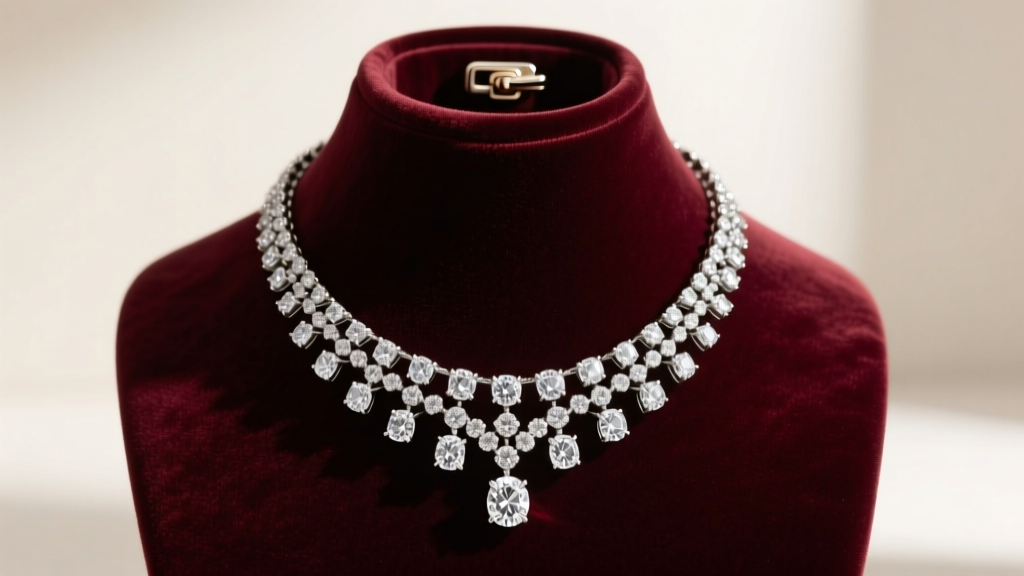
The Cinematic Illusion: Why Movie Props Fail in Real Life
When audiences see the iconic diamond necklace movie moments—such as the breathtaking 136-carat Toussaint in Ocean's 8 or the legendary Heart of the Ocean in Titanic—they are witnessing masterful cinematic illusion. Hollywood jewelers and prop masters prioritize camera readiness over structural longevity. These pieces are often constructed using lightweight resins, hidden monofilament wires, and glued-in cubic zirconia to prevent actor fatigue and avoid insurance liabilities. However, when collectors and enthusiasts attempt to recreate these iconic looks for real-world galas, weddings, or high-end cosplay in 2026, they immediately run into severe structural and ergonomic failures. The transition from a controlled film set to the dynamic movement of real life requires a complete re-engineering of the piece's architecture. This guide solves the most common mechanical, material, and sourcing problems encountered when bringing a diamond necklace movie replica into reality.
Troubleshooting Weight and Clasp Mechanics
The most frequent point of failure in heavy statement necklaces is the clasp. A standard lobster clasp, designed for pieces weighing under 30 grams, will inevitably snap or slip when subjected to the 60-to-100-gram weight of a massive, multi-strand cinematic replica. When a large center stone is introduced, the pendulum effect of walking causes micro-tugs that fatigue standard jump rings and clasp springs.
Upgrading the Closure System
To solve this, you must abandon spring-loaded closures entirely. For any necklace exceeding 40 grams, the industry standard is a tongue-and-groove box clasp equipped with dual figure-8 safety catches. According to master jewelers at Ganoksin, the internal tongue must be forged from work-hardened 18k white gold or platinum to prevent bending, while the safety wires should be crafted from 16-gauge or 14-gauge wire. This ensures that even if the primary friction-fit tongue is accidentally depressed by a stray hair or fabric, the dual figure-8 safeties will hold the necklace securely against the collarbone.
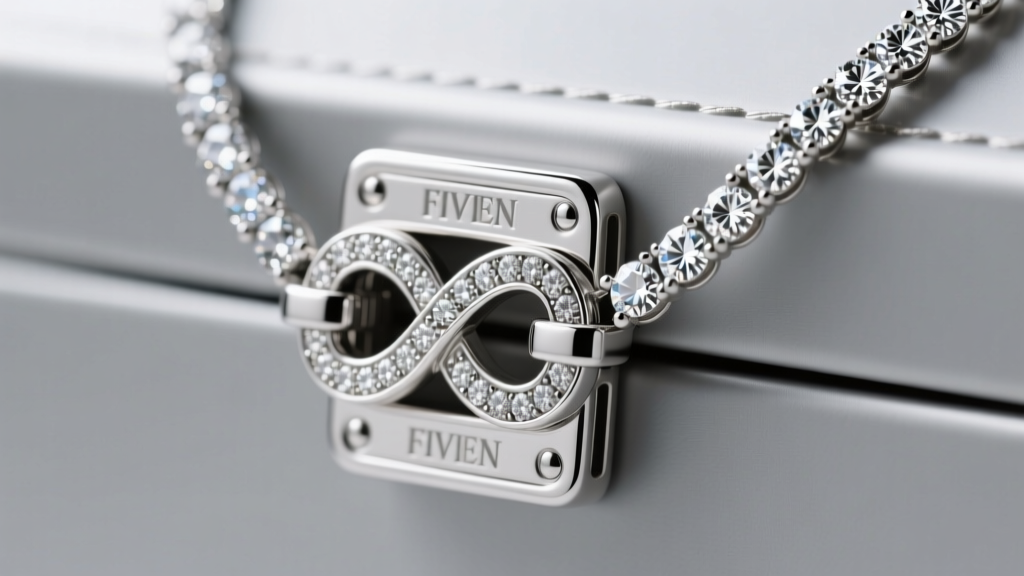
Internal Armature and Wire Gauges
Movie props often rely on the actor's posture to keep the necklace draped correctly. In reality, heavy stones will pull the chain downward, causing the necklace to slide off the shoulders. To troubleshoot this, bespoke jewelers use an internal armature. By threading a flexible, 18-gauge stainless steel or nitinol (nickel-titanium) memory wire through the links or beads of the collar section, the necklace maintains a rigid, ergonomic curve that hugs the clavicle, distributing the weight of the pendant evenly across the back of the neck rather than concentrating it on the front.
Stone Sourcing Matrix: Solving the Carat Budget Gap
Recreating a 50-carat center stone seen in a diamond necklace movie is financially prohibitive for most buyers using natural earth-mined diamonds. Fortunately, the 2026 market offers exceptional alternatives, but each comes with distinct physical properties that affect the jewelry's design. A common mistake is assuming all diamond simulants weigh the same. Specific gravity (SG) dictates how heavy a stone feels relative to its size, which directly impacts the stress placed on the necklace's prongs and chain.
| Material | Specific Gravity (SG) | Refractive Index (RI) | Mohs Hardness | Est. Price (per ct.) | Troubleshooting Notes |
|---|---|---|---|---|---|
| Cubic Zirconia (CZ) | 5.60 - 6.00 | 2.15 | 8.0 - 8.5 | $5 - $20 | Significantly heavier than diamond; requires reinforced prongs. Scratches easily over time. |
| Moissanite | 3.21 | 2.65 | 9.25 | $300 - $600 | Lighter than diamond. High double refraction can cause a 'disco-ball' effect in stones over 15mm. |
| Lab-Grown Diamond | 3.52 | 2.42 | 10.0 | $800 - $1,500 | Identical physical properties to natural diamonds. GIA certifies optical and chemical equivalence. |
Expert Insight: If you are using a massive 30mm Cubic Zirconia to replicate a movie prop, be aware that it will weigh nearly 70% more than a diamond of the exact same dimensions. You must instruct your jeweler to thicken the gallery wire and basket base to support this excess mass, otherwise the stone will warp the setting and eventually pop out.
Metal Allergies and Tarnish: The Rhodium Plating Problem
To achieve the brilliant, icy white look of platinum on a budget, many replica manufacturers use brass or sterling silver bases flashed with rhodium. The problem? Standard commercial rhodium plating is incredibly thin (often 0.5 to 0.75 microns). Within weeks of wear, the friction against the skin and exposure to cosmetic oils will wear through the plating, exposing the base metal. This leads to severe tarnishing, green skin discoloration, and potential contact dermatitis from nickel alloys often found in cheap white gold or brass mixes.
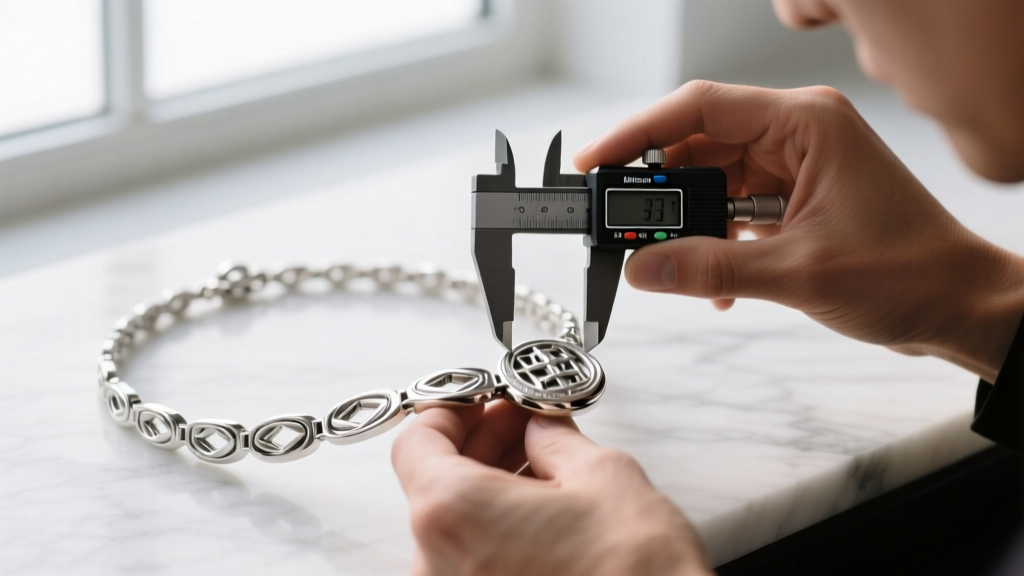
The 2.5-Micron Rule
When commissioning a replica, explicitly request a heavy rhodium flash of at least 2.5 microns over a nickel-free palladium white gold or high-grade sterling silver base. Palladium white gold is naturally a warmer, grayish-white metal, meaning that even if the rhodium eventually wears thin on the back of the pendant after years of use, the underlying metal will not turn yellow or green, preserving the aesthetic integrity of the piece. Always ask the bench jeweler for a plating thickness test using an X-ray fluorescence (XRF) spectrometer before accepting the final delivery.
Custom Commissioning: CAD and Prong Tolerances
When you move from buying off-the-shelf replicas to commissioning a custom CAD (Computer-Aided Design) piece based on a movie still, you must scrutinize the digital rendering for structural weaknesses. Prop jewelry relies on glue; fine jewelry relies on tension and metal memory.
- Prong Height and Thickness: For any center stone exceeding 10mm in diameter, prongs must be a minimum of 1.2mm thick at the base and extend at least 1.5mm above the girdle of the stone. Movie props often feature impossibly thin, needle-like prongs that look elegant on camera but would snap under real-world torque.
- Gallery Clearance: Ensure the CAD model includes a minimum 2mm clearance between the culet (bottom point) of the stone and the wearer's skin. This prevents the sharp culet from scratching the chest and allows light to enter the pavilion, maximizing brilliance.
- Sprue Mark Placement: Ask your designer where the casting sprues (the channels where molten metal enters the mold) will be cut. Ensure they are not located near the delicate filigree or clasp joints, as cutting and polishing sprue marks in these areas can weaken the structural integrity of the necklace.
Final Fitting and Wardrobe Integration
The final troubleshooting phase involves the intersection of the necklace and the wardrobe. Movie necklaces are designed for specific necklines, often secured with double-sided tape to the actor's skin or dress. For real-world wear, you must consider the fabric. Heavy diamond replicas will easily snag on delicate silks, lace, or loose-knit wools. If you plan to wear your cinematic masterpiece over bare skin, ensure the under-gallery (the metal framework beneath the stones) is meticulously polished and features a 'comfort-fit' domed edge to prevent scratching the sternum. By addressing specific gravity, clasp mechanics, and plating thickness, you can transform a fragile Hollywood illusion into a resilient, heirloom-quality piece of jewelry that commands the room long after the director calls cut.


