How to Find a Free Medical Alert Necklace for Seniors (2026)
Discover how to secure a free medical alert necklace for seniors in 2026 and compare the best hypoallergenic materials for aging skin.


Securing a free medical alert necklace for seniors is a top priority for caregivers navigating the complexities of aging, chronic conditions, and emergency response. However, obtaining the necklace at no cost is only half the battle. The material composition of the pendant and chain dictates its safety during medical procedures, its compatibility with fragile aging skin, and its long-term legibility. As of 2026, assistance programs offer a wider variety of metallurgical options than ever before, making it crucial to understand what you are selecting from the catalog.
How to Qualify for a Free Medical Alert Necklace for Seniors
Before diving into metallurgy, it is essential to know where to source these life-saving accessories without out-of-pocket costs. In 2026, seniors and their caregivers can leverage several established avenues:
- Medicare Advantage (Part C) OTC Benefits: Many private Medicare Advantage plans now include medical alert jewelry under their Over-The-Counter (OTC) or health and wellness allowances. Caregivers can order directly through plan catalogs.
- Area Agencies on Aging (AAA): Local AAA offices frequently run fall-prevention and chronic-care grants that provide free medical IDs to low-income seniors.
- Non-Profit Assistance Programs: Organizations like the MedicAlert Foundation offer financial assistance and free basic membership tiers for qualifying seniors, ensuring they receive a foundational ID necklace.
The Metallurgy of Medical IDs: What to Choose for Senior Skin
Aging skin undergoes significant structural changes. The epidermis thins, collagen production drops, and the skin's moisture barrier weakens. This makes seniors highly susceptible to allergic contact dermatitis and pressure ulcers from heavy or reactive metals. When selecting from a free catalog, prioritize the following materials based on their specific properties.
Surgical Stainless Steel (316L)
Often the default option in free catalogs, 316L stainless steel is highly durable and resistant to tarnish. However, it contains 8% to 10.5% nickel. While the 'surgical' designation means nickel leaching is strictly limited to less than 0.5 µg/cm²/week, seniors with severely compromised skin barriers or a known history of nickel allergies should avoid this material. Furthermore, its density (8.0 g/cm³) makes it noticeably heavier, which can cause cervical spine fatigue or skin dragging in frail individuals.
Aerospace-Grade Titanium (Grade 23 / Ti-6Al-4V ELI)
Titanium Grade 23 (Extra Low Interstitial) is the gold standard for implantable medical devices and premium medical alert jewelry. It is 100% nickel-free and entirely biocompatible. From a physical standpoint, titanium has a density of just 4.43 g/cm³—making it nearly 45% lighter than stainless steel. This dramatic weight reduction is vital for seniors who find traditional metal chains irritating or exhausting to wear over thinning neck skin.
Medical-Grade Silicone and TPU
For the pendant itself, some programs offer encased silicone or thermoplastic polyurethane (TPU) tags. While not metal, these materials feature a Shore A hardness of 40-50, providing a soft, flexible surface that will not cause blunt-force trauma to the sternum if the senior experiences a forward fall.
Material Comparison Matrix
| Material | Density (g/cm³) | Nickel Content | Vickers Hardness (HV) | MRI Safety (3T) |
|---|---|---|---|---|
| 316L Stainless Steel | 8.00 | 8 - 10.5% | 150 - 190 | Conditional (Artifacts) |
| Titanium Grade 23 | 4.43 | 0% | 320 - 340 | Safe (Paramagnetic) |
| Sterling Silver (925) | 10.36 | 0% (Copper alloy) | 60 - 80 | Safe (Diamagnetic) |
| Medical Silicone | 1.10 | 0% | N/A (Shore A 45) | Safe (Non-magnetic) |
Engraving Legibility and Material Hardness
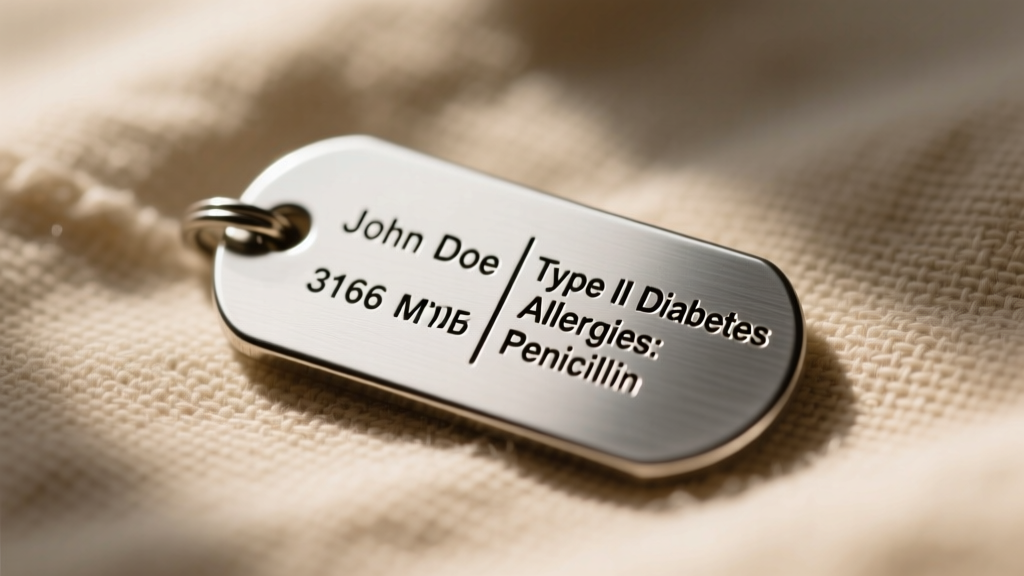
A medical alert necklace is useless if first responders cannot read it. The Vickers hardness (HV) of the chosen material directly impacts how engraving is applied and how well it holds up over years of friction against clothing.
Stainless Steel (150-190 HV): This softer metal allows for deep rotary mechanical engraving. The deep grooves can be filled with enamel paint, ensuring high contrast. However, over 5 to 10 years, friction can wear down the painted fill, leaving shallow, hard-to-read grooves.
Titanium Grade 23 (320-340 HV): Because titanium is significantly harder and possesses a passive oxide layer, mechanical engraving is difficult and can compromise its corrosion resistance. Instead, free catalogs utilizing titanium will employ fiber laser annealing. This process uses intense heat to oxidize the surface layer, turning the text permanently black without removing any material. This results in an engraving that will never fade, chip, or rub off, ensuring critical data like 'DNR' or 'Blood Thinner' remains legible for life.
MRI Compatibility: A Critical Safety Factor
Seniors frequently undergo Magnetic Resonance Imaging (MRI) to diagnose neurological or orthopedic issues. The magnetic properties of the necklace material are a matter of clinical safety.
According to Medicare.gov and radiological safety guidelines, 316L stainless steel is weakly ferromagnetic. In a powerful 3-Tesla MRI machine, a steel pendant can experience translational pull (becoming a projectile) or radiofrequency-induced heating, potentially burning the senior's chest. Furthermore, steel creates massive 'starburst' artifacts on the scan, obscuring diagnostic images of the cervical spine or brain stem.
Titanium, conversely, is paramagnetic. It will not be pulled by the magnet and produces minimal imaging artifacts. If the senior is likely to need frequent MRIs, caregivers must bypass steel options in the free catalog and strictly select titanium or silicone alternatives.
The Chain vs. Cord Debate: Cervical Spine Considerations
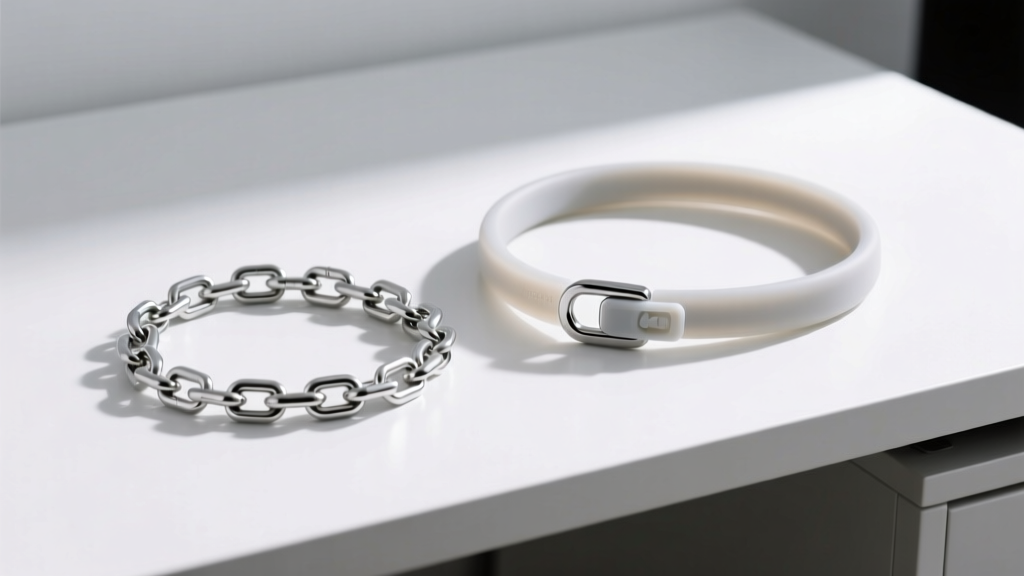
The pendant material is only part of the equation; the suspension system matters just as much. Free programs typically offer a choice between a stainless steel box chain and a braided silicone or nylon cord.
Stainless Steel Box Chains
While durable, metal chains act like tiny saws against the fragile, crepe-like skin of the elderly neck. The repetitive friction of a metal chain can lead to micro-tears and contact dermatitis. Additionally, standard lobster-claw clasps require fine motor dexterity to operate, which is often impaired in seniors with rheumatoid arthritis or Parkinson's disease.
Silicone Cords with Breakaway Clasps
A medical-grade silicone or braided cotton cord is vastly superior for senior wear. It eliminates metal-on-skin friction and is entirely non-reactive. More importantly, these cords are fitted with plastic breakaway safety clasps. If the necklace is snagged on a bedrail, wheelchair lift, or during a fall, the clasp snaps open at roughly 15 pounds of pressure, preventing accidental strangulation—a critical safety feature that rigid metal chains lack.
Final Checklist for Caregivers
When ordering a free medical alert necklace for seniors through Medicare Advantage or non-profit grants, use this material-focused checklist to ensure optimal safety:
- Verify the Alloy: Confirm the pendant is Titanium Grade 23 or 316L Steel. Avoid mystery 'base metals' or silver-plated alloys that will flake and expose reactive cores.
- Check the Engraving Method: Look for laser-annealed black text on titanium for permanent legibility, or deep rotary cuts with enamel fill on steel.
- Select the Right Cord: Always choose a silicone or cotton cord with a breakaway safety clasp over a metal chain to protect fragile neck skin and prevent snagging hazards.
- Confirm MRI Status: If the senior has a pacemaker, neurostimulator, or frequent MRI needs, strictly avoid stainless steel components.
By understanding the material science behind these life-saving accessories, caregivers can maximize the value of free assistance programs, ensuring their loved ones receive a medical alert necklace that is safe, comfortable, and reliable in an emergency.


