Man MRI Necklace Guide: Safe Metals, Clasps, and Magnetic Risks
Discover the technical realities of wearing a man MRI necklace. Learn about magnetic susceptibility, RF heating risks, and safe non-ferromagnetic metals.

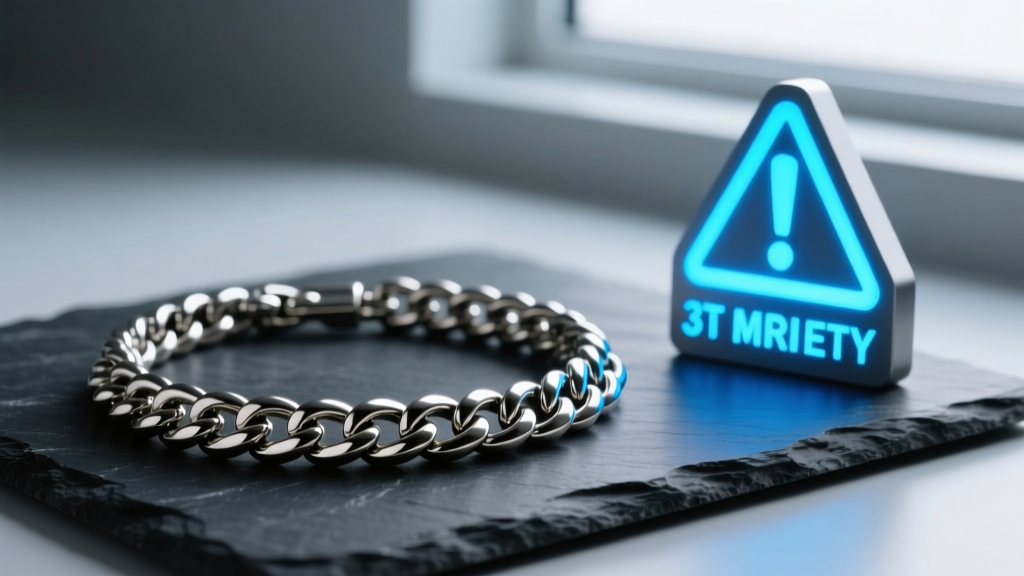
The Physics of the MRI Bore: Why Most Men's Necklaces Fail
When a physician orders a Magnetic Resonance Imaging (MRI) scan, the immediate protocol requires the removal of all metallic objects. However, a growing trend in men's jewelry involves heavy, permanent-feeling chains—such as thick Cuban links or rope chains—that some men are highly reluctant to remove. This has led to a surge in searches for the elusive "man mri necklace," with patients hoping to find a chain they can safely wear inside the bore. As of 2026, with the widespread adoption of 3-Tesla (3T) and even 7-Tesla research scanners, the margin for error is zero.
To understand why 95% of men's metal necklaces are strictly contraindicated, we must look at the two primary physical forces at play: translational attraction and radiofrequency (RF) thermal heating. The static magnetic field (B0) of a 3T scanner is roughly 60,000 times stronger than the Earth's magnetic field. If a necklace contains ferromagnetic elements, the translational pull can turn the jewelry into a dangerous projectile. More insidiously, the RF pulses used to excite hydrogen protons can induce electrical currents in conductive materials. A necklace resting against the skin forms a closed conductive loop, acting as an antenna that concentrates thermal energy and causes severe, localized second- or third-degree burns.
Material Breakdown: Ferromagnetic vs. Non-Magnetic Metals
Not all metals react identically in a magnetic field. The concept of "magnetic susceptibility" dictates how a material will behave. Below is a technical breakdown of common metals used in men's jewelry and their actual MRI safety profiles according to the American College of Radiology (ACR) guidelines.
| Material | Magnetic Susceptibility | RF Heating Risk | MRI Safety Rating |
|---|---|---|---|
| Carbon Steel / Iron | High (Ferromagnetic) | Severe | MR Unsafe |
| 316L Stainless Steel | Low/Moderate (Austenitic) | Moderate to High | MR Conditional (Often Banned) |
| Tungsten Carbide | Variable (Binder dependent) | High | MR Unsafe |
| Titanium (ASTM F136) | Extremely Low (Paramagnetic) | Negligible | MR Safe |
| 18k Yellow Gold | Low | Moderate (Alloy dependent) | MR Conditional |
| Platinum (950) | Very Low | Low | MR Conditional |
The Tungsten Trap
Many men favor tungsten carbide for its extreme scratch resistance and heavy, masculine weight. However, pure tungsten is too brittle for jewelry; it must be mixed with a binder. If the manufacturer uses a cobalt binder, the necklace becomes highly ferromagnetic and will violently rip off the patient's neck in the MRI suite. Even nickel binders, while less magnetic, pose severe RF heating and contact dermatitis risks. Tungsten should never be worn into an MRI.
The Titanium Standard
Implant-grade titanium (specifically ASTM F136 or Grade 5 Ti-6Al-4V) is the gold standard for MR-safe jewelry. Its magnetic susceptibility is nearly identical to human tissue, meaning it experiences virtually no translational pull and minimal RF heating. If a true "man mri necklace" exists, it must be forged entirely from this specific aerospace and medical-grade alloy.
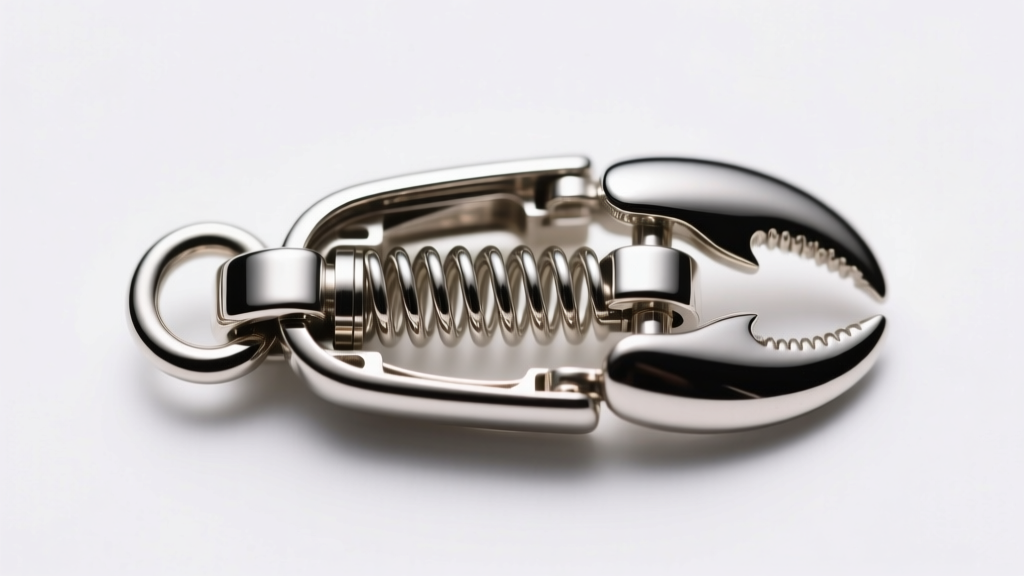
The Hidden Danger: Spring Rings and Lobster Clasps
Here is where even well-informed patients and jewelry makers fail. You may purchase a verified, solid titanium Cuban link chain, but if it is secured with a standard lobster clasp or spring-ring clasp, the necklace is MR Unsafe.
The internal mechanism of these clasps relies on a tiny tension spring. Because titanium and precious metals do not possess the necessary spring-back memory for repeated mechanical compression, manufacturers almost universally use martensitic stainless steel or high-carbon steel for the spring component. Martensitic steel is highly ferromagnetic. When exposed to a 1.5T or 3T field, this microscopic spring will experience immense torque, potentially snapping the clasp, pinching the skin, or acting as a focal point for RF-induced arcing (sparking) right at the base of the patient's neck.
Safe Clasp Alternatives
To maintain an unbroken MR-safe chain, the clasp must contain zero ferromagnetic components and rely on mechanical friction or gravity rather than spring tension. Safe alternatives include:
- Titanium Toggle Clasps: A solid titanium bar that passes through a solid titanium ring. No springs, no magnetic risk.
- Magnetic Clasps (Neodymium): WARNING. While secure, neodymium magnets will distort the local magnetic field and are strictly prohibited in the MRI bore.
- Screw-Thread Barrels: Machined from the same material as the chain, these twist together and contain no internal steel springs.
- Continuous Welded Loops: The safest option for men who never remove their chains. The chain is slipped over the head and the links are permanently welded shut with a laser, eliminating the clasp entirely.
MRI Tech Perspectives: Artifacting and Image Distortion
Even if a necklace is deemed "MR Safe" from a physical injury standpoint, radiologists may still demand its removal due to susceptibility artifacts. Metals, even paramagnetic ones like titanium, have a different magnetic susceptibility than human tissue. This discrepancy causes local distortions in the B0 magnetic field.
If a patient is undergoing an MRI of the cervical spine, thyroid, or brain, a titanium necklace resting on the clavicle will cause "signal voiding" and spatial distortion in the surrounding voxels. This artifacting can obscure micro-fractures, herniated discs, or small lesions in the lower neck. According to the Radiological Society of North America (RSNA), any metal within 15 centimeters of the imaging field of view risks degrading the diagnostic value of the scan. Therefore, while a titanium chain won't burn you, it may force the technician to reschedule your scan or result in an inconclusive diagnosis.

Safe Alternatives for the "Never Take It Off" Guy
For men who wear necklaces for medical alert purposes, psychological comfort, or religious reasons, finding a viable solution for the MRI suite requires stepping away from traditional metal chains. The FDA and ACR consistently advise that the safest approach is complete removal of all jewelry, but if a medical ID is mandatory, consider these engineered alternatives:
- Silicone Paracord with a Titanium Dog Tag: High-tensile silicone cord contains zero metal and does not conduct RF energy. Paired with a laser-engraved ASTM F136 titanium pendant and a silicone tension-loop fastener, this provides a completely MR-safe medical alert necklace.
- PEEK (Polyether Ether Ketone) Chains: PEEK is a high-performance, radiolucent thermoplastic used in spinal implants. Some specialized jewelers now machine men's chains from PEEK, offering the heavy, linked aesthetic of a Cuban chain with zero metallic properties.
- Carbon Fiber Links: Woven carbon fiber is non-magnetic and highly resistant to RF heating. However, ensure the connecting jump rings are also titanium, as cheap carbon fiber jewelry often uses plated brass or steel connectors.
Final Verdict: Should You Risk It?
The concept of a universal "man mri necklace" that allows you to walk seamlessly into a 3T scanner wearing heavy metal is largely a myth perpetuated by jewelry marketers who misunderstand MRI physics. While implant-grade titanium with a welded or toggle clasp is physically safe from burns and projectile risks, the resulting image artifacting will likely ruin any scan focused on the head, neck, or upper thorax.
The most actionable advice for 2026? Invest in a high-quality, laser-welded permanent titanium chain for daily wear, but keep a secondary, medical-grade silicone ID band in your wallet for the inevitable day you end up in the radiology department. Always disclose any jewelry to your MRI technologist before entering the scanner room, and consult the FDA's MRI Safety Guidelines for the most up-to-date regulatory standards on metallic implants and accessories.


