The Ultimate Necklace Sizing Chart and Layering Guide
Discover how to use a necklace sizing chart to perfect your layering game. Explore exact lengths, neckline pairings, and 2026 pendant trends.


Finding the perfect necklace length is rarely as simple as picking a number off a tag. Whether you are investing in a heavy 14k gold rope chain or curating a delicate mixed-metal stack, understanding how a chain interacts with your unique anatomy is the cornerstone of modern jewelry styling. In 2026, the shift toward 'quiet luxury' and intentional, proportion-driven styling means that guessing your chain length is no longer acceptable. A millimeter of difference can transform a sophisticated matinee drop into a restrictive, uncomfortable collar.
This comprehensive guide decodes the mechanics of jewelry proportions. By mastering the data behind a professional necklace sizing chart, you will learn how to calculate exact layering gaps, match chain drops to specific garment necklines, and troubleshoot the physics of heavy pendants.
The Anatomy of a Perfect Fit: Why Standard Lengths Fail
The jewelry industry relies on standard length increments—typically 14, 16, 18, 20, 22, and 24 inches. However, these measurements assume a baseline neck circumference of 13.5 inches and a standard torso drop. According to ergonomic data cited by the Gemological Institute of America (GIA), the average adult female neck circumference ranges from 13 to 14.5 inches, while male circumferences often range from 15 to 17 inches.
If your neck measures 15 inches, a standard 16-inch choker will leave only one inch of ease, resulting in a restrictive fit that sits high on the thyroid cartilage rather than resting gracefully on the clavicle. Conversely, a 14-inch collar on a 13-inch neck will act as a tight choker. The golden rule of necklace sizing is the 'Two-Finger Rule': you should always be able to comfortably slide two fingers between your skin and the chain at the nape of your neck. For individuals with broader shoulders or longer torsos, a chain that is marketed as a 24-inch matinee may fall closer to the sternum rather than the mid-chest, fundamentally altering the visual weight of the piece.
The Master Necklace Sizing Chart
Use this definitive chart as your baseline. Note that the 'Fall Point' is calculated based on an average 14-inch neck and standard female torso proportions. Always adjust your target length up by 1 to 2 inches if you have a larger neck circumference or broader shoulders.
| Length (Inches) | Industry Name | Visual Fall Point | Best Neckline Pairing | Ideal Chain Gauge |
|---|---|---|---|---|
| 14" - 15" | Collar / Choker | Base of the neck | Off-the-shoulder, V-neck | 18g - 16g (2mm+) |
| 16" - 17" | Princess (Short) | Top of the clavicle | Scoop neck, Boat neck | 22g - 18g |
| 18" - 19" | Princess (Standard) | Below the collarbone | Crew neck, Button-down | 22g - 16g |
| 20" - 22" | Matinee (Short) | Top of the bustline | Deep V, Turtleneck | 18g - 14g |
| 24" - 26" | Matinee (Long) | Center of the bust | High-neck, Evening wear | 16g - 12g |
| 28" - 36" | Opera / Rope | Below the bust / Navel | Minimalist sheaths, Gowns | 20g - 14g |
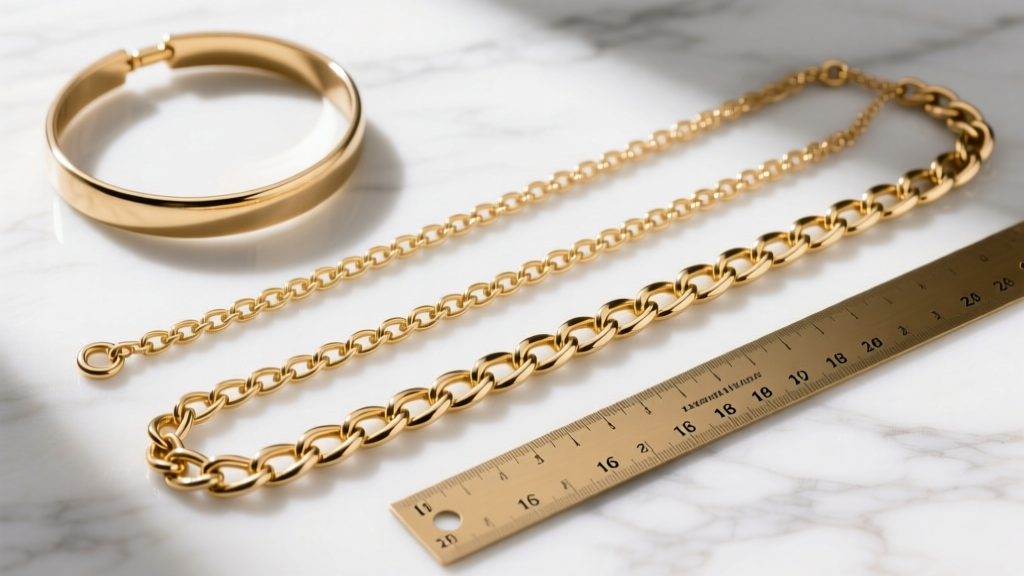
Neckline Pairings: Matching Chain Drops to Collars
A necklace should never compete with the structural lines of your garment; it should frame them. The geometry of your neckline dictates the required chain drop.
The Choker and Princess Length Sweet Spot
For boat necks and wide scoop necks, the horizontal line of the garment demands a contrasting vertical or tight horizontal element. A 15-inch collar or a 16-inch princess chain sits entirely above the fabric line, drawing the eye upward to the face. Avoid 18-inch chains with boat necks, as the chain will awkwardly bisect the collarbone just where the fabric begins, creating visual clutter.
Matinee and Opera Lengths for High Fashion
Turtlenecks and high mock-necks require length to break up the expanse of fabric. A 24-inch matinee chain in a 14k yellow gold herringbone weave provides a striking contrast against dark, heavy knits. According to styling guidelines featured in Blue Nile's Education Center, pairing a heavy pendant on a 24-inch chain over a turtleneck elongates the torso, creating a slimming vertical illusion that shorter chains completely fail to achieve.
Layering Mechanics: Calculating the 2-Inch Rule
The most common failure in multi-chain styling is tangling, which occurs when chains of similar lengths and weaves overlap. To achieve a flawless layered look in 2026, you must adhere to the 'Two-Inch Rule'—the minimum length gap required between chains to prevent the links from catching on one another.
- Cable and Curb Chains: These weaves have open, rounded links. A strict 2-inch gap (e.g., layering a 16-inch with an 18-inch) is sufficient to prevent tangling, provided the gauge difference is at least 2 sizes (e.g., a 22-gauge 16" chain with an 18-gauge 18" chain).
- Snake and Box Chains: These feature tight, interlocking geometric plates. Because they act almost like solid ribbons of metal, they generate high surface friction. You need a minimum 3-inch gap when layering snake chains to allow them to move independently without twisting together.
- Herringbone Chains: Highly fluid but prone to kinking. Never layer two herringbone chains. Always anchor a herringbone with a rigid cable or rope chain, maintaining a 2.5-inch gap.
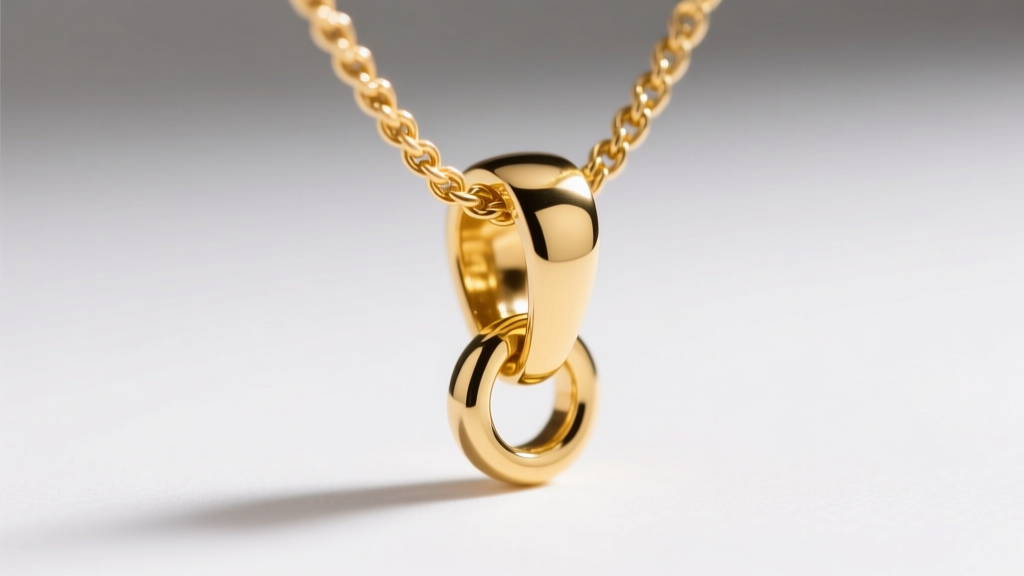
Pendant Proportions and Bail Sizing
A necklace sizing chart is useless if your pendant ruins the drape of the chain. The physics of jewelry dictate that the chain must be heavy enough to support the pendant without the clasp migrating to the front of your neck—a frustrating phenomenon known as 'the pendant flip.'
To prevent this, calculate the weight ratio. Your chain should weigh at least 60% to 75% of the total pendant weight. If you are hanging a 10-gram solid gold signet pendant, a flimsy 2-gram 22-gauge cable chain will fail. You need a 3mm to 4mm rope or Figaro chain weighing at least 7 grams to act as a counterbalance.
Furthermore, pay strict attention to bail dimensions. A standard cast bail has an inner opening of roughly 4mm x 6mm. If you attempt to thread this onto a 5mm Cuban link chain, the bail will catch, bend, or fail to slide past the soldered links. Always measure the inner diameter of the bail, not the outer dimensions, and ensure your chain's widest point is at least 1mm smaller than the bail's inner width.
Troubleshooting Common Sizing Failures
Even with a perfect necklace sizing chart, real-world wear introduces variables. Here is how to troubleshoot the most common mechanical and aesthetic failures:
The Pinching Herringbone: Flat-lay chains like herringbone and omega conform tightly to the skin. If your chain is sized too short (less than 1.5 inches of ease), it will act like a tourniquet, pinching fine neck hairs and restricting swallowing. Always add a 2-inch extender chain to flat weaves.
Clasp Migration: If your clasp constantly slides to the front of your neck, your chain is too light for the pendant, or the chain is too long, allowing the pendant to slide up the 'V' of the drop. Fix this by having a bench jeweler add a small, 1-gram decorative counter-bead directly opposite the clasp at the nape of the neck. Custom sizing and soldering from a professional jeweler typically costs between $35 and $85 per joint, a worthy investment for a high-karat piece.
The Extender Chain Trap: While 2-inch extender chains offer sizing flexibility, they ruin the drape of chains heavier than 14-gauge. The dangling tail of the extender will catch on clothing and pull the clasp askew. For heavy chains, always opt for custom sizing to your exact neck measurement rather than relying on mass-produced extenders.
By treating your jewelry wardrobe with the same precision as tailored clothing, you elevate your daily styling from accidental to intentional. Use this chart, measure your own anatomy, and build a collection that fits flawlessly.


