Troubleshooting a Peach Moonstone Necklace: Care & Repair Guide
Is your peach moonstone necklace cloudy or scratched? Learn expert troubleshooting tips to clean, restore adularescence, and repair settings safely.

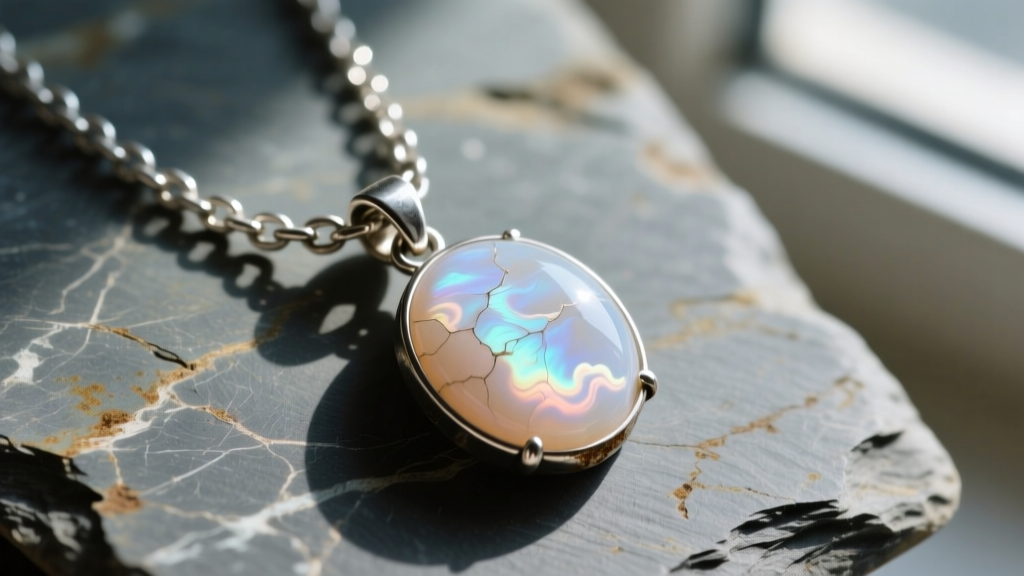
A peach moonstone necklace is a captivating piece of jewelry, prized for its warm, ethereal glow and soothing pastel hues. However, because moonstone belongs to the feldspar mineral group, it presents a unique set of vulnerabilities. Many owners eventually face a common crisis: their once-luminous pendant suddenly looks like a dull, cloudy piece of chalk, or the stone develops mysterious surface scratches. If you are dealing with a loss of shine, structural chips, or setting failures, this comprehensive troubleshooting guide will help you diagnose and resolve the issue.
The Cloudiness Crisis: Restoring Lost Adularescence
The most frequent complaint regarding a peach moonstone necklace is a sudden loss of its signature glow. This optical phenomenon, known as adularescence (or the Schiller effect), is caused by light scattering between alternating microscopic layers of orthoclase and albite feldspar. According to the Gemological Institute of America (GIA), when the surface of the cabochon becomes coated with body oils, hard water minerals, or lotion residue, light can no longer penetrate the dome to refract through these internal layers. The stone isn't permanently damaged; it is simply suffocating under a microscopic film.
Step-by-Step Deep Cleaning Protocol
Do not reach for commercial jewelry dips or ultrasonic cleaners. The high-frequency vibrations of an ultrasonic machine can exploit moonstone's natural cleavage planes, causing internal fractures. Instead, follow this lapidary-safe cleaning method:
- Prepare the Solution: Mix 1 part unscented, mild liquid castile soap (like Dr. Bronner's Baby Unscented) with 10 parts distilled water. Avoid tap water, as chlorine and calcium deposits will worsen the cloudiness.
- Soak Briefly: Submerge the pendant for exactly 3 to 5 minutes. Prolonged soaking can degrade the epoxy used in some glued bezel settings.
- Agitate Gently: Use an extra-soft baby toothbrush to lightly sweep the surface of the stone and the crevices of the bail. Never apply heavy pressure.
- Rinse and Dry: Rinse under a slow stream of distilled water. Immediately pat dry with a clean, lint-free microfiber cloth. Air-drying will leave water spots that mimic cloudiness.
Scratch and Chip Troubleshooting
Peach moonstone registers between 6 and 6.5 on the Mohs hardness scale. Furthermore, Mindat.org notes that feldspar minerals possess 'perfect cleavage' in one direction, meaning they can split cleanly along specific crystallographic planes if struck at the wrong angle. If your necklace has been stored loosely in a jewelry box alongside quartz or diamonds, surface abrasions are inevitable.
Assessing the Damage
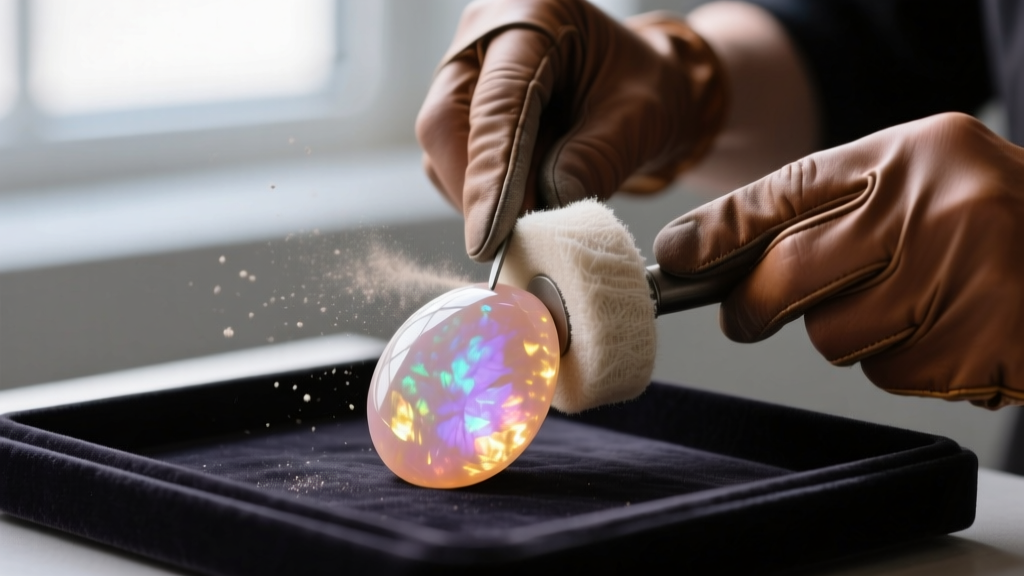
- Micro-scratches (Surface Haze): If the stone feels slightly rough but has no deep gouges, a professional jeweler can re-polish the cabochon dome using a soft muslin wheel and cerium oxide or tin oxide compound. This removes a microscopic layer of the stone, restoring the smooth optical surface required for adularescence.
- Deep Gouges: Scratches that catch your fingernail require a full re-cut and re-polish by a skilled lapidary artist. Be aware that this will slightly reduce the carat weight and alter the stone's dimensions, potentially requiring a new setting.
- Edge Chips: If the stone has chipped near the drill hole or the girdle edge, the structural integrity is compromised. The stone must be removed from the setting and re-cabbed to grind away the fracture line before it spreads.
Setting Failures: Prongs vs. Wire Wraps
Because of its cleavage vulnerability, peach moonstone is rarely set in traditional high-prong settings. You will usually find it in bezels, semi-bezels, or wire-wrapped harnesses. If your stone feels loose, the troubleshooting approach depends on the mounting style.
Wire-Wrapped Settings: Sterling silver and gold-filled wires work-harden over time but can bend if snagged on clothing. If the stone rattles, do not use standard metal pliers to tighten the wire, as the steel teeth will permanently gouge the soft silver. Instead, use nylon-jaw pliers to gently squeeze the structural frame and tighten the bail loops. If the wire has fatigued and snapped at a stress point, the entire harness must be replaced by a wire-wrapping artisan.
Bezel Settings: If a stone is sliding out of a solid metal bezel, the metal rim has likely been stretched or bent outward. A jeweler must use a bezel pusher or a small chasing hammer to carefully burnish the metal rim back over the girdle of the moonstone, ensuring even pressure to avoid cracking the stone.
Authentication Matrix: Real vs. Imitation
Before investing time and money into repairing or re-polishing your necklace, you must verify its authenticity. The market is flooded with 'opalite'—a manufactured glass that mimics the pastel hues of peach moonstone. If your stone is glass, it cannot be re-polished using lapidary compounds designed for feldspar, and it holds virtually no resale value.
| Diagnostic Feature | Genuine Peach Moonstone | Glass / Opalite Imitation |
|---|---|---|
| Adularescence | Directional; the glow shifts and floats as the stone is rotated under a single light source. | Static; the milky glow is uniform and does not shift dynamically with rotation. |
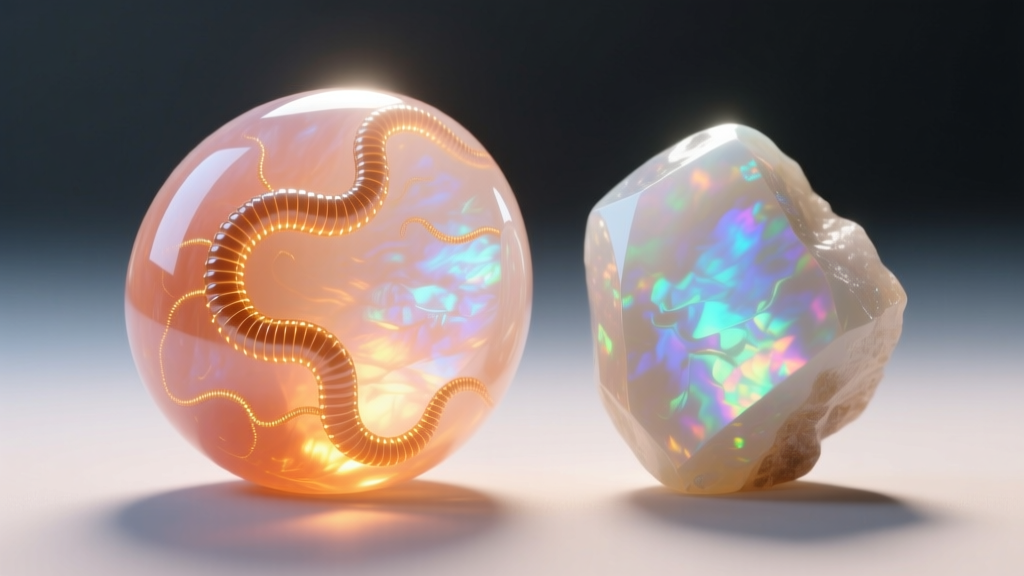
| Inclusions | Often contains 'centipedes' (tension cracks) or tiny dark mineral inclusions visible under 10x magnification. | Completely flawless, or contains perfectly spherical gas bubbles from the manufacturing process. |
| Temperature | Feels distinctly cool to the touch and takes longer to warm up against the skin. | Feels closer to room temperature and warms up almost instantly in the hand. |
| Refractive Index (RI) | 1.520 - 1.525 (Measured via refractometer) | 1.500 - 1.510 (Standard manufactured glass) |
Preventative Maintenance Framework
Once you have restored your peach moonstone necklace, implementing a strict preventative framework will extend the life of the cabochon and the metalwork. Adopt the 'Last On, First Off' rule: your necklace should be the final item you put on after applying perfumes, hairsprays, and cosmetics, and the first item you remove upon returning home.
For storage, never drop your necklace into a communal jewelry box. Moonstone is easily scratched by harder gemstones like sapphire, topaz, or even quartz dust. Store the necklace flat in a dedicated, anti-tarnish flannel pouch. If the necklace features a sterling silver chain, include a silica gel packet and a 3M anti-tarnish strip in the storage pouch to prevent silver sulfide buildup, which can transfer dark tarnish to the porous edges of the moonstone over time. By understanding the mineralogical quirks of feldspar, you can ensure your peach moonstone necklace retains its captivating, otherworldly glow for decades.


