Expert Guide to the Pegasus Necklace: Metals, Casting & Care
Discover the technical artistry behind the pegasus necklace. Explore casting methods, metal grades, wing articulation, and expert care tips.

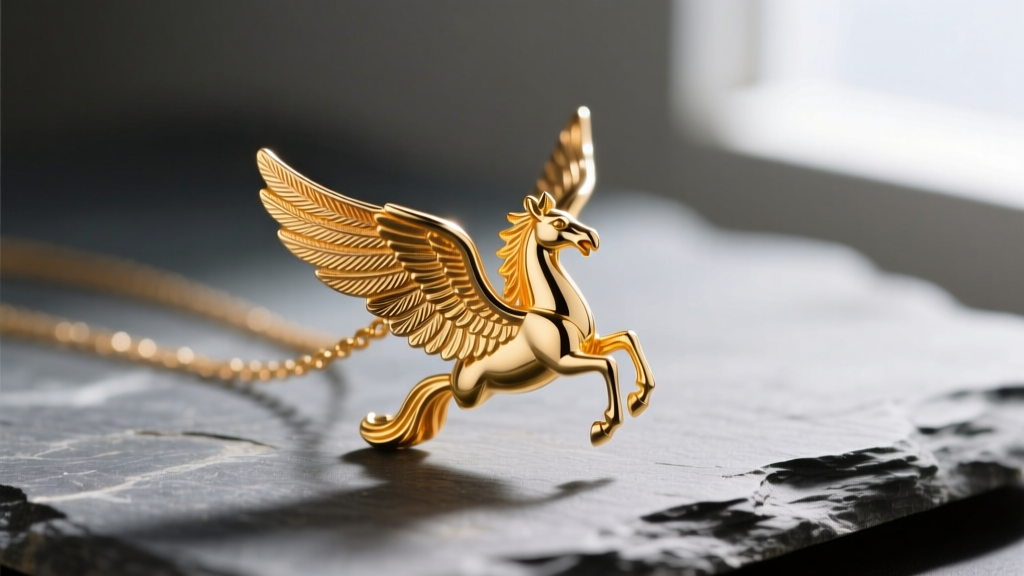
The Pegasus motif has captivated jewelry designers for centuries, symbolizing poetic inspiration, freedom, and divine ascent. However, translating the dynamic anatomy of a winged horse into a wearable, durable piece of fine jewelry requires far more than artistic vision. As a cornerstone of mythological jewelry, the pegasus necklace demands rigorous metallurgical planning, precise casting techniques, and structural engineering—especially when incorporating kinetic elements like articulated wings. In this expert deep dive, we deconstruct the technical artistry behind crafting a high-end pegasus pendant, exploring alloy selection, mechanical tolerances, and long-term wearability.
The Anatomy and Lost-Wax Casting Process
Creating a masterwork pegasus necklace begins with the model. While modern jewelers frequently utilize high-resolution DLP 3D resin printers capable of 25-micron layer thicknesss, traditional hand-carved wax models still yield the most organic musculature and feather textures. The critical challenge in casting a winged horse is managing the extreme variance in cross-sectional thickness. The torso of the Pegasus may be 4mm thick, while the tips of the primary flight feathers taper to less than 0.5mm.
According to casting experts at Ganoksin, this drastic variance creates a high risk for localized porosity and incomplete fills (shrinkage voids) during the cooling phase. To mitigate this, master casters employ strategic spruing—attaching thin wax channels to the thickest parts of the horse's body to act as a molten metal reservoir. The burnout temperature of the investment mold must also be tightly controlled; for sterling silver, the flask is typically held at 1350°F, while 18k gold requires flask temperatures closer to 1100°F to ensure the molten alloy flows into the microscopic feather barbs before solidifying.
Metallurgical Choices: Alloys and Hardness
The choice of metal dictates not only the aesthetic but the structural integrity of the pegasus necklace, particularly at the fragile wing joints and the bail. The Gemological Institute of America (GIA) notes that pure gold is far too soft for intricate, high-wear pendants, necessitating specific alloy blends to achieve the required Vickers hardness (HV).
| Metal Alloy | Composition | Hardness (HV) | Tarnish Resistance | Best Application |
|---|---|---|---|---|
| Sterling Silver | 92.5% Ag, 7.5% Cu | 65 - 75 | Low (Prone to oxidation) | Highly detailed, oxidized vintage finishes |
| 14k Yellow Gold | 58.5% Au, Ag/Cu/Zn | 110 - 130 | High | Everyday wear, kinetic wing hinges |
| 18k Yellow Gold | 75% Au, Ag/Cu | 90 - 115 | High | Luxury heirlooms, rich color depth |
| Platinum 950/Ru | 95% Pt, 5% Ru | 130 - 150 | Excellent | Heavy, ultra-durable micro-pavé settings |
For a pegasus necklace featuring micro-pavé diamonds along the wings, Platinum 950/Ruthenium is the superior choice. Its high tensile strength allows for microscopic prongs that secure stones without obscuring the feather detailing, while its natural white luster eliminates the need for rhodium plating.
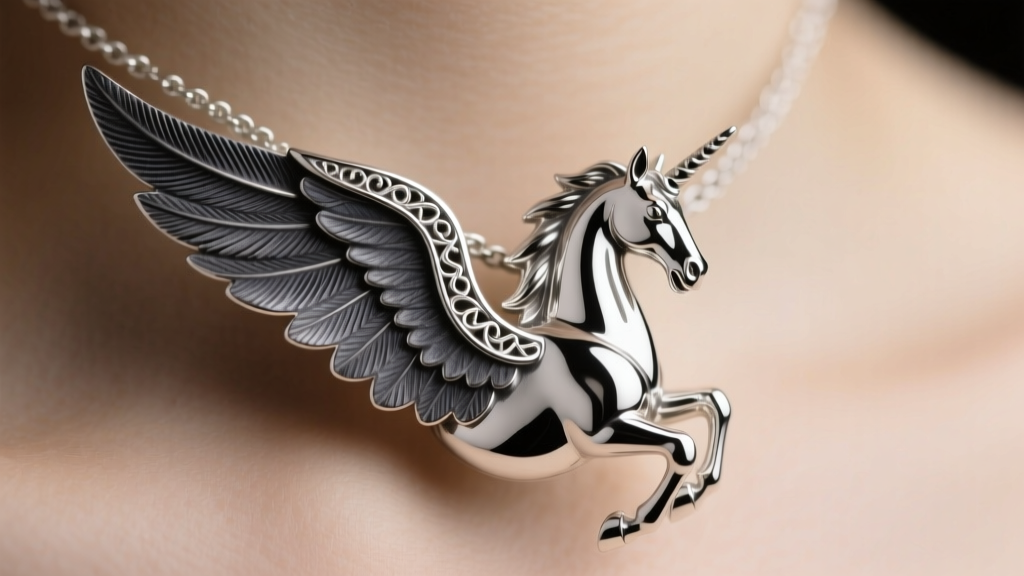
Kinetic Engineering: Articulated Wings
The most coveted pegasus necklaces feature articulated wings that fold and unfold. Engineering these kinetic joints requires microscopic precision. Jewelers typically use cold connections rather than solder for moving parts, as solder would fuse the joints solid.
Rivets vs. Jump Rings
- Micro-Rivets: Using 0.6mm to 0.8mm wire, the artisan drills a precise hole through the wing base and the horse's shoulder. The wire is inserted, cut flush, and peened with a micro-hammer. This creates a permanent, low-profile hinge. The tolerance gap between the wing and the body must be exactly 0.15mm to allow movement without lateral wobble.
- Flush Jump Rings: For slightly thicker designs, a 1.2mm inner-diameter jump ring can be used. However, the ring must be work-hardened and closed with a seamless flush cut to prevent the wing from catching on clothing and pulling the joint apart.
Failure Mode Warning: The most common point of failure in kinetic pegasus pendants is metal fatigue at the hinge point. Repeatedly folding the wings back and forth will eventually cause a standard silver or 18k gold rivet to snap. For kinetic pieces, 14k gold or hardened platinum alloys are strongly recommended for the hinge wire.
Chain Pairing: Gauge, Weave, and Tensile Strength
A fully cast, solid 18k gold pegasus pendant of moderate size (approx. 25mm x 20mm) will weigh between 8 and 14 grams. Pairing this with an inadequate chain is a frequent consumer error that leads to catastrophic chain failure. The chain must possess a tensile strength rating that exceeds the pendant's weight by a factor of at least five to account for dynamic shock loads (e.g., the pendant swinging and suddenly stopping).
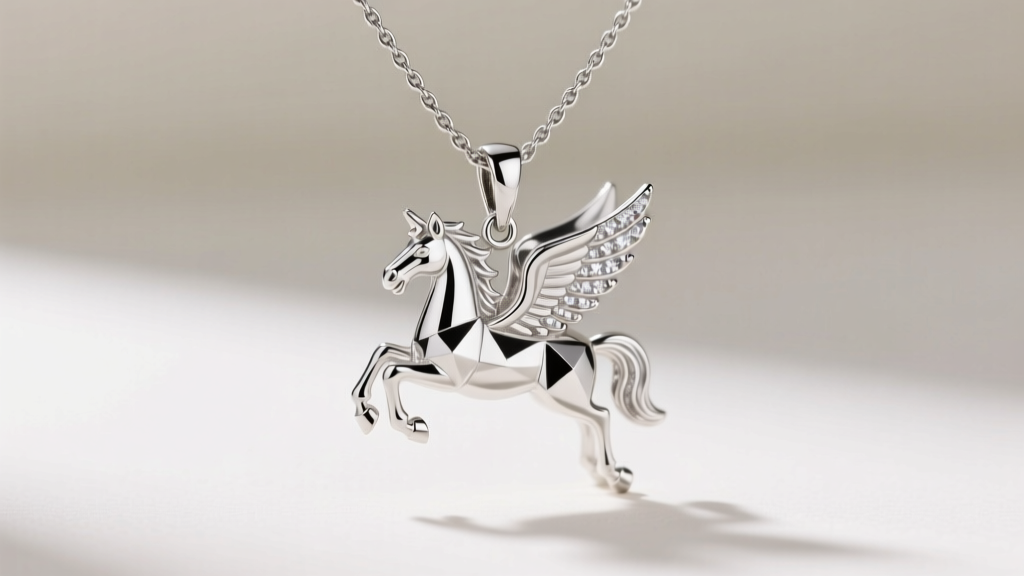
For a 12-gram pendant, avoid delicate cable or box chains under 1.5mm. Instead, opt for the following structural weaves:
- Rope Chain (2.5mm - 3.5mm): The twisted links distribute weight evenly and offer exceptional tensile strength. The spiral structure also complements the organic curves of the Pegasus motif.
- Figaro or Curb Chain (3.0mm): Flat-lying and highly durable, these chains provide a masculine or bold foundation that prevents the heavy pendant from flipping upside down during wear.
Furthermore, the bail (the loop connecting the pendant to the chain) must be engineered with an inner diameter at least 1mm larger than the chain's outer width to ensure smooth articulation and prevent abrasive wear on the chain links.
Surface Finishes and Patina Enhancement
To maximize the visual depth of the Pegasus's plumage, jewelers employ chemical patination. For sterling silver and copper-alloyed golds, liver of sulfur (potassium sulfide) is applied to darken the recessed areas of the feathers and musculature. After the dark oxidation sets, the high-relief areas are polished with a rouge wheel, creating a striking two-tone contrast that makes the anatomical details pop. For white gold pegasus necklaces, a final flash of rhodium plating is applied via electroplating to ensure a brilliant, scratch-resistant, and tarnish-proof surface.
Investment Tiers and Market Pricing
Understanding the technical execution helps contextualize the pricing of a pegasus necklace in the current market:
- Mass-Market / Cast from Stock Molds ($80 - $250): Typically die-struck or cast in thin-walled sterling silver. Details are often muddy, wings are static, and chains are lightweight and prone to breaking.
- Boutique Artisan / Custom Cast ($600 - $1,800): Hand-finished 14k or 18k gold pieces. Features hand-engraved feather textures, properly engineered kinetic hinges, and heavy, reliable chains.
- High Jewelry / Master Goldsmith ($4,000+): Platinum or high-karat gold, featuring micro-pavé diamond setting, invisible articulation mechanisms, and bespoke, hand-forged chain weaves.
When investing in a pegasus necklace, always scrutinize the hinge mechanics, the spruing marks (which should be entirely filed away), and the clasp security. A masterfully engineered piece will not only serve as a stunning mythological talisman but will endure as a structurally sound heirloom for generations.


