Rice Pearl Necklace Guide: Nacre, Luster & Material Grades
Compare natural, cultured, and imitation rice pearl necklace materials. Learn about nacre thickness, luster grades, and stringing durability.

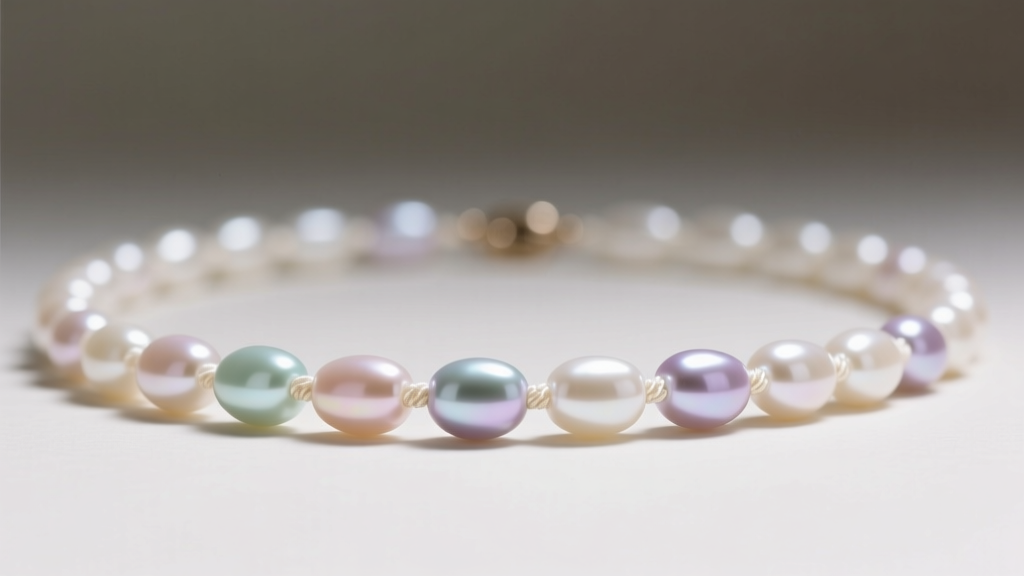
When shopping for a rice pearl necklace, the untrained eye might only see a strand of charming, elongated gems. However, as a jewelry material specialist, I look at the microscopic aragonite platelets, the conchiolin binding matrix, and the structural integrity of the stringing medium. The term 'rice pearl' refers strictly to the shape—a baroque, elongated form typically measuring 2-4mm in width and 5-9mm in length. But the material composition of these pearls, and the materials used to string them, vary wildly across the market.
In this comprehensive material guide, we will deconstruct the physical properties of freshwater cultured rice pearls, compare them against common imitations, and evaluate the stringing materials that dictate the necklace's lifespan and drape.
The Anatomy of a Rice Pearl: What Defines the Material?
Unlike traditional round Akoya or South Sea pearls, which are bead-nucleated (meaning a round shell bead is inserted into the oyster and coated with a thin layer of nacre), high-quality freshwater rice pearls are tissue-nucleated. A tiny piece of mantle tissue from a donor mussel is inserted into the host mussel.
This biological process results in a pearl that is 100% solid nacre. There is no inner shell bead. The material is composed entirely of microscopic crystalline aragonite platelets held together by an organic protein called conchiolin. This solid-nacre construction gives authentic freshwater rice pearls exceptional durability and a deep, glowing luster that originates from within the entire volume of the gem, rather than just its surface.
Material Showdown: Freshwater Cultured vs. Imitation Glass

The market is flooded with imitation rice pearls, often sold under deceptive names like 'shell pearls' or 'crystal pearls.' Understanding the material differences is critical for assessing value and longevity.
| Material Property | Cultured Freshwater Rice Pearl | Glass Imitation (Coated) | Plastic Imitation |
|---|---|---|---|
| Core Composition | 100% Solid Nacre (Aragonite) | Lead-free or Leaded Glass | Polystyrene / Acrylic |
| Surface Coating | None (Natural Nacre) | Essence d'Orient / Pearlescent Paint | Molded Pearlescent Paint |
| Specific Gravity | 2.60 – 2.85 | 2.50 – 4.00 (Varies by lead content) | 1.05 – 1.20 |
| Mohs Hardness | 2.5 – 3.0 | 5.5 – 6.0 (Glass core) | 2.0 – 2.5 |
| Luster Origin | Deep refraction through crystal layers | Surface reflection only | Surface reflection only |
As noted by the Gemological Institute of America (GIA), the luster of a real pearl is created by light penetrating the translucent layers of nacre and reflecting back. Imitations merely reflect light off their painted exterior, resulting in a flat, chalky, or overly uniform 'plastic' shine.
Nacre Thickness and Luster Grading in Rice Pearls
Because tissue-nucleated rice pearls are solid nacre, we do not measure 'nacre thickness' in millimeters as we do with bead-nucleated saltwater pearls. Instead, material grading focuses on luster quality and surface cleanliness.
- Gem Grade (AAA): Exceptional luster with sharp, distinct light reflections. The surface is 95%+ clean of blemishes, pits, or chalky spots. The aragonite crystals are perfectly aligned.
- Fine Grade (AA): High luster, but reflections are slightly softer. Minor surface blemishes or subtle 'rings' (growth lines) are visible upon close inspection.
- Commercial Grade (A): Chalky or dull luster due to malformed aragonite crystals. Heavy blemishing, pitting, and visible banding. Often heavily bleached to hide material flaws.
The Tooth Test and Specific Gravity Diagnostics
If you are evaluating a rice pearl necklace in person, rely on material physics rather than visual inspection alone.
The Tooth Test: Gently rub the pearl against the biting edge of your front tooth. Authentic nacre is composed of overlapping crystalline platelets, which feel distinctly gritty or sandy. Glass or plastic imitations, coated with smooth paint, will feel perfectly slick.
Specific Gravity (Density): Real pearls have a specific gravity of roughly 2.70. If the necklace feels suspiciously heavy, it likely features leaded glass cores. If it feels unnaturally light, the cores are plastic.
Stringing Materials: Silk vs. Nylon vs. Beading Wire
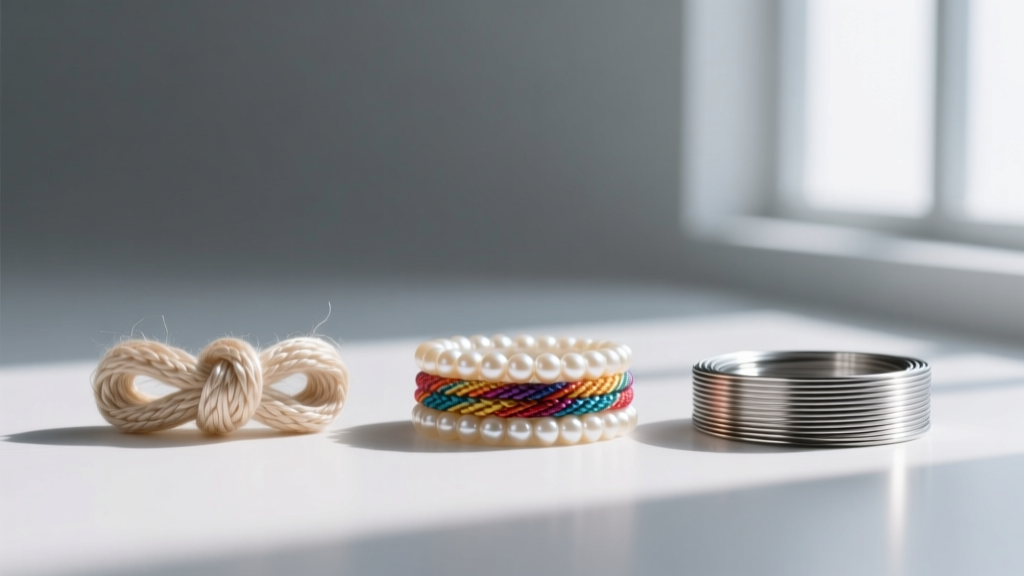
The pearls themselves are only half the material equation. A rice pearl necklace's drape, durability, and failure rate are entirely dependent on the stringing medium. Because rice pearls have small, often irregularly shaped drill holes (typically 0.5mm to 0.8mm), the stringing material must be thin yet possess high tensile strength.
Traditional Silk Thread (Size F or #2)
Historically, pure silk has been the gold standard. For small rice pearls, a Size F or #2 silk thread is used, with a knot tied between every single pearl.
Pros: Unmatched fluid drape; knots prevent pearl-on-pearl abrasion and protect against total loss if the strand breaks.
Cons: Silk is a protein fiber that degrades when exposed to human sweat, cosmetics, and UV light. It stretches over time, leading to unsightly gaps between the pearls. Requires professional restringing every 1-2 years.
Braided Nylon (e.g., Power Pro or Silamide)
Modern synthetic alternatives have largely overtaken silk in professional studios.
Pros: Impervious to water and sweat; zero stretch; incredibly high tensile strength relative to its microscopic diameter.
Cons: Knots can be more difficult to pull tight against the pearl due to the slickness of the synthetic material. Requires a specialized thread conditioner or a drop of flexible jeweler's cement on the knots.
Coated Stainless Steel Beading Wire (e.g., Accu-Flex 0.014")
Some mass-market rice pearl necklaces are strung on multi-strand stainless steel wire coated in nylon.
Pros: Virtually unbreakable under normal wear; requires no knotting, reducing manufacturing costs.
Cons: Never use wire for high-end rice pearls. Wire has 'memory' and stiffness. It prevents the necklace from draping fluidly against the collarbone, causing it to stick out awkwardly. Furthermore, the sharp edges of the rice pearl's drill hole will eventually saw through the nylon coating, exposing the steel to moisture and causing rust.
Pricing Tiers and Market Expectations
Understanding material properties helps contextualize pricing. In the current market, here is what you should expect to pay based on material grade and stringing:
- Imitation / Shell Pearl Strands: $15 – $40. (Glass core, painted surface, strung on cheap nylon).
- Commercial Grade Freshwater (A): $45 – $90. (Chalky luster, heavily blemished, often bleached, strung on unknotted wire).
- Fine Grade Freshwater (AA): $120 – $250. (Good luster, minor blemishes, knotted on silk or nylon).
- Gem Grade Freshwater (AAA): $300 – $600+. (Mirror-like luster, pristine surfaces, hand-knotted on premium silk with a solid 14k gold clasp).
Care and Material Degradation
Nacre is an organic-inorganic composite material, making it highly susceptible to chemical degradation. With a Mohs hardness of just 2.5 to 3.0, rice pearls are softer than a copper coin and will easily scratch if stored alongside diamond or quartz jewelry.
More importantly, the calcium carbonate in the aragonite crystals reacts violently with acids. According to the GIA Pearl Care Guidelines, everyday substances like perfume, hairspray, and even the natural lactic acid in human sweat can etch the surface of the nacre, permanently dulling the luster and creating a chalky, white powdery residue.
Actionable Care Protocol: Always apply cosmetics and perfumes at least 10 minutes before putting on your rice pearl necklace. After wearing, wipe the strand gently with a damp, lint-free microfiber cloth to remove acidic skin oils before storing it in a breathable cotton pouch—never in an airtight plastic bag, which can trap moisture and accelerate the degradation of the silk stringing material.


