Ultimate Guide to Cleaning and Caring for a Titanium Necklace
Learn how to clean, maintain, and restore your titanium necklace. Expert tips on removing dirt, protecting anodized finishes, and daily care.

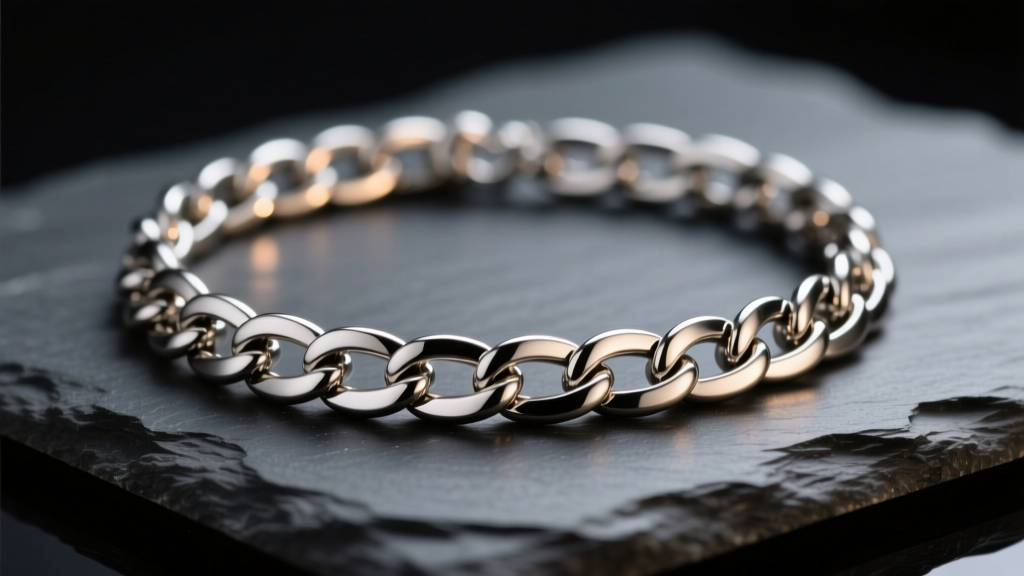
The Metallurgy of Your Titanium Necklace
When investing in high-quality, hypoallergenic jewelry, understanding the exact material composition is the first step toward proper maintenance. A titanium necklace is not a monolith; it is typically crafted from one of two distinct metallurgical grades. The most common is Commercially Pure (CP) Grade 2 titanium, prized in the jewelry industry for its exceptional biocompatibility and high ductility, making it ideal for intricate chain links and lightweight pendants. Conversely, heavy-duty clasps, men's dog tags, and structural tension-settings often utilize Grade 5 titanium (Ti-6Al-4V), an alloy blended with aluminum and vanadium that boasts a tensile strength nearly four times greater than CP Grade 2.
Knowing which grade you own dictates your polishing approach. While both grades share the same fundamental resistance to corrosion, Grade 5 requires more aggressive, specialized compounds to remove surface scratches due to its increased hardness on the Mohs scale.
The Passivation Layer: Why Titanium Resists Tarnish
Unlike sterling silver, which reacts with sulfur in the air to form black silver sulfide, or copper alloys that develop a green patina, titanium is inherently immune to traditional tarnish. According to the International Titanium Association, the moment raw titanium is exposed to oxygen, it instantly forms a microscopic, invisible shield of titanium dioxide (TiO2). This passivation layer is what makes your titanium necklace entirely impervious to saltwater, sweat, and UV degradation.
However, this does not mean your necklace will never look dull. The TiO2 layer is highly porous at a microscopic level. Over months of daily wear, this microscopic texture traps sebum (skin oils), dead epidermal cells, lotions, and environmental dust. What owners often mistake for "tarnish" or "oxidation" on a titanium necklace is actually just a compacted layer of organic grime dulling the metal's natural light refraction. Restoring the shine requires lifting this debris without scratching the underlying oxide layer.
Routine Cleaning Protocol for Unfinished Titanium
For standard, un-anodized titanium chains and polished pendants, a simple surfactant-based cleaning routine is all that is required to restore factory-level brilliance.
Step 1: The Pre-Rinse
Never apply soap directly to a dry chain. First, submerge your titanium necklace in a bowl of warm distilled water. Tap water contains dissolved minerals like calcium and magnesium that can leave microscopic hard-water spots on highly polished titanium surfaces. The warm pre-rinse softens hardened sebum trapped between the chain links.
Step 2: The Surfactant Wash
Apply three drops of a pH-neutral, lotion-free dish detergent (such as original Dawn) to a soft-bristled infant toothbrush or a dedicated jewelry brush. Gently agitate the brush along the length of the chain, paying special attention to the clasp mechanism and the jump ring connecting the pendant. The surfactants will break the surface tension of the oils, lifting them away from the titanium dioxide layer.
Step 3: The Microfiber Dry
Rinse thoroughly under a gentle stream of warm distilled water. Immediately pat the necklace dry with a clean, lint-free microfiber cloth. Air-drying titanium, especially in humid environments, can result in temporary water spotting that requires a secondary buffing to remove.
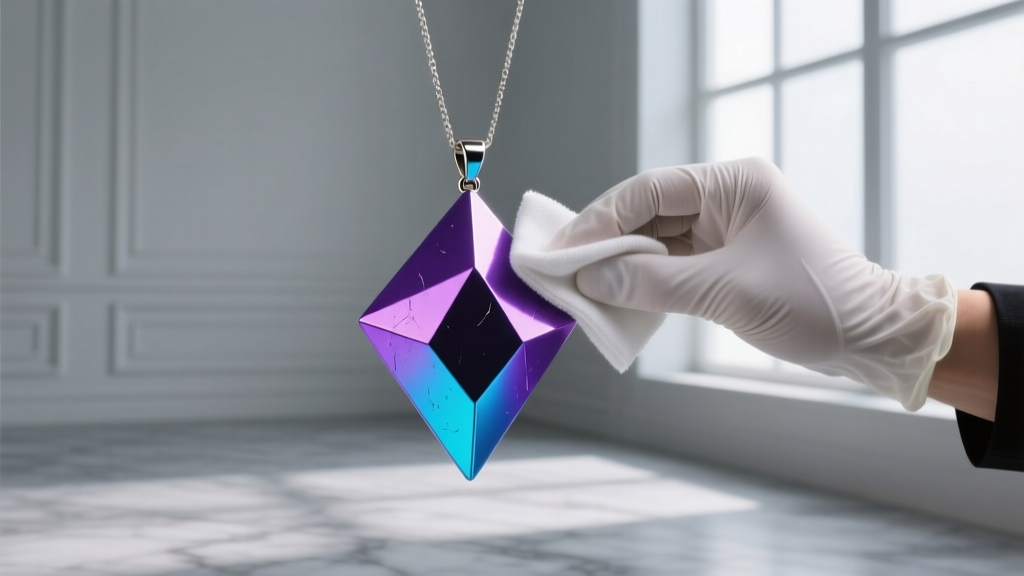
Managing Anodized Titanium Pendants
Anodized titanium requires a drastically different care protocol. Titanium does not accept traditional electroplating (like gold vermeil or rhodium). Instead, it is colored through an anodizing process, where an electrical current is passed through the metal in an electrolyte bath. This voltage-controlled process thickens the TiO2 layer to exact nanometer specifications, causing light interference that produces vivid colors—ranging from 15V (gold) to 90V (vibrant blue) and 110V (purple).
Because the color is an optical illusion created by the thickness of the oxide layer, it is highly susceptible to mechanical abrasion. Never use ultrasonic cleaners on anodized titanium. The high-frequency cavitation bubbles can create microscopic pitting in the oxide layer, resulting in a permanent, cloudy, or "frosted" appearance that destroys the color vibrancy. Furthermore, avoid any polishing pastes, baking soda, or toothpaste, as these mild abrasives will literally sand away the color layer, reverting the metal to its natural gunmetal grey.
To clean an anodized titanium necklace, simply soak it in a mild solution of warm water and a few drops of baby shampoo for five minutes, rinse with distilled water, and gently pat dry. If the color fades over years of wear due to microscopic surface scratching, it must be re-anodized by a professional jeweler using a specialized rectifier.
Chemical Threats: What to Keep Away
While titanium is famously used in aerospace and marine engineering for its corrosion resistance, it is not invincible. Certain specific chemicals will rapidly compromise the structural integrity and finish of your titanium necklace. Refer to the table below for critical chemical warnings:
| Chemical Agent | Effect on Titanium Jewelry | Risk Level |
|---|---|---|
| Hydrofluoric Acid (HF) | Completely dissolves the TiO2 passivation layer and aggressively eats into the base metal. | Critical (Avoid entirely) |
| Concentrated Chlorine / Bleach | Can cause localized pitting and stress corrosion cracking, especially in Grade 5 alloy clasps under tension. | High (Remove before swimming) |
| Hydrochloric Acid (Muriatic) | Causes severe surface etching and permanent dulling of high-polish finishes. | High |
| Acetone / Nail Polish Remover | Harmless to bare titanium, but will strip protective lacquers on mixed-media pendants or damage epoxy resin inlays. | Moderate (Use with caution) |
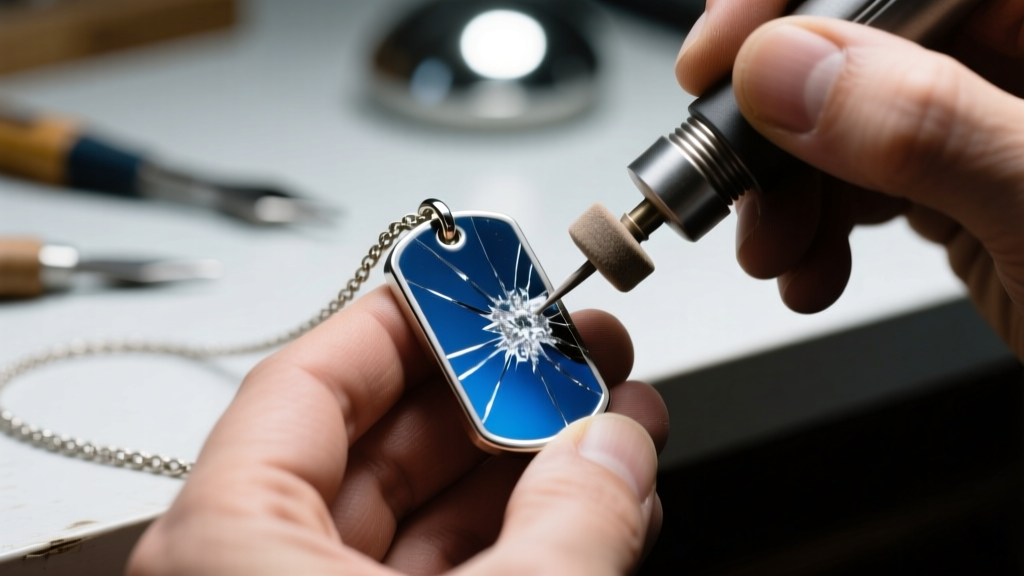
Removing Scratches from Grade 5 Titanium
If your heavy-duty Grade 5 titanium necklace has accumulated deep scratches, standard jewelry polishing cloths (which are impregnated with mild rouge) will be entirely ineffective. Grade 5 titanium sits at roughly a 6 on the Mohs hardness scale, making it significantly harder than silver or gold.
To remove scratches, a jeweler must use a progressive wet-sanding technique followed by specialized abrasive compounds. The process typically begins with 600-grit silicon carbide paper to level the scratch, progressing to 1200 and 2000 grits. The final mirror polish is achieved using a soft cotton buffing wheel loaded with aluminum oxide or synthetic diamond polishing paste (typically 1-micron to 3-micron grit). Attempting to buff deep scratches out of titanium without proper lapidary equipment will result in "orange peel" surface distortion, ruining the flat geometry of the pendant.
Ultrasonic Cleaners and Gemstone Settings
The Gemological Institute of America (GIA) frequently warns consumers about the hidden dangers of ultrasonic cleaners. While bare titanium can easily withstand ultrasonic vibrations, the settings holding your gemstones might not. Titanium is incredibly rigid and lacks the malleability of gold or platinum. Because it cannot be easily bent or prong-adjusted, titanium jewelry often relies on tension settings, bezels, or high-strength aerospace epoxies to secure stones.
The intense, localized heat and high-frequency vibrations generated by an ultrasonic cleaner can weaken epoxy bonds and cause micro-fractures in tension-set gemstones. If your titanium necklace features diamonds, sapphires, or tension-set stones, stick strictly to the manual surfactant wash method outlined above to prevent catastrophic stone loss.
"Titanium's rigidity is its greatest strength in design, but its greatest vulnerability in maintenance. You cannot simply bend a titanium prong back into place if a stone loosens; the metal must be carefully machined or the setting entirely replaced." — Master Bench Jeweler
Long-Term Storage Best Practices
When you are not wearing your titanium necklace, proper storage is essential to prevent mechanical damage. While titanium is hard, it is still softer than diamonds, sapphires, and tungsten carbide. If you toss your titanium chain into a communal jewelry box alongside diamond tennis bracelets or tungsten rings, the harder materials will act like sandpaper, leaving deep, permanent gouges in the titanium.
Always store your titanium necklace in a dedicated, soft-flannel pouch or a separate compartment in a lined jewelry box. Ensure the clasp is fastened to prevent the chain from tangling, and hang pendants vertically if possible to prevent the bail from warping under the weight of the chain over time. With these precise, metallurgically sound care techniques, your titanium necklace will retain its structural integrity and brilliant finish for a lifetime.


