Expert Guide to Buying and Sizing a White Gold Key Necklace
Discover the technical details of buying a white gold key necklace. Learn about karat alloys, rhodium plating, chain gauges, and pendant casting.

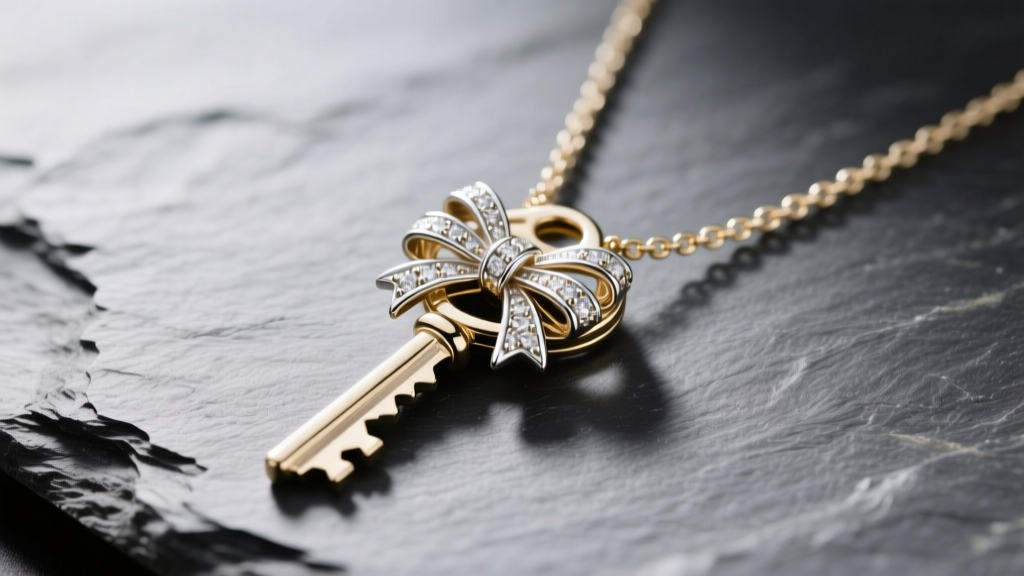
When evaluating a white gold key necklace, most consumers focus solely on the aesthetic appeal of the pendant. However, as a functional piece of jewelry that rests against the sternum and endures constant kinetic friction, the structural integrity and metallurgical composition of the piece are paramount. A key pendant is inherently top-heavy and features deep undercuts in its teeth and bow, making it highly susceptible to specific failure modes if manufactured or paired incorrectly. This expert deep dive dissects the alloy compositions, electroplating standards, chain gauge tensile strengths, and clasp engineering required to ensure your necklace lasts a lifetime.
The Metallurgy of White Gold: Nickel vs. Palladium Alloys
White gold does not exist in nature; it is an alloy created by mixing pure yellow gold with bleaching metals. According to the Gemological Institute of America (GIA), the specific bleaching agents used drastically alter the metal's hardness, color, and hypoallergenic properties. When selecting a white gold key necklace, you must identify the underlying alloy matrix.
- Nickel White Gold (Typically 14k): Composed of 58.5% pure gold mixed with nickel, copper, and zinc. Nickel provides excellent Vickers hardness (approx. 135 HV), making it highly resistant to scratching. However, it possesses a distinct yellowish-gray undertone that requires heavy rhodium plating to appear truly white. Furthermore, nickel is a primary contact allergen, banned in jewelry in the EU under the Nickel Directive.
- Palladium White Gold (Typically 18k): Composed of 75% pure gold alloyed with palladium and silver. This alloy is naturally hypoallergenic and possesses a much whiter base color, requiring less rhodium plating. The trade-off is a lower hardness rating (approx. 110 HV), making it slightly more prone to micro-scratches, though it offers superior malleability for intricate key casting.
Rhodium Plating: Thickness, Wear, and Maintenance
Because white gold alloys are rarely perfectly white, they are electroplated with rhodium, a platinum-group metal. The Federal Trade Commission (FTC) Jewelry Guides mandate that if a piece is rhodium-plated, it must be disclosed, but they do not regulate the micron thickness. This is where mass-market jewelers cut corners.
Expert Rule of Thumb: A key pendant swings and rubs against the chest and chain bail constantly. Flash plating (0.1 to 0.3 microns) will wear through to the yellowish base metal within three to six months. Always demand a minimum plating thickness of 0.75 to 1.0 microns for pendants, and 1.5 microns for the accompanying chain.
If you are purchasing a vintage or antique skeleton key pendant, verify whether the rhodium has worn off the high-contact areas (the bow and the tip of the teeth). Replating a complex 3D key requires meticulous masking and polishing, typically costing between $45 and $85 at a specialized bench jeweler.
Key Pendant Architecture: Casting vs. Stamping
The manufacturing method dictates the pendant's durability and level of detail. Flat, 2D skeleton keys are often die-stamped from sheet metal, resulting in a lightweight, hollow-backed piece that is prone to bending if snagged. Conversely, 3D barrel keys or ornate gothic keys require lost-wax casting.
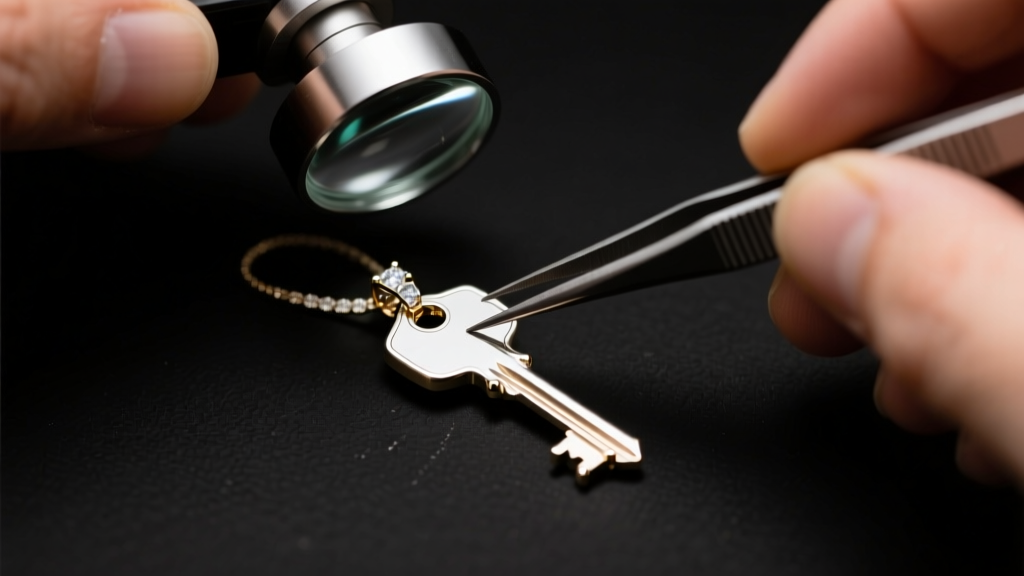
In lost-wax casting, molten gold is injected into a plaster mold. For a key pendant, the jeweler must ensure proper "sprue" placement (the channel where gold enters the mold). If the sprue is attached at the delicate teeth of the key and improperly filed down, it leaves a structural weak point that can snap under tension. Always inspect the edges of the key's teeth with a jeweler's loupe for rough patches or porosity (tiny surface pits caused by trapped gas during casting).
Bail Mechanics and Chain Gauge Compatibility
The bail—the loop connecting the key to the chain—is the most critical stress point. A heavy cast 18k white gold key pendant can easily weigh between 4 and 9 grams. A standard 2mm x 3mm soldered ring bail will cause severe friction wear on both the bail itself and the chain links. For key pendants exceeding 4 grams, a 4mm x 6mm oval or rectangular hinged bail is required to distribute the kinetic load evenly.
| Pendant Weight | Recommended Chain Gauge | Optimal Chain Style | Tensile Risk Factor |
|---|---|---|---|
| Under 3g (Stamped) | 0.9mm - 1.2mm | Cable or Box Chain | Low (if under 2g) |
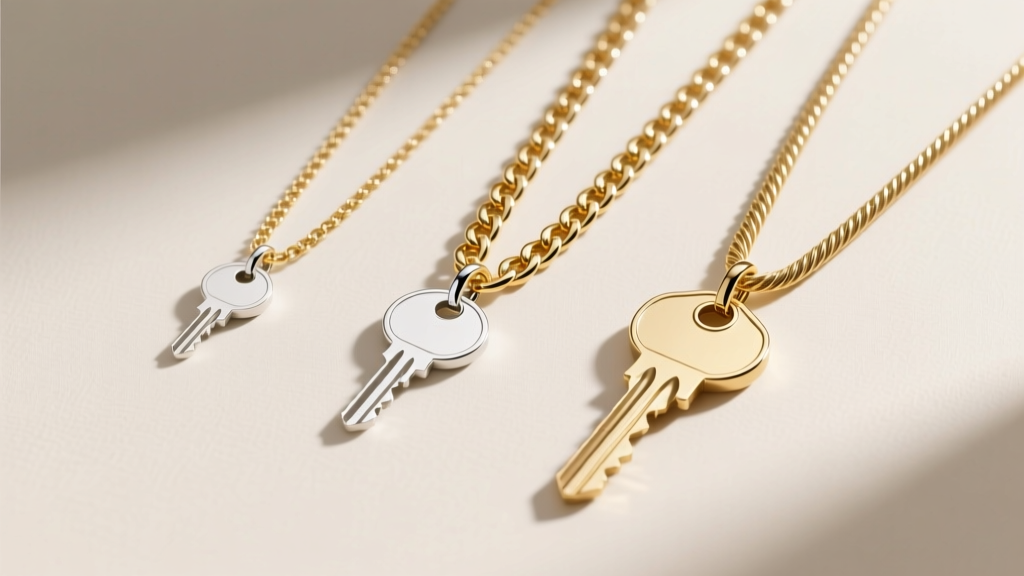
| 3g - 6g (Cast) | 1.5mm - 2.0mm | Curb or Rope Chain | Moderate |
| Over 6g (Heavy Cast) | 2.5mm - 3.5mm | Figaro or Mariner | High (requires thick gauge) |
Clasp Engineering: Securing Heavy Key Pendants
The clasp is the most frequent point of catastrophic failure in necklaces. Mass-market jewelers often pair heavy pendants with lightweight spring-ring clasps to save on gold weight. A standard 5mm spring ring relies on a tiny internal steel spring that will inevitably fail when subjected to the pendulum-like swinging of a heavy key pendant.
For a white gold key necklace, you must insist on a lobster clasp (minimum 9mm for chains under 2.0mm, and 12mm for chains over 2.0mm). Lobster clasps utilize a solid internal mechanism that is vastly superior in shear strength. For chains exceeding 2.5mm, a box clasp with a figure-8 safety catch is the only secure option, providing redundant mechanical locking to prevent loss if the primary tongue dislodges.
Pricing Matrix: What You Should Actually Pay
Pricing for a white gold key necklace should be calculated using a transparent formula based on the daily spot price of gold, the alloy premium, and the manufacturing labor. As of 2026, with gold markets remaining volatile, here is the realistic retail pricing matrix you should expect from a reputable, transparent jeweler:
- 14k Nickel White Gold (Stamped 2D Key, 1.2mm Box Chain, 12"-16"): $350 - $550. (Low gold weight, high retail markup).
- 14k Palladium White Gold (Cast 3D Key, 1.5mm Curb Chain, 18"): $650 - $950. (Better alloy, moderate gold weight).
- 18k Palladium White Gold (Intricate Cast Key, 2.0mm Rope Chain, 20"): $1,100 - $1,800. (High gold purity, heavy gram weight, premium labor).
Note: If a retailer is selling an 18k white gold cast key necklace with a 2.0mm chain for under $600, the chain is likely hollow-core (electroformed) or the karatage is misstated. Hollow-core chains will crush under the weight of a solid key pendant within weeks.
Final Verdict and Care Protocols
A white gold key necklace is a masterclass in balancing symbolic design with metallurgical reality. To ensure longevity, prioritize palladium-alloyed white gold to minimize rhodium maintenance, match the chain gauge strictly to the pendant's gram weight, and never use ultrasonic cleaners on rhodium-plated pieces, as the high-frequency cavitation can strip the plating from the deep undercuts of the key's teeth. By focusing on these technical specifications over superficial branding, you secure a piece of jewelry engineered to withstand both time and daily wear.


