Fix Bench Failures: Upgrading to Professional Jewelry Making Tools
Stop marring wire and losing grip. Learn how to troubleshoot common bench failures and when upgrading to professional jewelry making tools is the fix.


Every jewelry maker has experienced the frustration of a ruined component. You are bending a delicate piece of 24-gauge dead-soft argentium silver, and suddenly, the wire snaps. Or perhaps you finish a complex wire-wrapped pendant, only to realize the sterling silver is covered in microscopic scratches. While it is tempting to blame your technique or the quality of your metal, the true culprit is often hiding in plain sight: your pliers. Transitioning from hobbyist kits to professional jewelry making tools is not just about prestige; it is a critical troubleshooting step for solving persistent bench failures.
In this guide, we will diagnose the most common physical failures on the jeweler's bench and explain exactly how upgrading your equipment solves these metallurgical and ergonomic bottlenecks.
Symptom 1: Wire Marring, Scratching, and Snapping
One of the most frequent complaints among beginners is that their tools are "eating" their wire. When you bend dead-soft copper or gold-filled wire, the metal is highly malleable. If your pliers leave deep gouges, those scratches act as stress concentrators. When the wire is bent or work-hardened, it will snap exactly at the deepest scratch point.
Diagnosing the Jaw Surface and Joint Play
Most budget pliers (typically priced under $15) feature a lap joint, where two pieces of steel overlap and are riveted together. Over time, this rivet loosens, creating lateral "play" or wobble. When you squeeze the handles, the jaws do not meet perfectly flush; instead, they slide past one another slightly. This shearing action grinds the microscopic casting burrs of cheap injection-molded steel directly into your soft metals.
Furthermore, budget steel jaws are rarely polished to a mirror finish. Under a 10x jeweler's loupe, the teeth or V-notches near the tip of cheap chain-nose pliers look like jagged mountain ranges.
The Professional Upgrade: Box Joints and Alternative Jaws
To solve marring, you must eliminate lateral play and change the jaw material. Professional jewelry making tools utilize a box joint construction, where one piece of steel passes through a milled slot in the other. This creates a rigid, zero-play hinge that ensures the jaws meet perfectly parallel every single time.
Additionally, professionals swap out raw steel jaws for softer, non-marring materials:
- Brass Jaws: Hard enough to grip securely, but softer than silver, gold, and copper. Ideal for heavy bending and coiling.
- Nylon Jaws: Perfect for final shaping, closing jump rings, and straightening wire without leaving any surface marks.
- Delrin (Acetal) Jaws: Offers a middle ground between brass and nylon, providing excellent grip with zero marring.
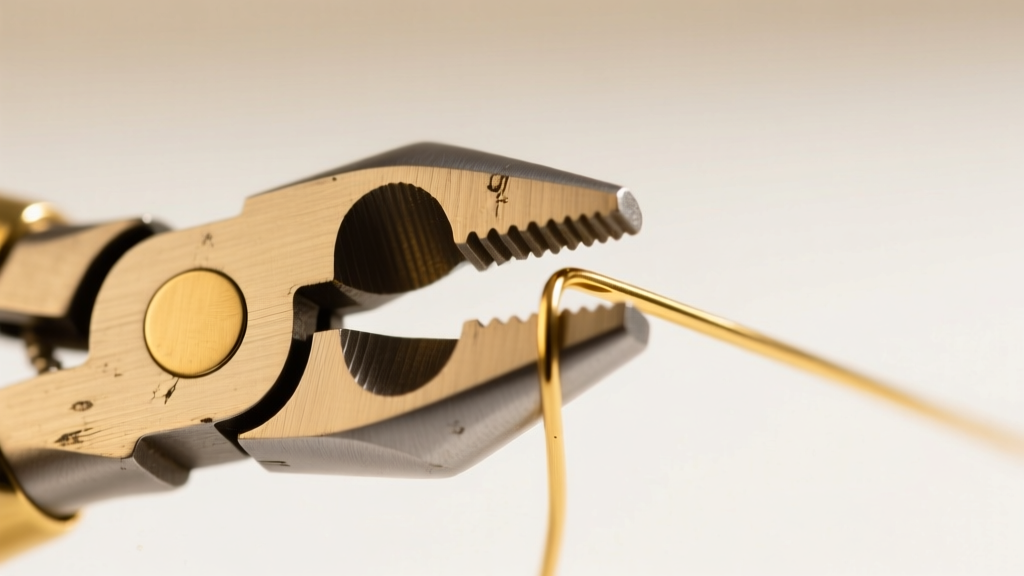
Brands like Rio Grande and PepeTools manufacture box-joint pliers with interchangeable brass and nylon inserts that completely eliminate the marring failure mode.
Symptom 2: Hand Fatigue and Grip Slippage
If you find your hand cramping after 30 minutes of making jump rings, or if you have to squeeze the handles with excessive force to maintain a grip on a stubborn piece of 18-gauge stainless steel, your tools are failing you ergonomically. Hand fatigue leads to shaky movements, which results in asymmetrical loops and uneven wire wrapping.
The Ergonomics of Professional Handles
Budget tools often feature bare steel handles or thinly dipped PVC grips that dig into the thenar eminence (the fleshy part of your palm). Professional jewelry making tools are engineered with ergonomic, dual-material handles that distribute pressure evenly across the hand.
Moreover, the internal spring mechanism dictates how much effort your hand must expend. Cheap leaf springs often bind or lose tension, requiring you to manually force the pliers open. Professional tools use precision-wound coil springs or specialized leaf springs with tension-adjustment screws.
Tool Comparison: Budget vs. Professional Ergonomics
| Feature | Budget Lap-Joint Pliers ($8 - $15) | Professional Box-Joint Pliers ($45 - $120) |
|---|---|---|
| Joint Type | Lap Joint (prone to lateral wobble) | Box Joint (zero lateral play) |
| Handle Material | Bare steel or thin PVC dip | Ergonomic dual-density TPR or silicone |
| Return Spring | External leaf spring (often binds) | Internal coil or adjustable leaf spring |
| Jaw Finish | Unpolished, visible machining burrs | Mirror-polished or precision-milled inserts |
| Lifespan | 6 - 12 months before joint loosens | 10+ years with basic oil maintenance |
According to ergonomics studies cited by the Ganoksin Jewelry Making Community, reducing the grip force required to close a tool by even 20% exponentially decreases the risk of repetitive strain injuries (RSI) like carpal tunnel syndrome over a multi-year bench career.
Symptom 3: Flush Cutter Pinching and Wire Deformation
A true flush cut should leave a wire end that is perfectly flat on one side and slightly rounded on the other. If your cuts look like a pinched "V" on both sides, or if the wire is bending sideways as the blades close, your cutter is failing.
Blade Alignment and Steel Hardness
The pinching failure occurs because the blades of cheap cutters are made from low-carbon steel that dulls rapidly. As the edge rolls over, the blades stop slicing and start crushing the metal. Furthermore, cheap cutters lack a "stop pin"—a small metal post that prevents the blades from overlapping and grinding against each other when squeezed empty.
Professional jewelry making tools in the cutting category, such as those made by Tronex or Lindstrom, are forged from high-carbon tool steel and induction-hardened to a Rockwell Hardness (HRC) of 60-65. This extreme hardness allows them to be sharpened to a micro-shear edge that slices through 14-gauge copper like butter, leaving a perfectly flat, flush finish without deforming the wire's crystalline structure.
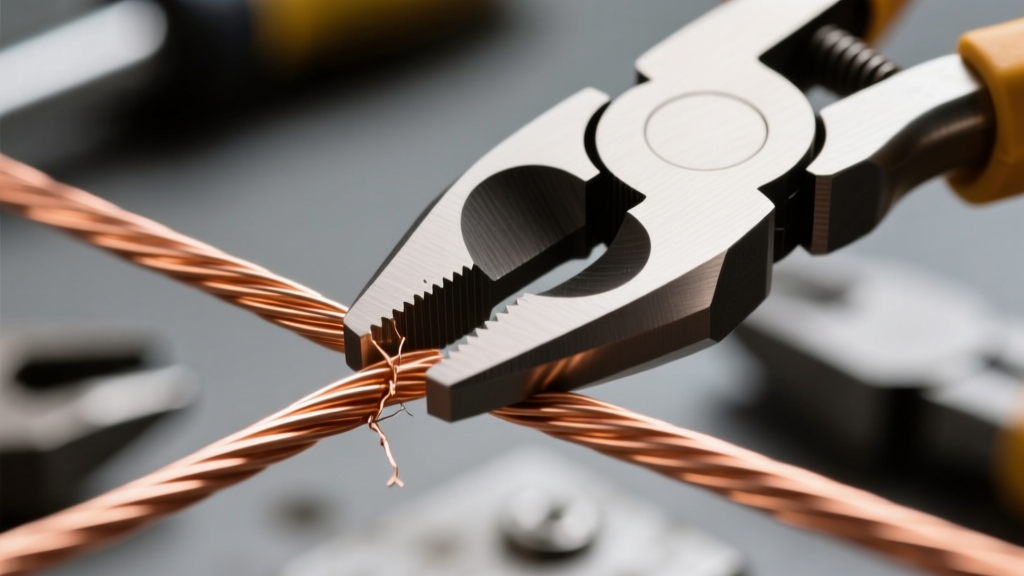
Expert Troubleshooting Tip: Never cut memory wire (hardened stainless steel) or titanium with your precision micro-shear flush cutters. The HRC 65 blades are incredibly hard but brittle; cutting hardened steel will cause microscopic chips in the blade edge, instantly ruining the flush-cut capability for softer metals. Always use dedicated, heavy-duty memory wire cutters for those specific materials.
Symptom 4: Inconsistent Ring Sizing and Mandrel Failures
You wrap a ring around a wooden mandrel, mark it at size 7, solder it, and polish it—only to find it fits like a size 6.5. This sizing failure is incredibly common and usually stems from the mandrel material and the lack of calibrated measuring tools.
Calibrating Your Sizing Tools
Wooden mandrels are porous, prone to warping with humidity changes, and often feature stamped size markings that are inaccurate by up to a quarter-size. Furthermore, wood compresses under the pressure of a rawhide mallet, altering the inner diameter of the ring being formed.
To troubleshoot sizing inaccuracies, upgrade to a hardened, grooved steel mandrel. Professional steel mandrels are turned on CNC lathes to exact aerospace tolerances. The grooves provide a resting place for your solder seam so it does not get crushed during hammering. Pair this with a digital caliper (accurate to 0.01mm) to measure the inner diameter of your rings, cross-referencing the exact millimeter measurement against a standard ring size chart rather than relying on painted lines on a plastic sizer.
Building Your Professional Toolkit: A Phased Approach
Outfitting a bench with professional jewelry making tools can cost upwards of $500 if done all at once. To manage your budget while immediately solving your most critical bench failures, follow this phased upgrade path:
- Phase 1 (Immediate Triage - $80): Replace your primary chain-nose and round-nose pliers with box-joint, nylon-jawed or brass-jawed professional models. This instantly solves wire marring and snapping.
- Phase 2 (Cutting Precision - $60): Invest in a single, high-quality micro-shear flush cutter (like a Lindstrom RX series). Reserve it strictly for soft metals (silver, gold, copper) to maintain the blade edge.
- Phase 3 (Ergonomics & Sizing - $150): Upgrade your heavy-duty bending pliers to ergonomic, dual-spring models to save your hands, and purchase a CNC-milled steel ring mandrel with a matching rawhide mallet.
Troubleshooting your jewelry making process is rarely about a lack of skill; it is usually about the physical limitations of your equipment. By identifying the exact failure points on your bench and strategically integrating professional jewelry making tools, you will drastically reduce material waste, eliminate hand fatigue, and elevate the finish of your final pieces to a retail-ready standard.