Navigating Jewelry Stores for Men: Metal Properties Compared
Learn how to evaluate metals when visiting jewelry stores for men. Compare titanium, tungsten, gold, and platinum properties, grades, and failure modes.

The Problem with Generic Men's Jewelry Retailers
Walking into jewelry stores for men often presents a deceptive facade. The lighting is calibrated to make every metal gleam, and the sales pitches rarely dive deeper than 'scratch-resistant' or 'hypoallergenic.' For the modern man buying a wedding band, a daily-wear chain, or a signature signet ring, aesthetic appeal is only half the battle. The true value of men's jewelry lies in its metallurgical properties, structural failure modes, and long-term wearability.
Most retail chains stock a homogenized selection of alternative metals and low-karat gold alloys, marketing them with buzzwords that obscure their actual physical limitations. To make an informed decision, you must look past the display case and understand the exact material grades, tensile strengths, and emergency removal protocols associated with each metal. This guide breaks down the metallurgical realities of the most common metals found in men's jewelry, providing a technical framework for your next purchase.
The Alternative Metals: Titanium, Tungsten, and Steel
Alternative metals dominate the men's wedding band market due to their aggressive pricing and modern, industrial aesthetics. However, not all alternative metals are created equal, and the specific alloy grade dictates the ring's lifespan.
Grade 5 Titanium vs. Commercial Pure (CP) Titanium
Titanium is celebrated for its high strength-to-weight ratio, but jewelry stores for men rarely specify the grade. Commercially Pure (CP) Titanium, typically Grade 2, is soft enough to scratch relatively easily and can be cut off with standard emergency room ring cutters. However, Grade 5 Titanium (Ti-6Al-4V), an aerospace-grade alloy containing aluminum and vanadium, is a completely different beast.
- Tensile Strength: Grade 5 boasts a tensile strength of roughly 950 MPa, compared to CP Grade 2's 345 MPa.
- Weight: It is nearly 45% lighter than steel, making it ideal for men who work with their hands and despise heavy rings.
- The Catch: Grade 5 titanium is notoriously difficult to resize. If your knuckle size fluctuates, a Grade 5 titanium band is essentially a disposable purchase.
Tungsten Carbide: The Scratch-Proof Myth and Shatter Risk
Marketing materials in jewelry stores for men frequently label tungsten rings as 'scratch-proof' and 'indestructible.' This is metallurgically false. What is being sold is not pure tungsten, but tungsten carbide—a composite material where tungsten particles are suspended in a binder metal.
The binder is the critical point of failure. Cheap rings use a cobalt binder, which can oxidize over time, leading to skin irritation and a pitted ring surface. Premium tungsten carbide uses a nickel binder, which is fully hypoallergenic and structurally superior. While tungsten carbide scores an impressive 8.5 to 9 on the Mohs hardness scale (making it highly scratch-resistant), it is incredibly brittle. If a man wearing a tungsten ring drops a heavy gym weight on his hand or slams it against a granite countertop, the ring will not bend; it will shatter into pieces. Furthermore, emergency responders cannot cut tungsten with standard rotary saws; they must use locking pliers to apply crushing force and crack the ring off, which can cause secondary trauma to a swollen finger.
Precious Metals: What Stores Actually Stock
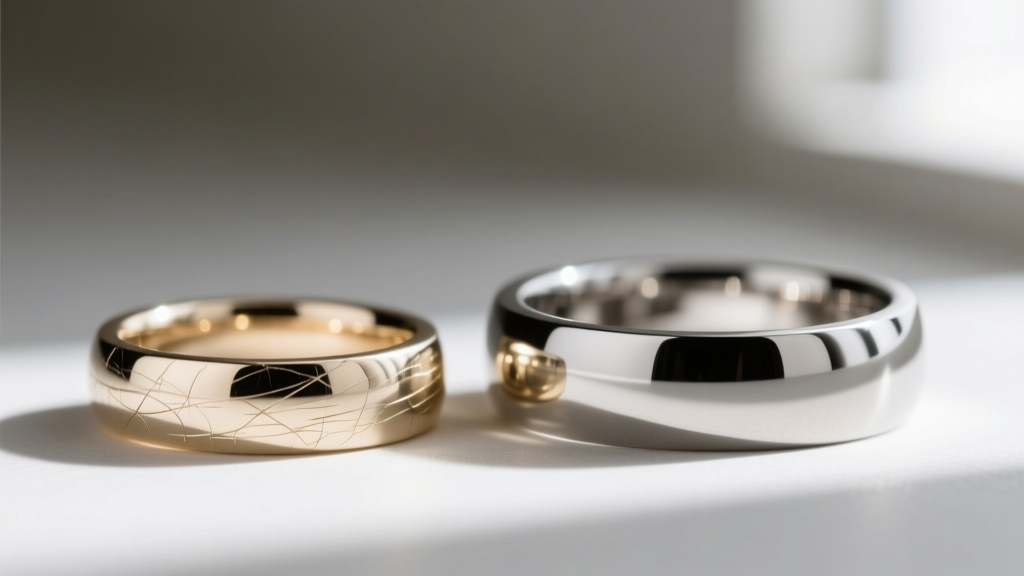
When transitioning from alternative metals to precious metals, the conversation shifts from brittle hardness to malleability, work-hardening, and alloy composition. According to the Gemological Institute of America (GIA), understanding karatage and alloy mixtures is essential for predicting how a precious metal ring will endure decades of daily abuse.
14k vs. 18k Gold: The Durability vs. Color Trade-off
Pure 24k gold is far too soft for men's daily-wear rings; it will deform and lose prongs holding gemstones within months. Therefore, gold is alloyed with metals like copper, zinc, and silver.
- 14k Gold (58.5% Pure Gold): With a Vickers Hardness (HV) of approximately 170, 14k gold is the workhorse of men's jewelry. It offers superior prong security and resists deep gouging. It is the recommended choice for men with active, hands-on lifestyles.
- 18k Gold (75% Pure Gold): Scoring lower on the hardness scale (around 130 HV), 18k gold is softer but offers a significantly richer, deeper yellow hue. It is best suited for men in white-collar environments or for signet rings that experience less blunt-force impact.
Platinum vs. White Gold: The Rhodium Plating Reality
Many men prefer the sleek, grayish-white tone of platinum or white gold, but the maintenance profiles of these two metals are polar opposites. White gold is an alloy of yellow gold and white metals (like palladium or nickel), but it naturally retains a faint yellowish tint. To achieve a bright white finish, it is plated with rhodium. This plating wears off within 12 to 24 months, requiring costly and repetitive re-plating.
Platinum, typically stamped as 900 Pt or 950 Pt (often alloyed with ruthenium or iridium for strength), is naturally white. As the GIA's platinum guide notes, platinum is a dense, malleable metal. When scratched, platinum doesn't lose material; the metal is merely displaced, creating a soft patina over time. This 'patina' is highly sought after by horology and jewelry enthusiasts, as it proves the metal's authenticity and age without compromising its structural integrity.
Technical Comparison Matrix
Use this data table to cross-reference the physical properties of metals commonly found in jewelry stores for men before making a final commitment.
| Metal / Alloy | Mohs Hardness | Vickers Hardness (HV) | Emergency Removal | Best Use Case |
|---|---|---|---|---|
| Grade 5 Titanium | 6.0 | 350 | Requires heavy-duty bolt cutters | Lightweight daily wear, active lifestyles |
| Tungsten Carbide | 8.5 - 9.0 | 1500+ | Must be cracked with vice grips | Office workers prioritizing scratch resistance |
| 14k Yellow Gold | 3.5 - 4.0 | 170 | Standard rotary ring cutter | Heirloom pieces, gemstone prong security |
| 950 Platinum | 4.0 - 4.5 | 135 | Standard rotary ring cutter | Prestige daily wear, developing a vintage patina |
| 316L Stainless Steel | 5.5 - 6.0 | 200 | Difficult; requires specialized cutters | Budget-friendly fashion jewelry, chains |
Red Flags to Spot When Browsing
Not all jewelry stores for men operate with full transparency. When evaluating a retailer's inventory, watch out for these deceptive marketing tactics and metallurgical red flags:
The 'Solid Gold' Trap: If a piece is advertised as 'solid gold' but lacks a specific karat stamp (like 14k or 18k) and a maker's mark inside the band or on the clasp, it is likely gold-plated brass or a gold-filled shell. Federal trade guidelines require precise karat stamping for solid gold items.
- Vague Tungsten Labeling: If the tag simply says 'Tungsten' rather than 'Tungsten Carbide,' walk away. Pure tungsten is impossible to machine into jewelry without industrial diamond tooling, and the omission of 'carbide' often masks the use of cheap, skin-irritating cobalt binders.
- Hollowed-Out Bands: Some stores sell 'comfort fit' gold bands that are actually hollowed out on the interior to save on precious metal weight. These rings dent easily, cannot be resized, and trap moisture against the skin, leading to bacterial growth.
- Misleading 'Scratch-Proof' Guarantees: No metal is scratch-proof. Even tungsten carbide can be scratched by materials with a higher Mohs rating, such as diamonds (Mohs 10) or certain synthetic abrasives found in construction materials and drywall.
Final Verdict: Matching the Metal to the Man
Choosing the right metal requires an honest assessment of the wearer's daily environment. If he works in construction, mechanics, or emergency services, avoid precious metals that can conduct heat or bend, and avoid tungsten carbide due to the crush-hazard and emergency removal risks; Grade 5 Titanium or a simple silicone band is the only responsible choice. For the corporate professional or the man who views jewelry as a generational heirloom, 18k gold or 950 platinum offers the prestige, weight, and resizing capabilities that alternative metals simply cannot provide.
By understanding the metallurgical realities behind the glass display cases, you can bypass the marketing fluff and select a piece of men's jewelry that will structurally and aesthetically endure a lifetime of wear.