How to Identify Fake Jewelry When Standard Tests Fail
Learn how to identify fake jewelry when basic magnet and acid tests fail. Troubleshoot false positives, HGE plating, and clasp anomalies.


There is nothing more frustrating for a jewelry collector or estate buyer than encountering conflicting authenticity data. You purchase a premium testing kit, run a magnet over a supposedly solid 14k gold chain, and feel a slight pull. Or perhaps you apply nitric acid to a vintage silver ring, and the reaction is entirely ambiguous. When you are trying to figure out how to identify fake jewelry, standard at-home tests are usually your first line of defense. But what happens when those tests fail or yield paradoxical results?
Modern counterfeiters and legacy manufacturing quirks both create scenarios where basic testing falls short. Heavy gold electroplating can trick acid tests, while internal structural components can trigger false magnet alarms. To confidently authenticate jewelry, you must move beyond rudimentary checks and learn to troubleshoot inconclusive results using metallurgical logic and advanced non-destructive testing.
The Limits of Basic At-Home Jewelry Testing
Standard jewelry testing kits rely on two primary methods: magnetic susceptibility and chemical reactivity. While effective for identifying blatant fakes (like solid brass posing as gold or aluminum posing as silver), these methods are fundamentally flawed when dealing with complex jewelry assemblies. According to the Federal Trade Commission (FTC), jewelry manufacturers are legally permitted to use non-precious metals in specific structural components of a piece, provided the primary metal meets purity standards. This legal loophole is the root cause of 90% of all false-positive magnet tests.
Troubleshooting Scenario 1: The "Magnet Drag" Anomaly
The most common troubleshooting scenario involves a gold or platinum chain that exhibits a slight magnetic pull. The immediate assumption is that the chain is gold-plated steel. However, before you dismiss the piece as fake, you must isolate the source of the magnetic attraction.
Spring Rings and Internal Armatures
If you are testing a chain with a spring ring clasp or a lobster claw clasp, the internal spring mechanism is almost always made of steel. Precious metals like gold and platinum are too soft to maintain the repeated tension required for a spring. Therefore, a genuine 14k or 18k gold chain will always show magnetic attraction at the clasp.
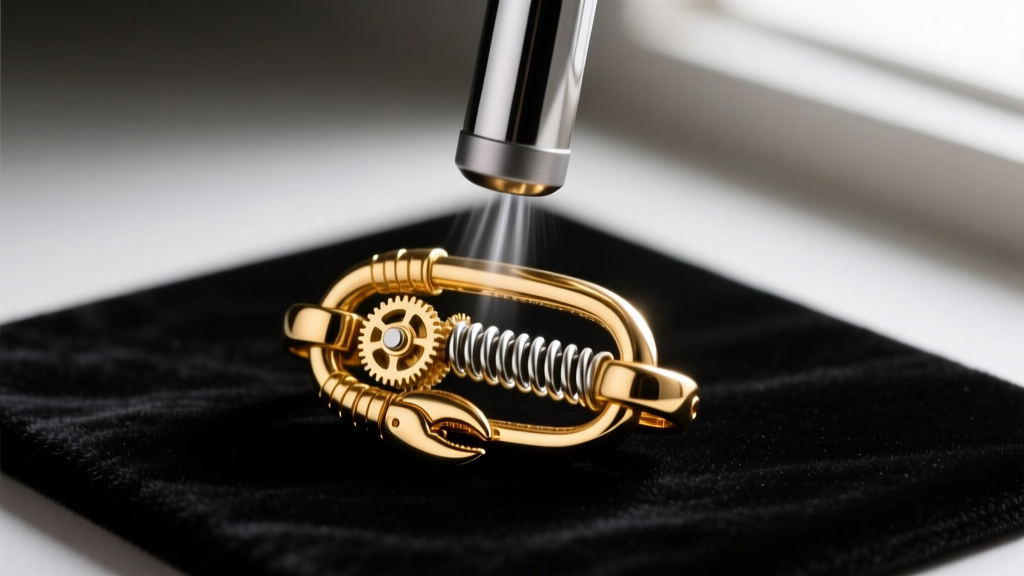
The Troubleshooting Fix: Drape the chain over a non-magnetic surface (like a plastic tray or your hand). Bring a strong neodymium magnet close to the chain links themselves, avoiding the clasp entirely. If the links jump to the magnet, the chain is likely gold-plated steel or nickel. If only the clasp reacts, the chain is likely genuine. Additionally, beware of hollow gold beads; some manufacturers use internal steel armatures to maintain the bead's spherical shape during casting. If a hollow bead reacts to a magnet but the solid links do not, the piece requires further specific gravity testing.
Troubleshooting Scenario 2: Acid Test False Positives on HGE
Chemical acid testing is highly accurate for solid metals but notoriously unreliable for heavily plated items if performed incorrectly. Counterfeiters frequently use Heavy Gold Electroplate (HGE) or Rolled Gold Plate (RGP) over base metals like brass or copper.
The File-Depth Rule for Heavy Electroplate
Standard gold flash plating is incredibly thin—usually around 0.175 microns. However, HGE must be at least 2.5 microns thick, and RGP requires the gold layer to constitute at least 1/20th of the total weight of the item. If you simply scratch the surface of an HGE ring with a testing stone and apply 14k nitric acid, the acid will react to the gold layer, yielding a false positive.
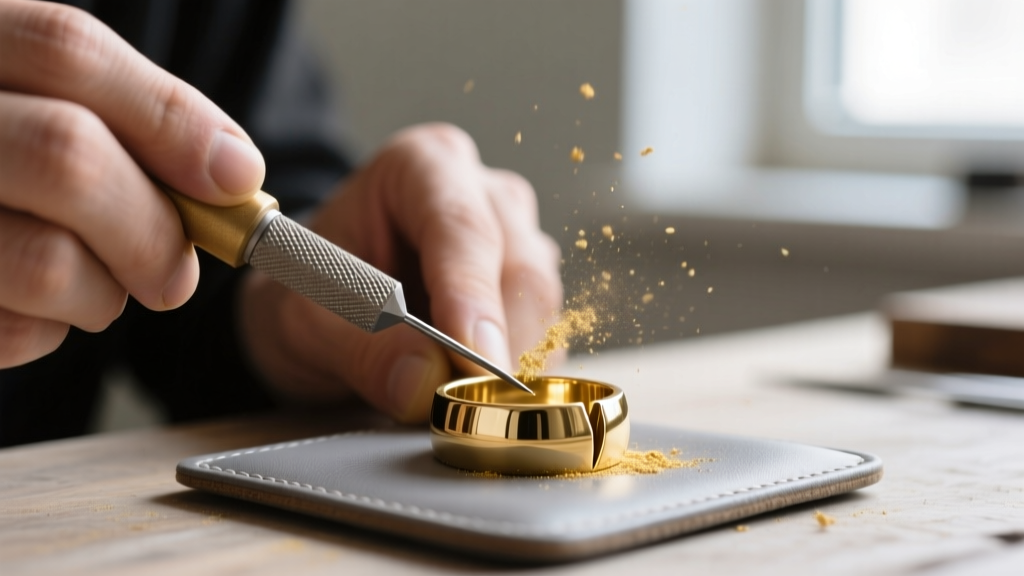
The Troubleshooting Fix: You must bypass the surface layer. Use a triangular needle file to cut a deep, aggressive notch into an inconspicuous area of the jewelry (like the inside of a ring band). Apply the testing acid directly into the deep groove, not on the surface.
- Genuine 14k Gold: The acid will show little to no reaction, or turn a very faint milky brown.
- Base Metal Core (Fake): The acid will immediately bubble, turn bright green (copper/brass core), or turn milky white (silver core).
For a deeper understanding of gold purity and testing limitations, the Gemological Institute of America (GIA) provides extensive guidelines on why chemical surface tests must always be paired with deep-notch verification.
Troubleshooting Scenario 3: The Rhodium-Plated Silver Deception
White gold, platinum, and sterling silver can look virtually identical to the naked eye, especially when the silver is heavily plated with rhodium to prevent tarnishing. If a piece is stamped "925" but feels unusually heavy and doesn't tarnish, you might suspect it is actually white gold or platinum mislabeled to avoid hallmarking laws, or conversely, a base metal fake stamped 925.
The Troubleshooting Fix (The Ice Cube Test): Silver possesses the highest thermal conductivity of any common metal. Place an ice cube on the suspected piece. Genuine sterling silver will transfer heat so rapidly that the ice cube will begin to melt almost instantaneously, even at room temperature. White gold and platinum will melt the ice significantly slower. If the ice melts at a normal, sluggish rate, the piece is likely stainless steel or a base metal fake stamped with a fraudulent 925 hallmark.
The Definitive Troubleshooting Matrix
When standard tests yield confusing data, use this matrix to diagnose the underlying issue and determine your next step.
| Symptom / Observation | Initial Test Result | The Hidden Reality | Definitive Troubleshooting Step |
|---|---|---|---|
| Chain links stick to magnet | Magnet Test: FAIL | Gold-plated steel or nickel alloy | Perform Specific Gravity test; if SG is under 8.0, it is fake. |
| Clasp sticks, links do not | Magnet Test: PASS (Partial) | Genuine gold with steel spring mechanism | Verify hallmark on clasp; check for wear spots revealing base metal. |
| Acid turns green on scratch | Acid Test: FAIL | HGE or RGP over brass/copper core | File a deep notch and re-test; if green persists in the groove, it is plated. |
| Ice melts slowly on "925" ring | Ice Test: FAIL | Stainless steel or cupronickel fake | Check for "China" or "Tibet" stamps; perform XRF spectrometry. |
| Ring is heavy but non-magnetic | Magnet Test: PASS | Tungsten carbide core (mimics 24k gold) | Specific Gravity test; Tungsten SG is ~15.6, while 24k gold is 19.32. |
Advanced Non-Destructive Verification: Specific Gravity
When acid and magnets fail, Specific Gravity (SG) testing is the ultimate equalizer. SG measures the density of a metal relative to water. Because every precious metal and common base metal has a unique density, you can mathematically prove what a piece is made of without damaging it.
The Formula:
SG = Weight in Air / (Weight in Air - Weight in Water)
To perform this, you need a digital scale accurate to 0.01 grams. Weigh the dry piece. Then, suspend the piece in a cup of distilled water on the scale (ensuring it doesn't touch the sides or bottom) and weigh it again.
- Solid 14k Yellow Gold: SG should fall between 12.9 and 14.6 (depending on the copper/silver alloy mix).
- Solid 18k Yellow Gold: SG should fall between 15.2 and 15.9.
- Sterling Silver (925): SG should be approximately 10.36.
- Brass (Common Fake): SG is around 8.4 to 8.7.
If you are testing a heavy chain that passed the magnet test but feels suspiciously light, an SG reading of 7.8 will immediately expose it as gold-plated stainless steel, regardless of what the surface acid test claimed.
When to Concede and Seek XRF Spectrometry
Troubleshooting at home has its limits. If you are dealing with multi-layered plating (such as a silver base, a copper barrier layer, and a thick gold top layer), even deep filing and SG tests can yield muddled results due to the composite density. Furthermore, testing vintage pieces with soldered joints can skew SG readings, as jewelry solder often contains lower-karat gold or cadmium.
If the financial stakes are high, stop troubleshooting at home and take the piece to a certified gemologist or precious metal refiner equipped with an X-Ray Fluorescence (XRF) spectrometer. XRF machines shoot X-rays into the metal and read the fluorescent energy bouncing back, providing an exact elemental breakdown down to the decimal percentage in seconds, entirely non-destructively. Mastering how to identify fake jewelry means knowing exactly when to put down the testing acid and call in the advanced technology.