How to Identify Art Deco Jewelry: Spotting Fakes and Revivals
Learn how to identify Art Deco jewelry and spot modern reproductions. Expert troubleshooting tips on hallmarks, filigree, and gem cuts.

The Core Problem: Original 1920s Pieces vs. Modern Revivals
When learning how to identify Art Deco jewelry, estate buyers and collectors face a market saturated with convincing reproductions. The Art Deco era (roughly 1920 to 1939) was defined by bold geometry, stark color contrasts, and unprecedented advancements in metallurgy. However, the 1980s saw a massive 'Deco Revival,' and today, modern CAD/CAM casting technologies allow manufacturers to replicate vintage designs with deceptive accuracy. To authenticate a piece, you must move beyond superficial design motifs and troubleshoot the structural, metallurgical, and gemological evidence.
According to the Victoria and Albert Museum (V&A), true Art Deco jewelry is a product of its specific industrial context. Original pieces were hand-fabricated or die-struck, whereas modern fakes are almost exclusively investment-cast. This fundamental difference in manufacturing dictates how the metal behaves, wears, and reflects light.
Troubleshooting Metalwork: Hand-Fabrication vs. Modern Casting
The most reliable diagnostic test for authenticity lies in examining the metalwork under a 10x jeweler's loupe. Authentic 1920s platinum pieces were typically die-struck or hand-pierced. Die-striking involves forcing metal into a steel die under immense pressure, which compresses the crystalline structure of the platinum or gold. This results in incredibly dense, sharp, and durable jewelry.
Identifying Cast Porosity and Mushy Milgrain
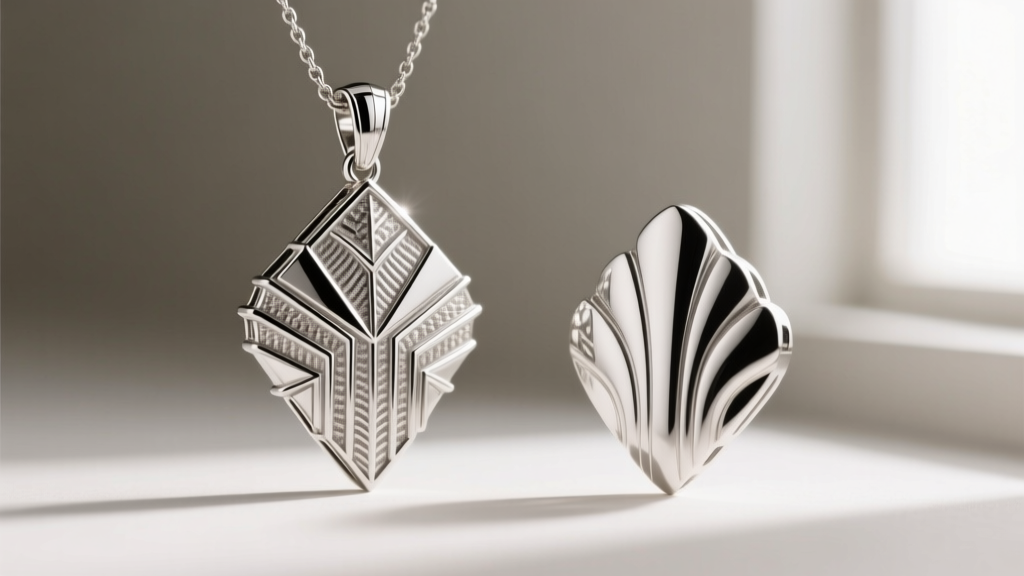
Modern reproductions are cast from molten metal poured into a mold. As the metal cools, it shrinks, resulting in rounded edges, microscopic porosity (tiny surface pits), and a lack of structural rigidity. Furthermore, examine the milgrain—the tiny beaded borders used to outline geometric shapes. On authentic pieces, milgrain was applied by hand using a knurling tool, leaving microscopic, organic irregularities. On modern cast fakes, the milgrain is part of the mold, appearing perfectly uniform, flat, and 'mushy' under magnification.
Expert Insight: Authentic Art Deco platinum is usually alloyed as 900/1000 (90% platinum, 10% iridium). If you see a modern 'PT950' stamp alongside cast construction, you are likely looking at a contemporary reproduction, as 950 platinum was rarely used for intricate Deco filigree due to its higher melting point and softness compared to the iridium alloy.
Gemstone Diagnostics: Calibré Cuts and Synthetic Tell-Tales
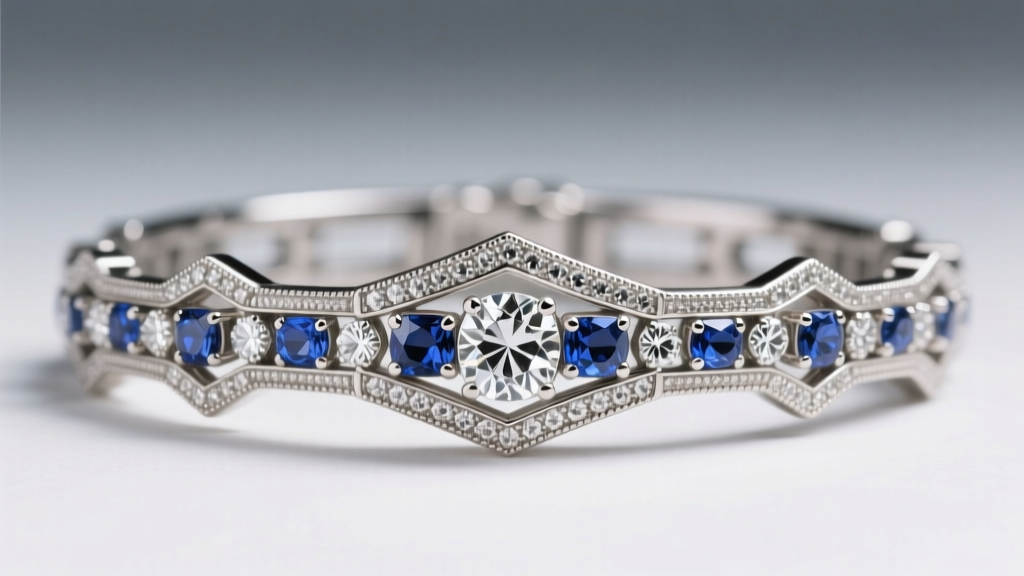
The gemstones in genuine Art Deco jewelry were cut specifically for the piece, not the other way around. The hallmark of high-end Deco design is the calibré-cut gemstone (usually rubies, sapphires, or onyx). These stones were custom-faceted to fit perfectly into geometric channels without any light gaps or visible metal prongs. Modern reproductions often use standard commercial cuts that leave awkward gaps or rely on heavy prongs to secure ill-fitting stones.
Navigating Early Synthetics vs. Modern Glass
Do not assume that a synthetic stone automatically means a piece is a fake. The Verneuil process for creating synthetic rubies and sapphires was widely used in the 1920s because natural, flawless stones were prohibitively expensive and difficult to cut into uniform baguettes. However, you must differentiate between 1920s Verneuil synthetics and modern glass or synthetic spinel.
- Verneuil Synthetic (Authentic 1920s): Exhibits curved striae (growth lines) and occasional gas bubbles under magnification.
- Molded Glass (Modern Fake): Shows sharp, angular flow lines, large spherical bubbles, and lacks the refractive index of corundum.
- Synthetic Spinel (1980s Revival): Often used in 1980s revival pieces to mimic ruby; shows a distinct 'cross-hatch' or mottled pattern under polarized light.
Clasp and Finding Mechanics: The Hidden Authenticators
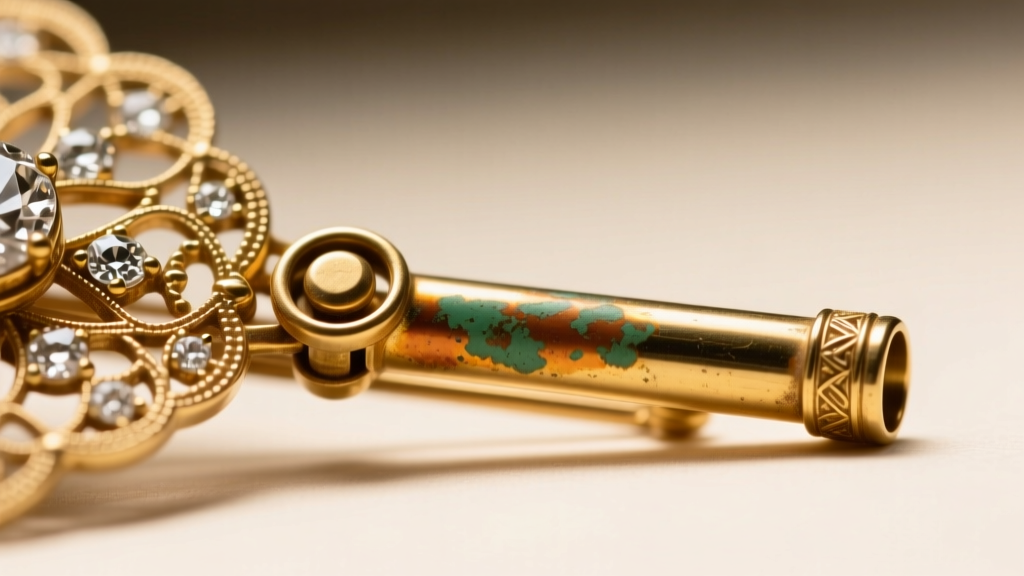
Findings (clasps, hinges, and safety catches) are frequently overlooked but serve as critical timestamps. The mechanics of a clasp can instantly date a piece. According to Lang Antiques University, the transition of clasp styles in the early 20th century provides a strict chronological framework for authentication.
| Clasp Type | Era of Prominence | Authentication Notes |
|---|---|---|
| Trombone (Push-Pull) | Pre-1930s | Common on European Deco brooches; features a simple barrel tube. High forgery risk if soldered poorly. |
| Early Box Clasp | 1920s - 1930s | Used on bracelets; often accompanied by a single figure-8 safety wire. Look for hand-soldered joints. |
| C-Clasp | Pre-1930s | Simple 'C' shape without a rolling lock. Pin stem should be long, often extending slightly past the 'C'. |
| Lobster / Modern Box | 1970s - Present | If a 'Deco' piece has a laser-stamped lobster clasp, it is either a modern reproduction or heavily altered. |
Material Anomalies: Bakelite, Enamel, and Black Onyx
Art Deco jewelers loved high-contrast materials, pairing diamonds with black onyx, coral, jade, and early plastics like Bakelite. Troubleshooting these materials requires specific chemical and visual tests.
The Bakelite Simichrome Test
Bakelite (polyoxybenzylmethylenglycolanhydride) was heavily used in 1930s costume and semi-fine jewelry. Modern fakes use acrylic or cellulose acetate. To test for authentic Bakelite, apply a small amount of Simichrome metal polish to a cotton swab and rub an inconspicuous area of the plastic. Authentic Bakelite will cause the swab to turn a distinct, vibrant yellow due to a chemical reaction with the phenol formaldehyde resin. Acrylic and modern plastics will not trigger this color change.
Champlevé vs. Cold Enamel
Authentic Deco black enamel is usually champlevé or guilloché. Champlevé involves carving channels into the metal, filling them with glass powder, and firing them in a kiln at over 1,000°F. The result is a glass-hard, deeply lustrous finish that sits slightly below the metal surface. Modern reproductions use 'cold enamel' (an epoxy resin). Cold enamel sits proud of the metal, feels like plastic to the fingernail, and will show micro-scratches and yellowing over time. Furthermore, the black onyx in authentic pieces is almost always dyed agate; if the 'onyx' is glass, it will feel warmer to the touch and may contain mold marks on the edges.
Summary Checklist for Estate Buyers
When evaluating a potential purchase, run through this diagnostic sequence:
- Magnification: Check for die-strike compression marks and hand-applied, irregular milgrain.
- Stone Fit: Verify that calibré and baguette stones fit seamlessly without gaps or heavy modern prongs.
- Clasp Mechanics: Ensure the clasp type aligns with pre-1940 manufacturing (no modern lobster claws or laser-welded safety chains).
- Material Testing: Use thermal and chemical tests (like the Simichrome test) to rule out modern plastics and cold epoxies.
Authentic platinum Art Deco bracelets and brooches typically command market prices ranging from $4,500 to over $45,000, depending on provenance and diamond quality. Modern cast reproductions generally retail between $800 and $2,500. By relying on structural forensics rather than just visual aesthetics, you can confidently navigate the market and build a genuine, historically accurate collection. For further gemological verification, always consult resources from the Gemological Institute of America (GIA) when dealing with high-carat antique diamonds.