Mantis Piercing Jewelry: Technical Guide to High Nostril Setups
Master mantis piercing jewelry selection. Explore gauge specs, ASTM F-136 titanium grades, and threadless vs. surface anchor setups for high nostrils.

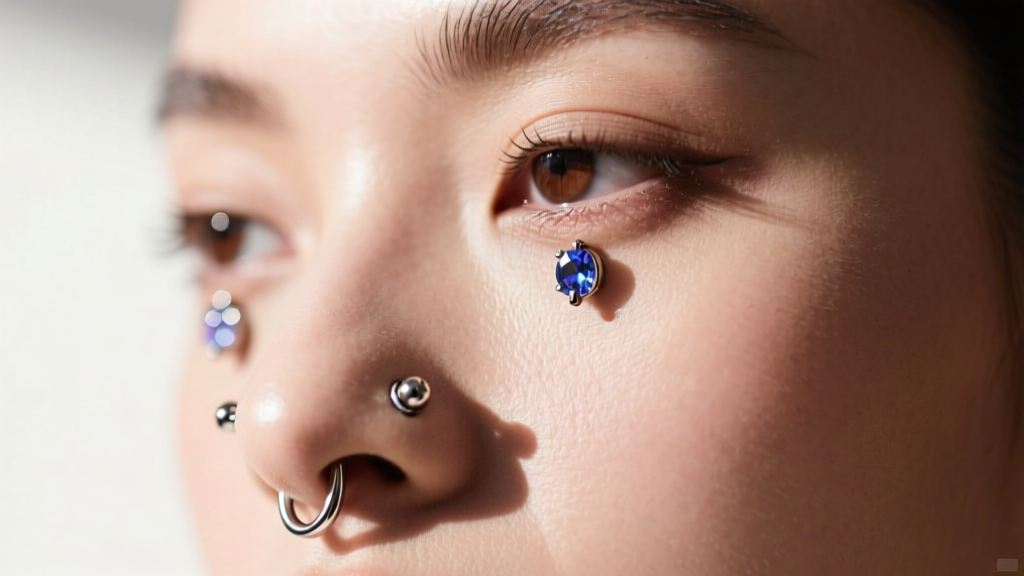
Anatomy of the Mantis: High Nostril vs. Surface Anchor
The term 'mantis piercing' refers to a symmetrical, paired placement high on the nasal bridge or upper nostril cartilage, mimicking the prominent eyes of a praying mantis. When selecting mantis piercing jewelry, precision is non-negotiable. The tissue in this region is notoriously thin, highly mobile, and prone to migration if the jewelry profile is incorrect. As of 2026, professional piercers generally execute this setup using one of two distinct methodologies: the transverse high-nostril cartilage puncture or the shallow surface anchor placement. Each requires a fundamentally different jewelry architecture to ensure long-term viability.
Flat-Back Labrets: The Gold Standard for Cartilage
When the mantis setup is pierced through the actual nasal cartilage, flat-back labrets are the only acceptable choice. The flat disc rests flush against the inner mucosal lining of the nasal cavity, preventing the 'cheese-cutter' effect common with butterfly-back studs. The post must be perfectly calibrated to the thickness of the high nostril tissue, which typically ranges from 4mm to 8mm depending on the client's anatomy and initial swelling.
Technical Specifications: Gauge, Length, and Material
Choosing the correct dimensions for mantis piercing jewelry requires an understanding of tissue density and vascular response. High-nostril piercings experience significant initial edema (swelling), necessitating a staged downsizing protocol. Below is the clinical standard for initial and healed mantis setups.
| Feature | High Nostril (Cartilage) | Surface Mantis (Bridge) |
|---|---|---|
| Jewelry Type | Flat-Back Labret | Micro Surface Anchor |
| Standard Gauge | 18g (1.0mm) or 16g (1.2mm) | 16g (1.2mm) or 14g (1.6mm) |
| Material Grade | ASTM F-136 Titanium | ASTM F-136 Titanium |
| Initial Post/Depth | 5/16' (8mm) or 1/4' (6mm) | 2.5mm - 3.5mm base depth |
| Healed Post/Depth | 3/16' (5mm) or 5/32' (4mm) | N/A (Fixed depth) |
According to the Association of Professional Piercers (APP) Jewelry Materials Guide, only implant-grade materials should be used in fresh punctures. For mantis setups, ASTM F-136 (Ti-6Al-4V-ELI) titanium is the absolute benchmark. It offers superior tensile strength compared to commercially pure (CP) titanium, allowing for thinner, stronger posts that minimize tissue displacement in the delicate nasal bridge.
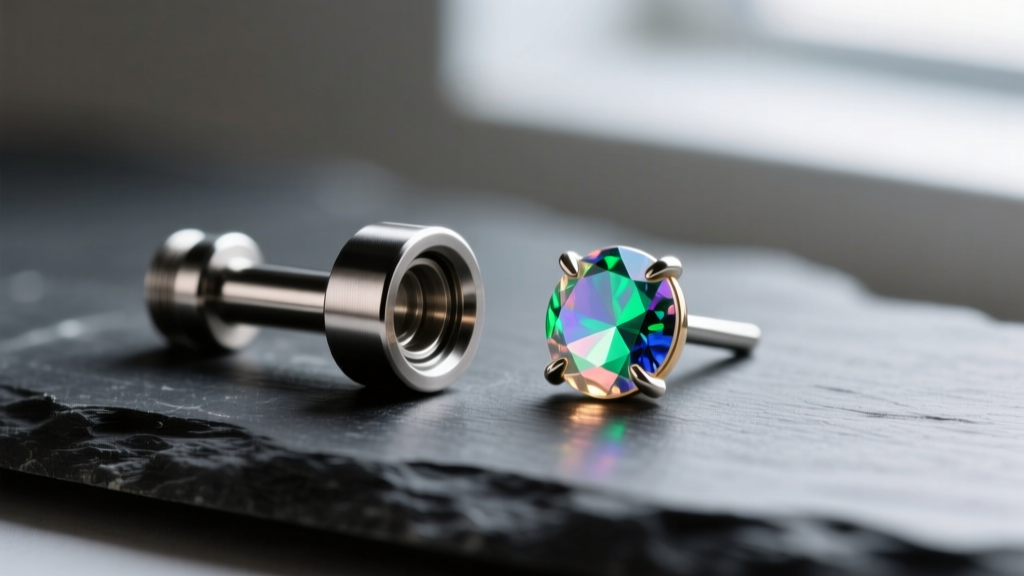
Threadless vs. Internally Threaded Ends for High Nostrils
The connection mechanism of your mantis piercing jewelry dictates both security and ease of maintenance. High nostrils are incredibly difficult to reach, making internally threaded jewelry (where the ball screws into the post) a logistical nightmare for clients attempting to change ends at home. Cross-threading or dropping the gemstone into the nasal cavity are common failure modes.
The Mechanics of Threadless Tension
Threadless jewelry, pioneered by brands like Neometal and BVLA, utilizes a friction-fit mechanism. The pin on the decorative end is slightly bent (usually between 10 to 15 degrees) before being inserted into the hollow post. As the pin straightens inside the shaft, it creates immense outward tension against the interior wall. The BVLA Threadless Jewelry Mechanics documentation confirms that this tension actually increases when the jewelry is pulled, making it virtually impossible to snag and pull apart accidentally—a critical feature for the high-nostril region where hair, towels, and glasses frequently cause trauma.
Gemstone Profile and Snag Risks
For a mantis piercing, low-profile ends are mandatory. Prong-set stones that sit more than 2mm above the base disc act as levers, catching on clothing and applying torque to the fistula. Bezel-set gems or CNC-machined solid metal ends (like the BVLA 'Fan' or Neometal 'Spike') offer a streamlined silhouette. In 2026, lab-grown bezel-set sapphires and emeralds have become the industry standard, providing flawless optical clarity and scratch resistance at a fraction of the cost of mined stones.
Troubleshooting Rejection and Migration
When a mantis piercing is performed as a surface anchor rather than a full cartilage puncture, the risk of rejection increases exponentially. Surface anchors rely on a perforated titanium base (the 'foot') that heals into the dermal layer. If the jewelry is too heavy, or if the base footprint is too small for the tension of the nasal bridge skin, the body will treat it as a splinter and push it out.
'The most common cause of surface mantis rejection is not the initial piercing technique, but the client upgrading to an oversized, heavy gemstone end before the dermal base has fully encapsulated. Stick to 2mm or 3mm ends for the first 12 months.' — Senior Piercer, Industrial Strength Body Piercing.
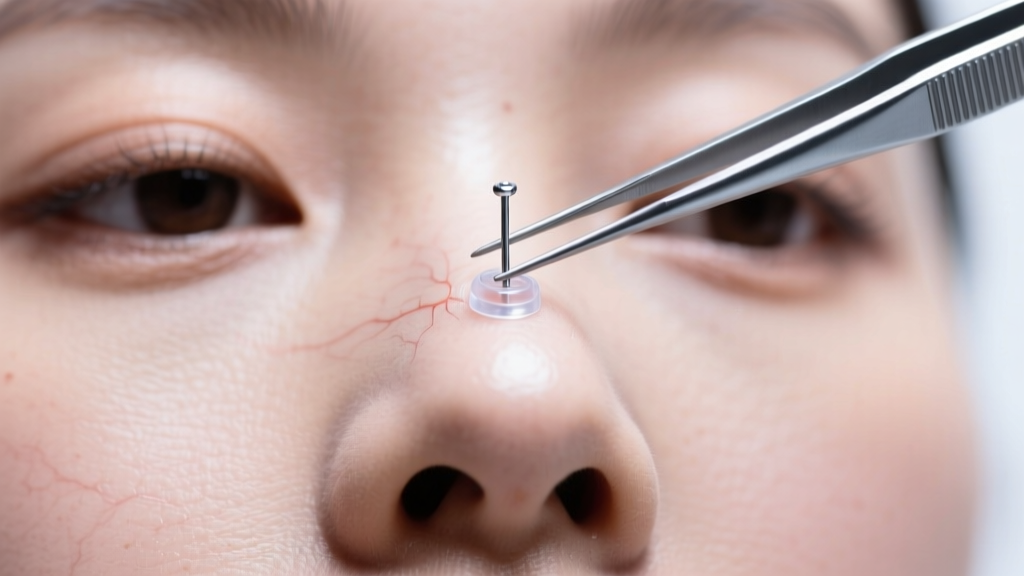
If you notice the skin around your surface mantis becoming translucent, red, or if you can visibly see the edge of the titanium base plate beneath the skin, migration has begun. At this stage, no amount of aftercare will reverse the process. The only harm-reduction strategy is immediate removal by a professional to minimize scarring, followed by a mandatory waiting period of 12 to 18 months before attempting the piercing again.
Curated Brand Recommendations for 2026
When investing in high-end mantis piercing jewelry, manufacturing tolerances are everything. A post that varies by even 0.1mm in diameter can cause the threadless pin to slip. We recommend the following manufacturers for their rigorous quality control:
- BVLA (Body Vision Los Angeles): The gold standard for threadless ends. Their 3mm and 4mm bezel-set collections are perfectly weighted for high-nostril applications.
- Neometal: Offers exceptional ASTM F-136 titanium posts with precision-machined interiors that guarantee a secure friction fit.
- Maria Tash: Known for their proprietary 'invisible' setting techniques and floating diamond designs, which reduce the overall profile and weight of the jewelry.
- Anatometal: While famous for internally threaded pieces, their 18g flat-back labrets feature a mirror-polished finish that drastically reduces plaque buildup inside the nasal cavity.
Aftercare Protocols Specific to Mantis Setups
The aftercare for mantis piercing jewelry requires a departure from standard nostril routines. Because the jewelry sits higher on the bridge, it is directly in the 'T-zone' of the face, an area prone to high sebum (oil) production and sweat accumulation. Furthermore, the proximity to the eyes means that traditional saline sprays can easily migrate into the tear ducts, causing irritation.
Instead of aggressive spraying, utilize a sterile, non-woven gauze soaked in 0.9% sterile saline. Press the gauze gently against the piercing site for 3 to 5 minutes to soften any lymphatic crusties. Never twist or rotate the flat-back labret; the internal disc can abrade the delicate mucosal lining of the nose. Downsizing the initial post to a healed length (usually 4mm or 5mm) should be performed by your piercer between weeks 4 and 6, once the primary edema has subsided. Failure to downsize will result in the post protruding too far into the nasal cavity, where it will trap mucus and bacteria, leading to chronic irritation bumps.

