50mm Hoop Earrings: Technical Guide to Gauges and Hinge Stress
Explore the metallurgy, gauge thickness, and hinge engineering of 50mm hoop earrings. Learn how to prevent lobe stretching with our technical guide.

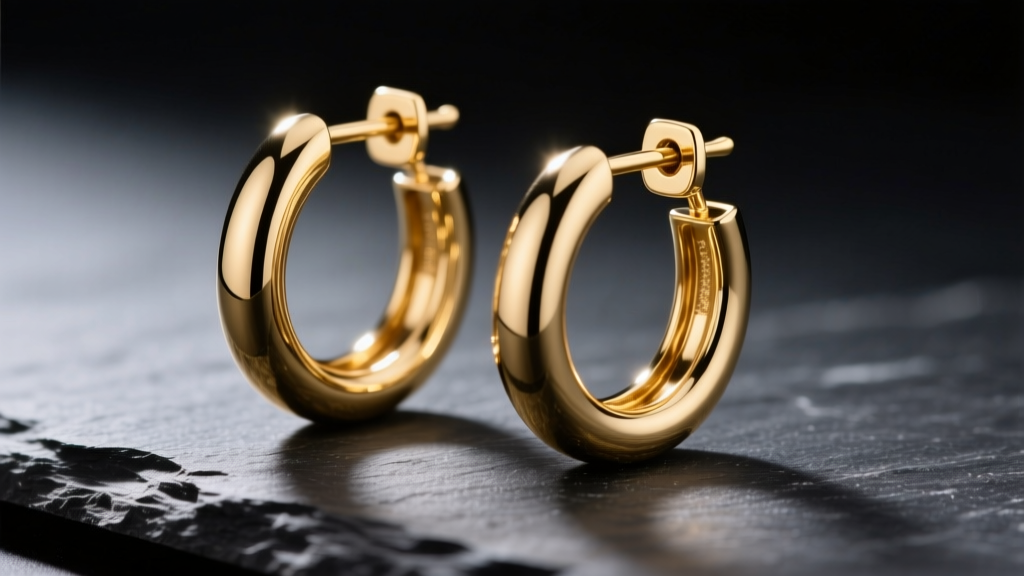
When evaluating statement jewelry, the 50mm hoop earring (approximately 2 inches in outer diameter) occupies a unique space in modern metallurgy and ergonomic design. While smaller huggies and standard 20mm hoops rely on simple tension and basic wire bending, scaling a hoop to 50mm introduces severe mechanical challenges. The increased radius amplifies kinetic energy, places exponential torque on the earlobe fistula, and demands rigorous structural engineering to prevent catastrophic failure modes like clasp disengagement or metal fatigue. In this 2026 technical deep dive, we dissect the material science, gauge requirements, and hinge mechanics that separate premium 50mm hoops from poorly constructed alternatives.
The Physics of the 50mm Diameter: Pendulum Effect and Lobe Stress
A 50mm outer diameter (OD) hoop extends roughly 25mm below the piercing site. This creates a pendulum effect. During normal locomotion—walking, turning the head, or exercising—the bottom arc of the hoop swings, generating kinetic energy that transfers directly to the earlobe. According to biomechanical principles of tissue stress, repetitive lateral pulling on a healed fistula can lead to the "cheese-cutter effect," where the jewelry slowly migrates downward through the tissue.
To mitigate this, expert jewelers do not simply scale up a 20mm design. They must calculate the center of mass and distribute the weight. If a 50mm hoop is bottom-heavy due to a thick solder joint at the base or a heavy decorative clasp, the pendulum swing becomes erratic, increasing the risk of the hoop catching on hair or clothing. The Association of Professional Piercers (APP) consistently warns against wearing heavy, large-diameter jewelry in standard 20-gauge piercings for extended periods due to the high risk of irreversible lobe elongation and tissue tearing.
Metallurgical Choices: Density vs. Durability in Large Hoops
Material selection for 50mm hoop earrings is a strict balancing act between density (weight) and tensile strength (resistance to bending). Because volume increases significantly with a 50mm circumference, the density of the chosen metal dictates whether the earring will be comfortable for all-day wear or restricted to brief evening use.
| Material Grade | Density (g/cm³) | Relative Weight (50mm Hoop) | Tensile Strength & Warp Resistance |
|---|---|---|---|
| Grade 23 Titanium (Ti-6Al-4V) | 4.43 | Ultra-Light | Exceptional (Highly rigid) |
| 316L Surgical Steel | 8.00 | Medium | Good (Moderate warp resistance) |
| 14k Gold Alloy (Nickel-Free) | 13.50 | Heavy | Moderate (Prone to bending if thin) |
| 18k Gold Alloy | 15.60 | Very Heavy | Low (Requires thick gauge or tubing) |
As noted by the Gemological Institute of America (GIA), higher karat gold alloys possess greater density and lower yield strength. A solid 18k gold 50mm hoop at a standard 1.2mm wire thickness will weigh over 4 grams per earring and will bend out of a perfect circle with minimal lateral pressure. Therefore, premium 18k gold 50mm hoops are almost exclusively manufactured using seamless hollow tubing or electroformed structures to reduce mass without sacrificing the outer volume and visual impact.
Gauge Thickness and Structural Integrity
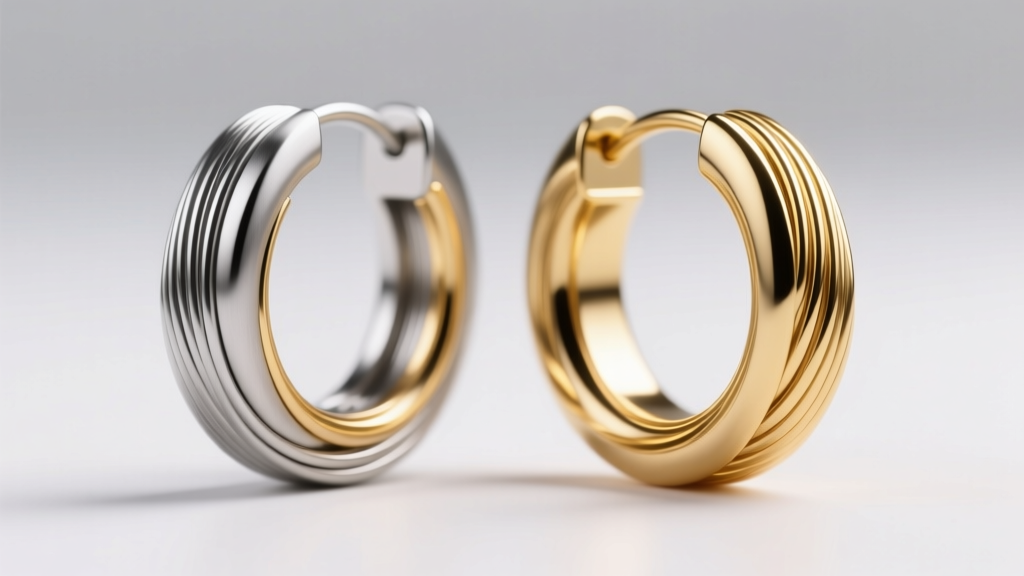
The most common point of structural failure in large hoops is wire warping. Standard lobe piercings are typically performed at 18G (1.02mm) or 16G (1.29mm). However, a 50mm hoop constructed from 18G wire lacks the cross-sectional area required to resist torsional stress. If you grab the bottom of an 18G 50mm hoop and pull, it will permanently deform into an oval shape.
The Stepped Post Engineering Solution
To solve the conflict between the need for a thick hoop body and a thin piercing hole, advanced jewelry manufacturers utilize a "stepped post" or "soldered sleeve" design. In this configuration:
- The Post (Piercing Wire): Machined to 18G (1.02mm) or 16G (1.29mm) to slide comfortably through a standard healed fistula without causing micro-tears.
- The Hoop Body: Constructed from 12G (2.05mm) or 10G (2.58mm) wire or tubing, providing the necessary rigidity to maintain a perfect 50mm circular geometry under stress.
- The Transition: A precision-machined taper or a flush-soldered collar connects the thin post to the thick body, ensuring no sharp edges scrape the earlobe.
"Never purchase a 50mm hoop made of solid wire thinner than 1.2mm (16G). The torsional leverage of a two-inch diameter guarantees that thinner wires will warp, causing the clasp to misalign and eventually snap open."
Hinge and Clasp Engineering: Preventing the "Snap and Lose" Failure
The clasp is the most vulnerable component of any hoop earring, and the risk of failure scales linearly with the hoop's diameter. On a 50mm hoop, the leverage applied to the clasp when the earring is snagged on a sweater or brushed by long hair is immense.
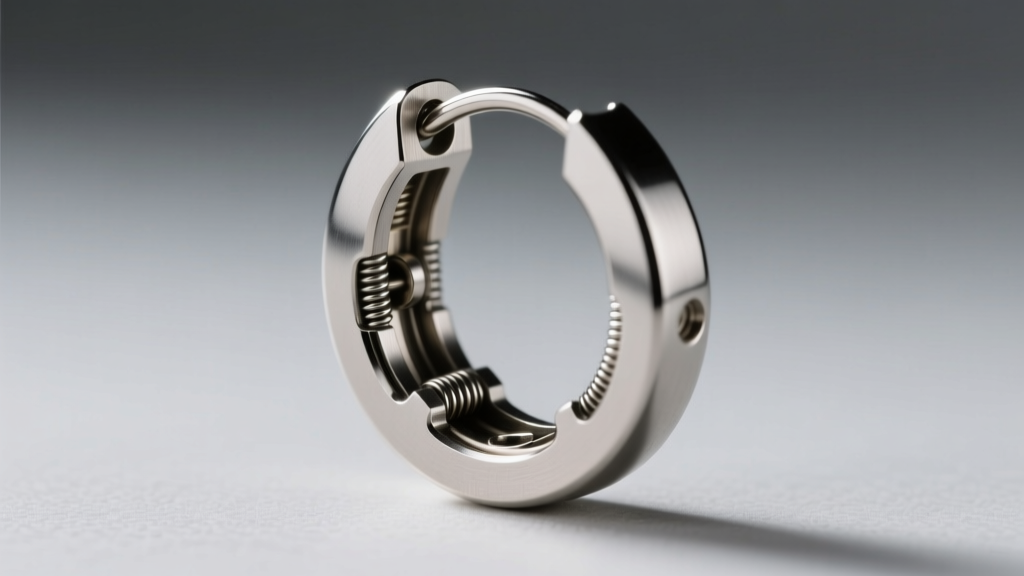
Evaluating Clasp Mechanisms for 50mm Hoops
Modern jewelry engineering in 2026 has largely phased out primitive tension clasps for large-diameter hoops. Here is how the primary mechanisms compare under load:
- Tension / Friction Fit (V-Closure): The post simply snaps into a grooved fork. Verdict for 50mm: Highly dangerous. The pendulum swing and hair-snagging will easily overcome the friction grip, resulting in lost jewelry. Avoid entirely for this size.
- Saddleback / Saddle Clasp: A hinged saddle that snaps over a catch wire. Verdict for 50mm: Moderate. Better than a V-closure, but the exposed catch wire is prone to snagging, which can pry the saddle open.
- Hidden Barrel / Click-Shut Hinge: A micro-milled internal pin locks into a recessed barrel. Verdict for 50mm: The gold standard. The 2026 CNC micro-milling tolerances allow for a mechanical lock that requires deliberate, bi-directional manual pressure to open, completely neutralizing the risk of accidental snags.
Ergonomic Fitting: Calculating Inner vs. Outer Diameter
Consumers often confuse Outer Diameter (OD) with Inner Diameter (ID). When a brand advertises a "50mm hoop," they are almost always referring to the OD. However, the ID is what dictates how the earring interacts with the anatomy of the ear.
If a 50mm OD hoop is made from thick 10G (2.58mm) tubing, the ID shrinks to roughly 44.8mm. For individuals with attached earlobes or prominent anti-tragus cartilage, a 45mm ID may result in the back of the hoop resting uncomfortably against the neck or jawline, causing friction sores. Expert fitters recommend measuring the distance from the piercing hole to the edge of the jawline. If this distance is less than 48mm, a 50mm OD hoop crafted from thick tubing will cause anatomical interference, and the wearer should either opt for a thinner wire profile or step down to a 40mm OD.
Expert Maintenance and Stress-Testing Your Hoops
Even the most rigorously engineered 50mm hoop earrings require proactive maintenance to combat metal fatigue and debris accumulation. The hinge mechanism, particularly on click-shut barrel designs, is a magnet for sebum, dead skin cells, and cosmetic products.
To maintain structural integrity and hygiene, follow this technical maintenance protocol:
- Ultrasonic Cleaning: Every 30 days, submerge the hoops in an ultrasonic cleaner filled with a mild, ammonia-free jewelry solution for exactly 3 minutes. This dislodges microscopic debris from the hinge pin that can cause the locking mechanism to stick or fail to fully engage.
- Hinge Lubrication: Apply a microscopic drop of synthetic watch oil (such as Moebius 9010) to the hinge pin using a fine needle. This prevents galling, especially in titanium and steel alloys where metal-on-metal friction can cause microscopic welding.
- The "Snap" Test: Before every wear, close the clasp and listen for the audible click. Then, apply gentle lateral pressure to the hoop body. If the clasp exhibits any lateral wobble exceeding 0.5mm, the internal pin is worn, and the earring must be retired or serviced by a master jeweler to prevent loss.
By understanding the metallurgical densities, gauge requirements, and hinge mechanics inherent to the 50mm scale, you can confidently select statement hoops that offer both striking visual impact and uncompromising structural safety.


