Amethyst Hoop Earrings: Stone Grades & Metal Properties
Compare natural vs. lab amethyst and precious metals for amethyst hoop earrings. Expert guide on Mohs hardness, grades, and gauge sizes.

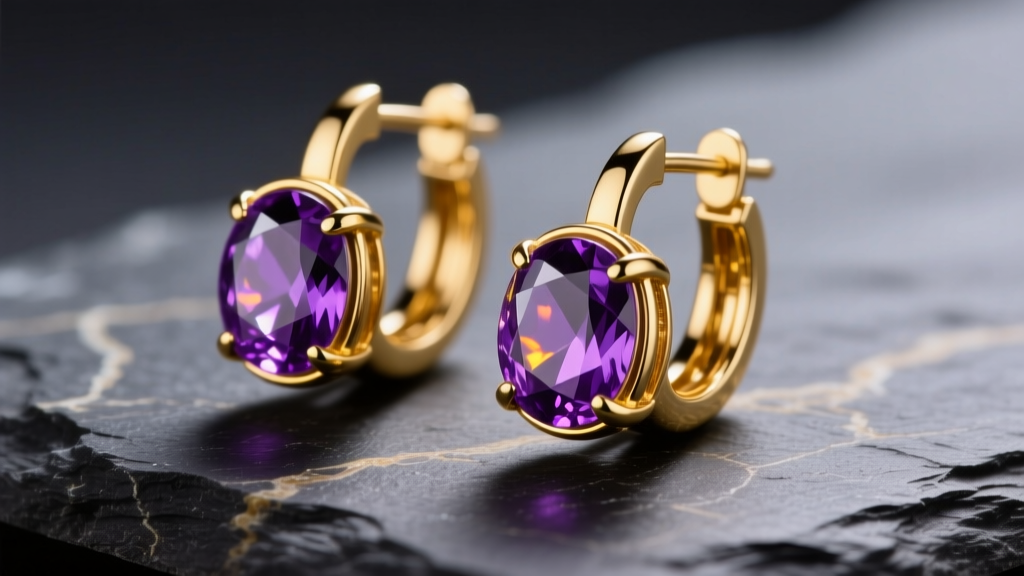
The Mineralogy of Amethyst: Hardness, Cleavage, and Wearability
When evaluating amethyst hoop earrings for daily wear, understanding the gemstone's physical properties is non-negotiable. Amethyst is a purple variety of macrocrystalline quartz, registering a 7 on the Mohs hardness scale. While a 7 is generally considered durable enough for jewelry, it is crucial to note that household dust contains microscopic quartz particles (also a 7). Over years of wear, this can lead to micro-abrasions on the stone's polish if not cleaned properly.
Unlike diamonds or topaz, amethyst has no distinct cleavage planes, meaning it will not split cleanly along structural weaknesses. However, it is still brittle and exhibits a conchoidal (shell-like) fracture. If a hoop earring is dropped onto a hard tile floor, the amethyst is highly susceptible to chipping at the girdle or culet. According to the Gemological Institute of America (GIA), amethyst is also sensitive to sudden temperature changes, which can cause thermal shock and internal fracturing.
Natural vs. Lab-Created: Structural Differences
Lab-created amethyst is grown via hydrothermal synthesis, replicating the exact chemical composition (SiO2) and crystal structure of natural stones. From a purely structural standpoint, lab amethyst is virtually identical to natural amethyst. However, natural stones often contain characteristic inclusions like 'tiger stripes' or 'zebra stripes' (liquid-filled fractures), which can act as internal fault lines. Lab-created stones are typically eye-clean and lack these structural vulnerabilities, making them slightly more resilient for bezel-set hoop designs where impact resistance is a priority.
Metal Alloys for Hoops: Which Base Supports Amethyst Best?
The longevity of amethyst hoop earrings depends heavily on the metal alloy used for the hoop wire and the stone settings. The metal must possess enough tensile strength to hold the gemstone securely without warping, while remaining comfortable for the earlobe.
| Metal Alloy | Composition / Grade | Vickers Hardness (HV) | Tarnish Resistance | Best Hoop Application |
|---|---|---|---|---|
| Sterling Silver | 92.5% Ag, 7.5% Cu | ~60-70 HV | Low (Requires Rhodium) | Lightweight, large-diameter statement hoops |
| 14k Yellow/White Gold | 58.5% Au, Alloyed | ~120-150 HV | High | Standard everyday hoops, secure prong settings |
| Titanium | Grade 23 (Ti-6Al-4V) | ~310 HV | Excellent | Huggies, clickers, and sensitive ear cartilage hoops |
| Platinum | 95% Pt, 5% Ru/Ir | ~110-130 HV | Excellent | Heirloom pieces, heavy stone drop hoops |
For standard lobe piercings, 14k gold offers the optimal balance of malleability for crafting intricate settings and hardness to prevent the hoop from pulling open. Sterling silver, while affordable, is prone to work-hardening and snapping if the hoop wire is too thin (below 20-gauge). Titanium is exceptionally rigid, making it the premier choice for 'clicker' style huggies, though it is notoriously difficult for jewelers to resize or repair if the hinge mechanism fails.
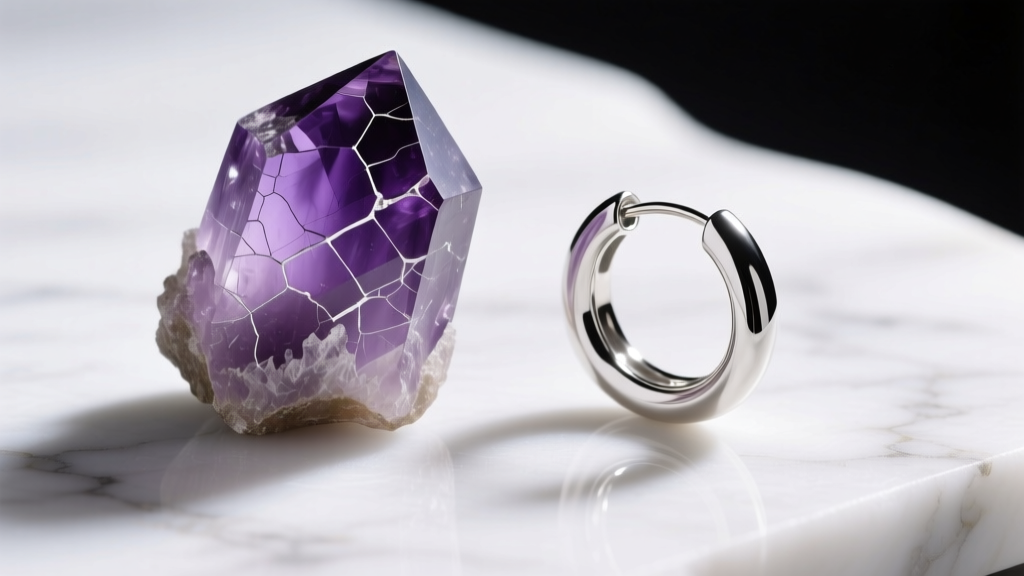
Sourcing and Color Zoning: Zambian vs. Brazilian Amethyst
The visual impact of your amethyst hoop earrings is dictated by the stone's geographic origin, which influences color saturation and clarity.
- Zambian Amethyst: Mined primarily in the Kariba amethyst mines, these stones are renowned for their deep, saturated purple hues with subtle red and blue flashes. They tend to have more visible inclusions, which jewelers often hide using bezel or channel settings along the hoop's curve.
- Brazilian Amethyst: Sourced from regions like Rio Grande do Sul, Brazilian stones are typically lighter in tone and larger in carat weight. They are highly prized for their 'eye-clean' clarity, making them ideal for prong-set hoops where maximum light return is desired.
Heat Treatment and Color Stability
The vast majority of commercial amethyst is heat-treated to enhance color or remove undesirable brownish tints. According to GIA care and cleaning guidelines, this treatment is stable under normal wearing conditions. However, prolonged exposure to intense UV light (such as frequent sunbathing while wearing the earrings) can cause the purple color centers to fade over time, a phenomenon particularly noticeable in lighter Brazilian stones.
Hoop Mechanics: Gauge Sizes, Hinge Types, and Stone Security
The structural integrity of the earring wire is just as critical as the gemstone. Selecting the correct gauge (thickness) and closure type prevents loss and earlobe tearing.
- 20-Gauge (0.81mm): The industry standard for lightweight, classic amethyst hoops. Fits most standard lobe piercings comfortably but can bend if the hoop diameter exceeds 40mm and the metal is silver.
- 18-Gauge (1.02mm): Recommended for heavier stone drops or huggie-style hoops. Provides the necessary rigidity to support the weight of multiple amethyst beads without warping the circular shape.
- 16-Gauge (1.29mm): Primarily used for thick cartilage hoops or heavy statement pieces. Requires a stretched or naturally larger piercing.
When it comes to closures, hinged snap closures and clickers offer the highest security for amethyst hoops. Traditional latch-back wires are a liability; the thin wire can easily catch on hair or clothing, bending the post and compromising the security of the gemstone settings.
Pricing Tiers and Value Assessment
Understanding the intersection of metal weight, stone origin, and craftsmanship helps in assessing the fair market value of amethyst hoop earrings.
Expert Appraisal Tip: Never pay premium prices for amethyst based solely on carat weight. Unlike diamonds, amethyst is abundant in large sizes. Value in amethyst hoops is driven by the depth of the 'Siberian' purple color grading, the precision of the lapidary cut (ensuring stones match perfectly along the hoop), and the karat/weight of the precious metal used.
- Entry-Level ($40 - $90): Lab-created or lightly colored Brazilian amethyst set in rhodium-plated 925 sterling silver. Usually feature simple bead settings or glued-in cabochons.
- Mid-Range ($150 - $450): Natural, eye-clean Brazilian or medium-tone Zambian amethyst set in 14k gold. Features secure prong or bezel settings with reliable hinged closures.
- Premium ($600 - $1,500+): Deep, saturated Zambian amethyst with custom precision cuts, set in 18k gold or platinum. Often features intricate pavé diamond accents along the hoop.
Care Protocols to Prevent Micro-Fractures
Proper maintenance ensures the optical clarity and structural integrity of your earrings. While amethyst is generally safe to clean in a mild ultrasonic cleaner, this is strictly prohibited if the stones have been fracture-filled or possess heavy internal liquid inclusions, as the high-frequency vibrations can shatter the stone from the inside out.
The safest and most effective cleaning method involves soaking the hoops in a lukewarm solution of distilled water and a few drops of pH-neutral dish soap for 10 minutes. Use a soft-bristled baby toothbrush to gently dislodge sebum and cosmetic buildup from the back of the gemstones and the hoop hinges. Rinse with distilled water to prevent hard water spots, and dry thoroughly with a microfiber cloth. Avoid steam cleaners entirely; the rapid thermal expansion can induce catastrophic conchoidal fracturing in quartz-family gems.


