Chain Maille Earrings: A Beginner's Guide to Weaves & Metals
Discover everything about chain maille earrings. Learn about popular weaves, metal grades, wire gauges, and how to choose lightweight styles for daily wear.

What Are Chain Maille Earrings?
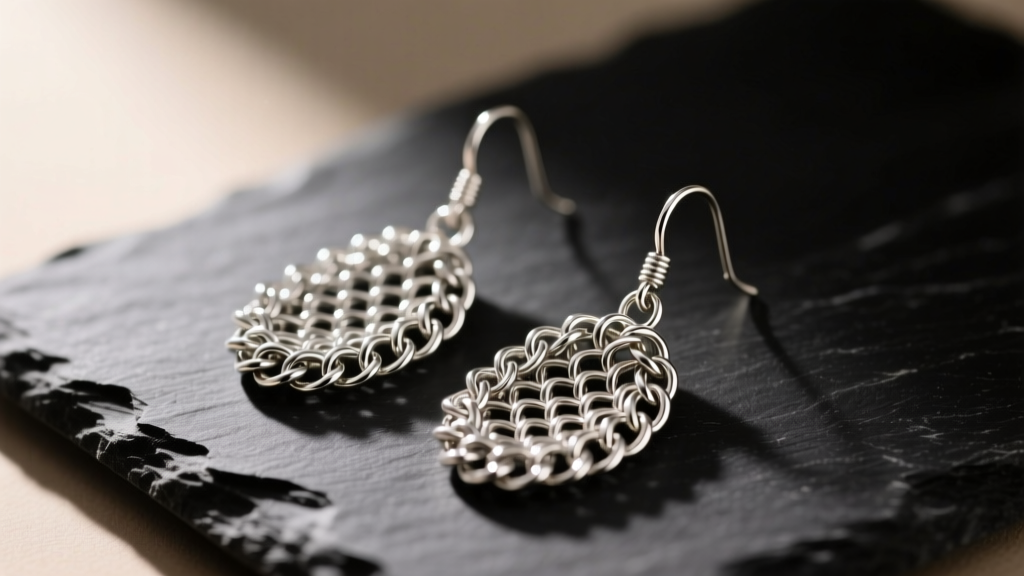
When most people hear the term chain maille, they immediately picture medieval armor or heavy costume replicas. However, in the world of fine and artisan jewelry, chain maille earrings represent a meticulous, highly technical craft. By weaving individual metal jump rings together without the use of solder, artisans create flexible, intricate mesh structures that drape beautifully from the earlobe or cartilage. For beginners looking to purchase their first pair, the sheer variety of patterns, metals, and weights can be overwhelming. This guide will demystify the art form, helping you understand the structural engineering and material science behind high-quality chain maille earrings so you can make an informed, confident purchase.
Decoding the Weaves: 4 Beginner-Friendly Patterns
The foundation of any chain maille earring is the weave. A weave dictates how the rings interlock, which in turn determines the drape, density, and weight of the final piece. According to the Maille Artisans International League (M.A.I.L.), there are thousands of documented weaves, but four stand out as the most popular and wearable for earrings.
1. European 4-in-1
This is the quintessential chain maille pattern, historically used in armor but scaled down for jewelry. In this weave, every central ring passes through four surrounding rings. When used in earrings, European 4-in-1 creates a flat, fabric-like mesh that moves with a fluid, liquid drape. It is an excellent choice for wide, geometric statement studs or lightweight dangle earrings that catch the light from multiple angles.
2. Byzantine
If you want a luxurious, rope-like aesthetic, the Byzantine weave is the gold standard. It features a complex, repeating knot-like pattern that is highly three-dimensional. Because the rings fold back on themselves, Byzantine chain maille earrings tend to be slightly heavier and denser. This weave is perfect for elegant, linear drop earrings that mimic the look of a flexible metal cord.
3. Full Persian
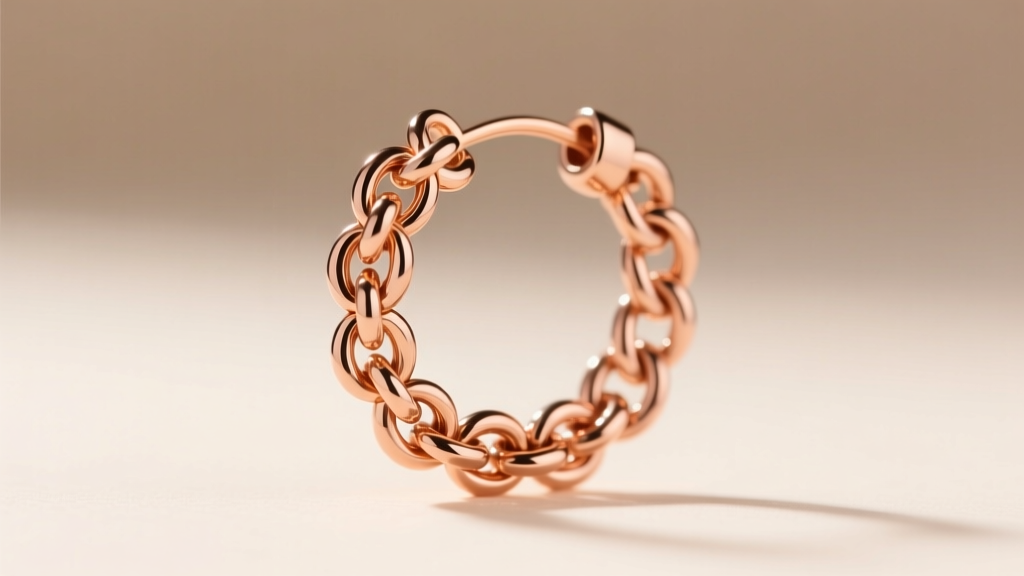
Full Persian creates a dense, scale-like tube that is incredibly eye-catching. The rings nest inside one another at opposing angles, creating a spiraling visual effect. Due to its density, Full Persian is often used for shorter, chunkier dangles or as the central focal point of a mixed-media ear cuff. It offers a substantial feel without requiring massive jump rings.
4. Dragonscale
Dragonscale is an advanced variation that utilizes two different sizes of jump rings—large rings paired with smaller rings that nest inside them. The result is a thick, heavily textured weave that resembles reptilian scales or a thick braided rope. Because it requires twice the metal, Dragonscale earrings are heavier and usually reserved for special occasion statement pieces rather than daily wear.
The Mathematics of Mesh: Gauge and Aspect Ratio (AR)
To truly understand the quality of chain maille earrings, you must understand Aspect Ratio (AR). This is the single most critical metric in the craft. AR is calculated by dividing the Inner Diameter (ID) of the jump ring by the Wire Diameter (WD). If the AR is too low, the rings cannot physically fit together to form the weave. If the AR is too high, the weave becomes sloppy, loose, and prone to snagging on hair or clothing.
Artisan jewelers use precise mandrels to wind coils of wire, ensuring the exact AR required for a specific pattern. When shopping, look for sellers who disclose their gauge and AR, as this indicates a high level of technical expertise. Jewelry supply authorities like Rio Grande Jewelry Supply emphasize that wire temper and exact inner diameter tolerances are what separate professional jewelry components from hobbyist craft wire.
| Weave Pattern | Ideal Aspect Ratio (AR) | Common Wire Gauge (Earrings) | Drape & Flexibility |
|---|---|---|---|
| European 4-in-1 | 5.0 - 5.5 | 20g (0.81mm) or 22g (0.64mm) | High (Fluid, fabric-like) |
| Byzantine | 3.4 - 3.6 | 18g (1.02mm) or 20g (0.81mm) | Medium (Rope-like, structured) |
| Full Persian | 4.6 - 4.8 | 20g (0.81mm) | Low-Medium (Dense, tubular) |
| Dragonscale | Large: 5.2 / Small: 3.4 | 18g (Large) / 22g (Small) | Low (Thick, rigid, heavy) |
Choosing the Right Metal: Beyond Basic Sterling
The metal used in chain maille earrings dictates not only the color but also the longevity, weight, and hypoallergenic properties of the jewelry. Because chain maille requires hundreds of individual rings, the density of the metal directly impacts how heavy the earrings feel on your lobes.
Niobium: The Color Chameleon
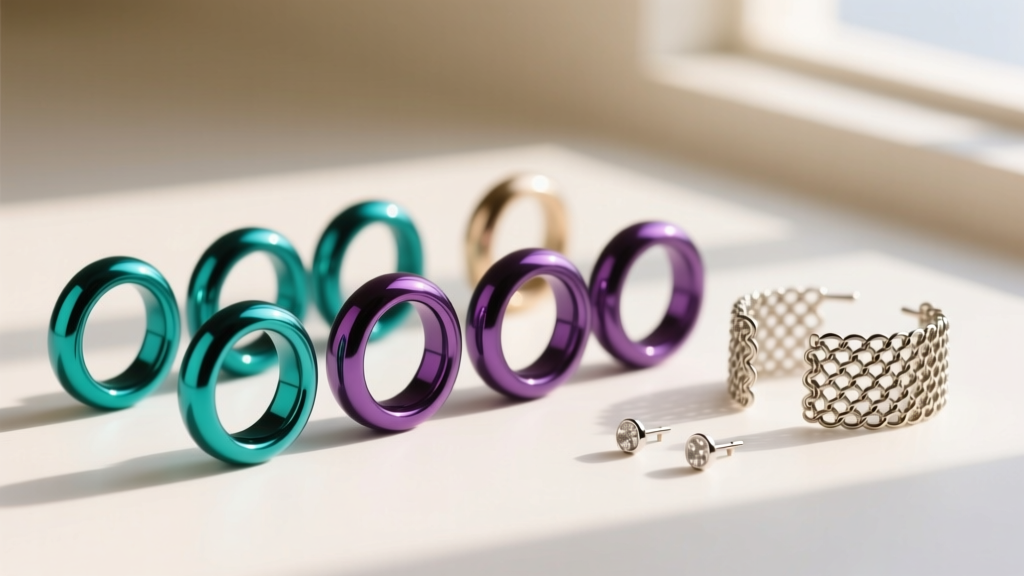
Niobium is a highly reactive, hypoallergenic transition metal that is a favorite among chain maille artisans. Its superpower lies in anodization. By passing a low-voltage electrical current through the metal in an electrolyte bath, the surface oxidizes to reflect specific wavelengths of light. This means niobium jump rings can be permanently colored in vibrant teals, purples, golds, and blacks without the use of toxic dyes or plating that can chip or wear off over time.
Titanium: Strength Meets Comfort
Titanium is exceptionally strong and completely biocompatible, making it ideal for sensitive ears. However, not all titanium is created equal. Grade 1 Titanium is commercially pure, softer, and easier for artisans to cut and weave, resulting in a slightly more flexible earring. Grade 5 Titanium (Ti-6Al-4V) is an aircraft-grade alloy that is much harder; it holds its shape perfectly but is notoriously difficult to work with, often requiring specialized saw blades to cut the jump rings cleanly without leaving sharp burrs.
Argentium Silver: The Tarnish-Resistant Upgrade
Traditional sterling silver (925) contains copper, which reacts with sulfur in the air to create black tarnish—a nightmare for intricate chain maille weaves where polishing cloths cannot reach the inner crevices. Argentium silver replaces some of the copper with germanium. This creates a transparent, self-healing layer of germanium dioxide on the surface, making Argentium chain maille earrings highly resistant to tarnish and significantly lower maintenance than standard sterling.
Hardware, Weight, and Preventing Earlobe Drag
The most common failure point in chain maille earrings is not the weave itself, but the hardware connecting it to the ear. A dense Byzantine dangle can easily weigh 8 to 12 grams per earring. If the ear wire (the hook that goes through the piercing) is made from dead-soft wire, the weight of the chain will slowly bend the hook open, causing you to lose the earring.
Always check the ear wire specifications. High-quality chain maille earrings should feature ear wires made from 20-gauge or 18-gauge half-hard or hard wire. Half-hard wire has been work-hardened (often by drawing it through a die or tumbling it), giving it the spring and tensile strength required to support the mesh without deforming. Additionally, because chain maille is flexible and can easily slip through the ear piercing if jostled, always use silicone O-ring earring backers rather than standard metal butterfly clutches. Silicone grips the wire securely and provides a cushion that prevents the weight of the maille from pulling uncomfortably on the earlobe.
Care and Maintenance for Intricate Mesh
Cleaning chain maille earrings requires a gentle touch. The intricate overlapping rings create hundreds of tiny crevices that can trap skin oils, lotion, and environmental dust.
- Ultrasonic Cleaners: While ultrasonic cleaners are great for solid gemstones, use them with caution on chain maille. The high-frequency vibrations can sometimes cause jump rings that were not closed perfectly flush to rattle open. Furthermore, if the weave is very dense (like Full Persian), water can become trapped inside the mesh, leading to hidden moisture and potential skin irritation.
- Chemical Dips: Never use harsh chemical silver dips (like Tarn-X) on chain maille. These acids strip away oxidation aggressively and can leave a chemical residue deep inside the weave that is impossible to rinse out, which may cause contact dermatitis.
- The Tumble Method: For durable metals like titanium, niobium, and sterling silver, the safest cleaning method is a rotary tumbler with stainless steel shot, mild dish soap, and water. The steel shot gently burnishes the outside of the rings and polishes the accessible crevices without bending the wire.
"The beauty of chain maille jewelry lies in its kinetic nature. It is not a static casting; it is a living, breathing mesh of individual components that move with the wearer. Respecting the mathematics of the weave and the temper of the wire is what transforms a simple craft into heirloom-quality adornment."
By understanding the weaves, the crucial mathematics of Aspect Ratio, and the unique properties of modern jewelry metals, you are now equipped to select chain maille earrings that are not only visually stunning but structurally sound and comfortable for years of daily wear.


