Daisy Earring Guide: Styles, Sizing & Styling for Beginners
Discover everything about the daisy earring trend. Learn about enamel types, gauge sizes, face-shape styling, and how to avoid cheap metals.

The Anatomy of a Daisy Earring
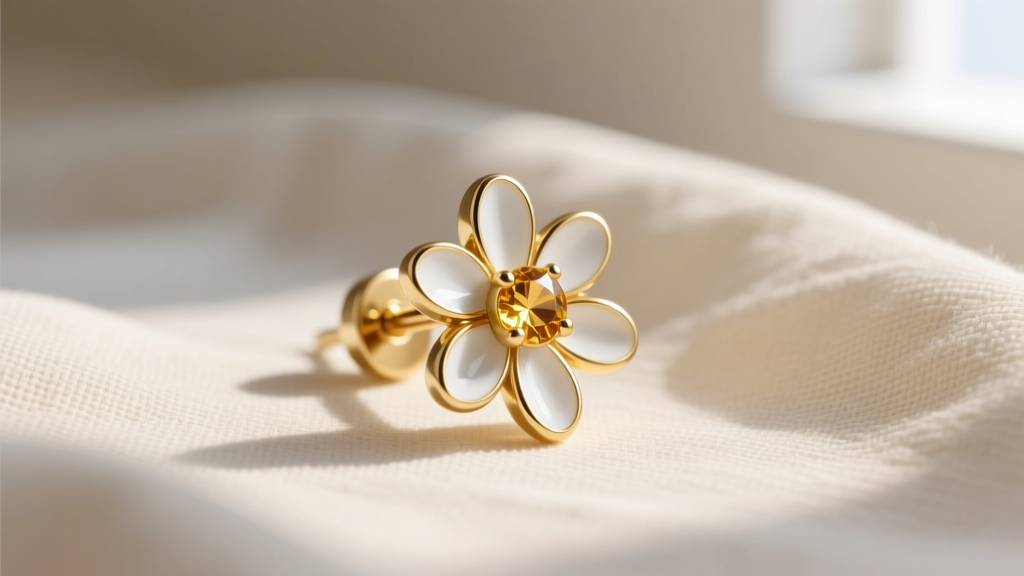
The daisy earring is a perennial staple in jewelry boxes worldwide, celebrated for its delicate symmetry and versatile charm. But as a beginner, navigating the sheer volume of options can be overwhelming. A classic daisy design consists of two main components: the petals and the center stone. The petals are typically crafted from stamped metal or cast wax, then finished with either bare metal, mother-of-pearl inlay, or enamel. The center is usually a bezel-set or prong-set gemstone—ranging from yellow sapphires and citrines to simple gold beads. Understanding this anatomy is your first step toward identifying quality craftsmanship versus mass-produced costume jewelry.
Material Breakdown: What Are You Actually Buying?
When shopping for your first high-quality daisy earring, the materials dictate both the longevity of the piece and the health of your piercings. Let us break down the two most critical material choices.
The Enamel Factor: Vitreous vs. Epoxy
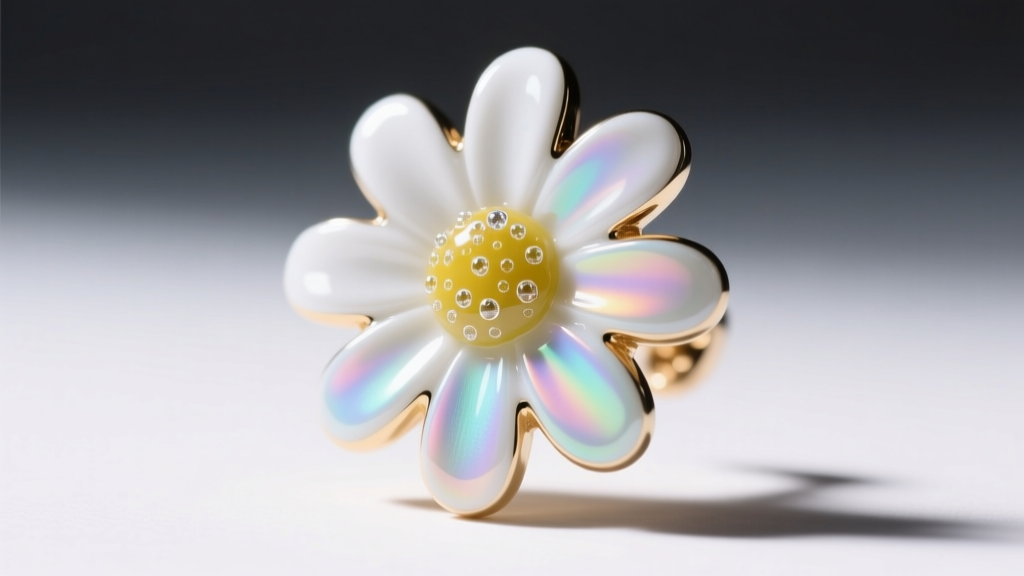
Enamel is the lifeblood of the classic white-petal daisy look. However, not all enamel is created equal. According to the Gemological Institute of America (GIA), true vitreous enamel is made from finely ground glass powder that is kiln-fired onto metal at temperatures exceeding 1400°F. This creates a hard, scratch-resistant, and luminous finish. In contrast, budget-friendly options use cold enamel (epoxy resin), which air-cures. Epoxy is prone to yellowing, chipping, and peeling within a year of daily wear. If you want a daisy earring that lasts, always verify that the product description specifies 'vitreous' or 'fired' enamel.
Metal Bases & Hypoallergenic Needs
The metal base is just as critical. For sensitive ears or fresh piercings, you must avoid brass and nickel-alloy bases. Look for 14k or 18k solid gold, or implant-grade titanium. According to ASTM International, the standard for implant-grade titanium is ASTM F-136. This specific grade is virtually nickel-free and highly biocompatible, making it the ultimate choice for cartilage piercings that take months to heal. Sterling silver (925) is acceptable for fully healed lobes but can tarnish and cause irritation in unhealed or highly sensitive cartilage.
Sizing & Gauge Guide for Every Piercing
One of the most common beginner mistakes is buying a daisy earring with the wrong post thickness (gauge) or diameter for the intended piercing. A 4mm daisy stud might look adorable on a standard lobe, but it will look lost on a flat piercing. Conversely, an 8mm daisy might be too heavy for a delicate helix. Use the table below as your definitive sizing framework.
| Piercing Location | Standard Gauge | Post Thickness (mm) | Ideal Daisy Diameter | Recommended Style |
|---|---|---|---|---|
| Standard Lobe | 20g or 18g | 0.81mm - 1.02mm | 4mm - 6mm | Push-back stud or clicker hoop |
| Upper Lobe / Helix | 18g or 16g | 1.02mm - 1.29mm | 3mm - 5mm | Flat-back labret stud |
| Flat / Conch | 16g or 14g | 1.29mm - 1.63mm | 6mm - 10mm | Flat-back labret or dangle |
| Tragus | 18g or 16g | 1.02mm - 1.29mm | 3mm - 4mm | Petite flat-back stud |
Pro Tip: If you are buying a daisy earring for a cartilage piercing, always opt for internally threaded or threadless flat-back labrets. Traditional 'butterfly' push-backs trap moisture and bacteria against the skin, which is a primary cause of contact dermatitis and piercing bumps.
Styling Framework: Face Shapes & Placements
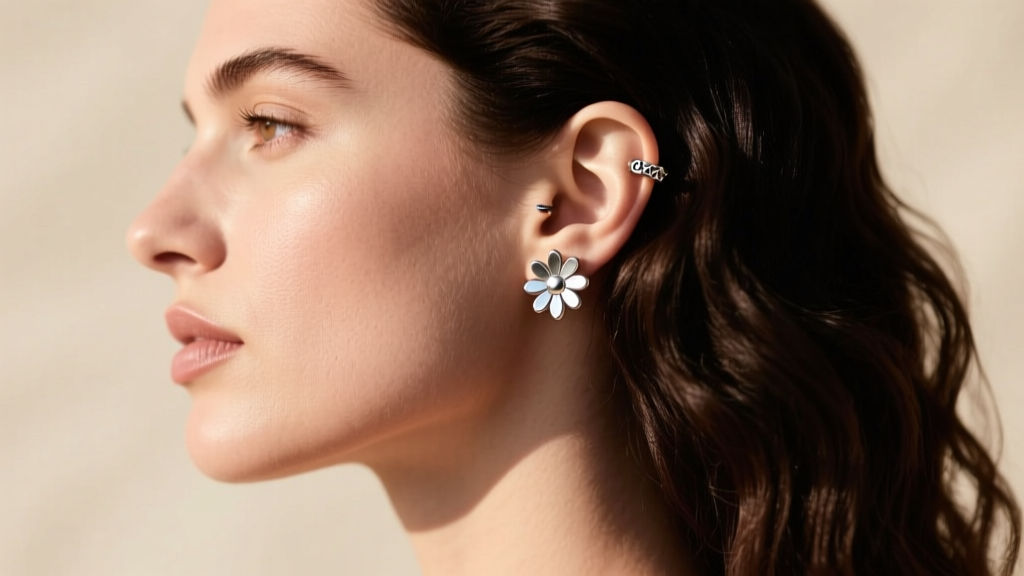
The daisy motif is inherently playful and soft, but the way you wear it should complement your facial structure. Here is a practical styling framework to help you choose the right silhouette.
- Round Faces: Avoid wide, clustered daisy studs that add horizontal volume. Instead, opt for elongated daisy drop earrings or dangle styles. The vertical movement draws the eye downward, creating a lengthening illusion.
- Square Faces: Angular jawlines benefit from the soft, curved geometry of the daisy. Medium-sized (5mm-7mm) classic daisy studs or huggie hoops featuring daisy charms will soften your natural angles without overwhelming your features.
- Heart-Shaped Faces: With a wider forehead and narrower chin, you want to add visual weight to the lower half of your face. Teardrop-shaped daisy earrings or chandelier styles with floral motifs are highly effective.
- Oval Faces: You have the most versatility. From tiny 3mm helix cuffs to bold, oversized statement daisy hoops, almost any proportion will work harmoniously with your natural symmetry.
Common Beginner Mistakes & Failure Modes
Even with the right materials, improper wear and care can ruin a beautiful piece of jewelry. Be aware of these specific failure modes:
1. Sleeping in Butterfly Backs
Falling asleep with standard push-back daisy studs will inevitably lead to bent posts. A 20g (0.81mm) gold post is incredibly malleable. Once bent, the structural integrity is compromised, and the friction notch that holds the clutch weakens, leading to lost earrings. Always remove them before bed, or switch to flat-back titanium labrets that are designed for 24/7 wear.
2. Ultrasonic Cleaning Enamel
While ultrasonic cleaners are excellent for bare diamond and gold jewelry, the high-frequency vibrations can cause micro-fractures in vitreous enamel, eventually causing the glass finish to pop out of the metal setting. Clean your enameled daisy earrings using only warm water, a drop of mild dish soap, and a soft-bristled baby toothbrush.
"The biggest mistake I see beginners make is treating enamel like solid stone. Enamel is essentially glass fused to metal; it requires the same gentle care you would give to a delicate vintage opal." — Master Bench Jeweler
Price Tiers: Where Should You Invest?
Understanding pricing helps you set realistic expectations for quality. Here is what you should expect to pay across the market spectrum:
- Fashion / Costume ($10 - $35): Expect brass or alloy bases plated in gold, with epoxy cold enamel and cubic zirconia centers. Great for occasional wear, but will tarnish and chip quickly.
- Demi-Fine ($40 - $120): The sweet spot for beginners. Brands in this tier use 925 sterling silver or gold vermeil bases, often with better quality cold enamel or basic vitreous enamel, and semi-precious stones like citrine or peridot.
- Fine Jewelry ($200 - $800+): Solid 14k or 18k gold bases, genuine vitreous enamel, and natural gemstones (yellow sapphires, diamonds). These are heirloom-quality pieces that will never tarnish and can be worn in the shower without degrading.
By understanding the anatomy, materials, and proper sizing of the daisy earring, you can confidently build a curated, hypoallergenic collection that suits your unique anatomy and personal style. Start with a high-quality 14k gold or titanium flat-back stud for your primary piercing, and expand into hoops and dangles as your collection grows.


