Beginner Guide to Choosing the Right Earring Holder Frame
Discover how to choose the ideal earring holder frame for studs, hoops, and dangles. Learn about materials, hole sizing, and tips to protect your jewelry.

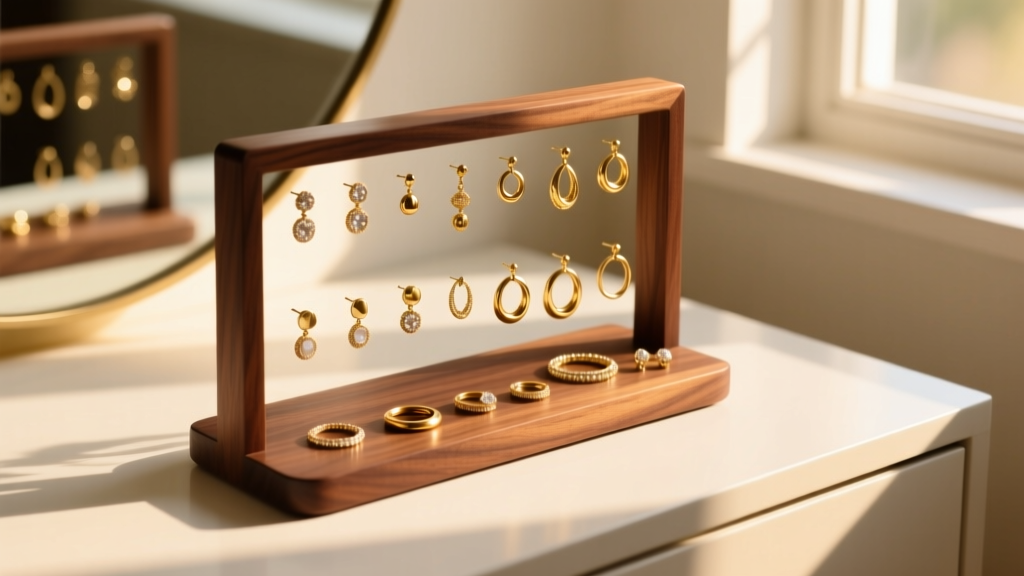
If you have ever opened a traditional jewelry box only to find a tangled mess of chains, missing butterfly backs, and bent earring posts, you already understand the limitations of conventional storage. As your collection grows beyond a few basic pairs, upgrading to a dedicated earring holder frame transitions from a luxury to an absolute necessity. However, not all display frames are created equal. Choosing the wrong material or hole size can inadvertently scratch your precious metals, bend your posts, or even accelerate tarnishing. This beginner-friendly guide will walk you through the exact specifications, material sciences, and organizational strategies you need to select the perfect earring holder frame for your unique collection.
Why Traditional Jewelry Boxes Fail Your Earrings
Most standard jewelry boxes utilize padded inserts or small, enclosed compartments. While this seems protective, it creates three distinct problems for earrings. First, friction. When studs and dangles are tossed into a shared compartment, the harder gemstones (like diamonds or sapphires) can easily scratch softer metals (like high-karat gold or silver). Second, moisture trapping. Enclosed velvet or suede linings can trap ambient humidity against the metal, creating a microclimate that accelerates the oxidation of sterling silver. Finally, structural damage. Without a dedicated vertical anchor, the delicate 20-gauge or 22-gauge wire posts of dangle earrings are easily bent under the weight of other jewelry pieces. An open-air earring holder frame solves all three issues by providing individual, suspended, and ventilated storage.
Decoding Earring Holder Frame Materials
The structural material of your frame dictates not only the aesthetic of your vanity but also the chemical safety of your jewelry. Here is a deep dive into the three most common materials used in modern earring displays.
Acrylic and Lucite (PMMA)
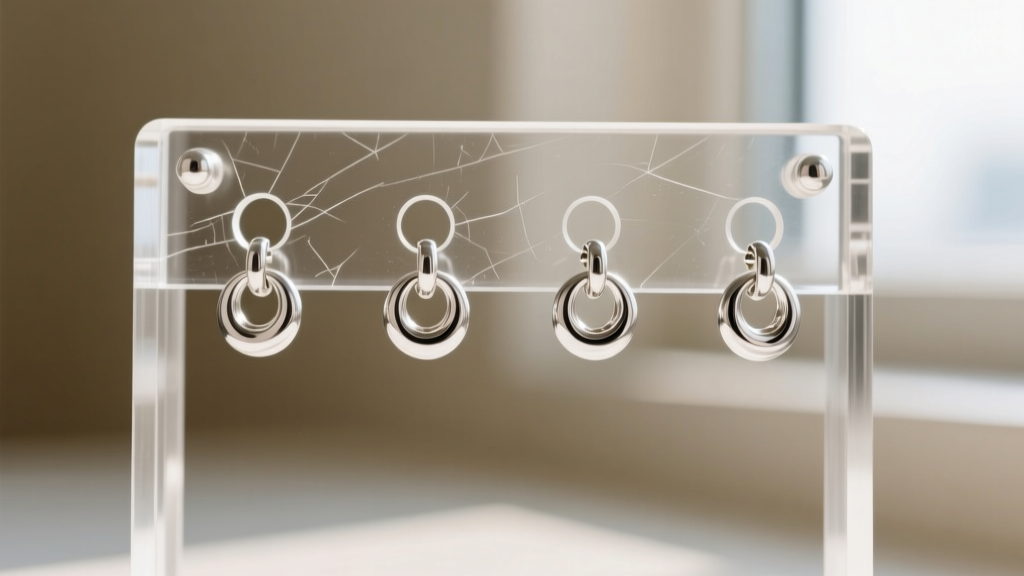
Clear acrylic frames are incredibly popular for their modern, minimalist look and high visibility. They allow you to see your entire collection at a glance. However, acrylic is highly susceptible to static electricity buildup, which acts as a magnet for household dust and skin cells, requiring frequent cleaning. Furthermore, cheap acrylic can yellow over time if exposed to direct UV sunlight. When purchasing an acrylic frame, look for cast acrylic rather than extruded, as it offers better optical clarity and resists micro-cracking around the laser-cut holes.
Solid Wood and MDF Veneers
Wooden frames offer a warm, classic aesthetic, but they require careful selection regarding their finish. Raw, unfinished woods—particularly oak, cedar, and walnut—naturally off-gas volatile organic compounds (VOCs) and acetic acid. According to conservation guidelines from the Gemological Institute of America (GIA), acidic off-gassing can react with the copper alloys in sterling silver and rose gold, causing rapid and severe tarnishing. Always ensure your wooden earring holder frame is sealed with a water-based polyurethane or features a fully cured, painted finish to create an inert barrier between the wood and your jewelry.
Metal Wire and Powder-Coated Steel
Metal frames, often featuring a grid or mesh design, are the most durable and offer the best structural support for heavy, gemstone-laden dangles. However, bare brass or copper wire frames should be avoided, as the copper can transfer to porous gemstones like turquoise, opal, or malachite if they swing and make contact. Opt for frames with a high-quality powder coating or an electroplated chrome finish to ensure the surface remains completely non-reactive.
The Critical Metric: Hole Sizing and Spacing
The most common mistake beginners make when buying an earring holder frame is ignoring the diameter of the punched or laser-cut holes. If the hole is too tight, you will scrape the plating off your earrings every time you insert or remove them. If it is too loose, heavy studs will droop, putting uneven stress on the earring back. To understand proper sizing, we must look at standard jewelry wire gauges. Data from Rio Grande Jewelry Supplies outlines the precise millimeter conversions for standard earring posts.
| Earring Type | Standard Wire Gauge | Post Diameter (mm) | Ideal Frame Hole Size |
|---|---|---|---|
| Fine Jewelry Studs | 20 Gauge | 0.81 mm | 1.5 mm |
| Standard Fashion Studs | 18 Gauge | 1.02 mm | 1.5 mm to 2.0 mm |
| Cartilage / Thick Posts | 16 Gauge | 1.29 mm | 2.0 mm to 2.5 mm |
| Wire Hook Dangles | 22 to 20 Gauge | 0.64 to 0.81 mm | Slotted or 3.0 mm+ |
As a general rule, the frame's hole should be at least 0.5mm wider than the earring's post diameter. This provides enough clearance for smooth insertion without sacrificing the upright posture of the earring. For dangle earrings with shepherd hooks, look for frames that feature slotted tops or notched edges rather than enclosed holes, allowing you to simply drop the hook into place without threading it.
Organizing by Earring Type: A Beginner's Blueprint
A well-designed earring holder frame accommodates the varying spatial requirements of different earring silhouettes. Here is how to map out your display based on the pieces you own.
Studs and Huggies
Studs and small huggie hoops require minimal vertical clearance but demand high horizontal density. Look for a frame with a tight grid pattern, ideally with 0.75-inch to 1-inch spacing between holes. This maximizes your storage footprint while ensuring that the gemstones of adjacent studs do not touch. If you collect high-profile studs (such as martini-set diamonds that sit 8mm off the lobe), ensure the frame has a slight forward tilt or a deep base to prevent top-heavy studs from falling backward.
Dangles and Drop Earrings
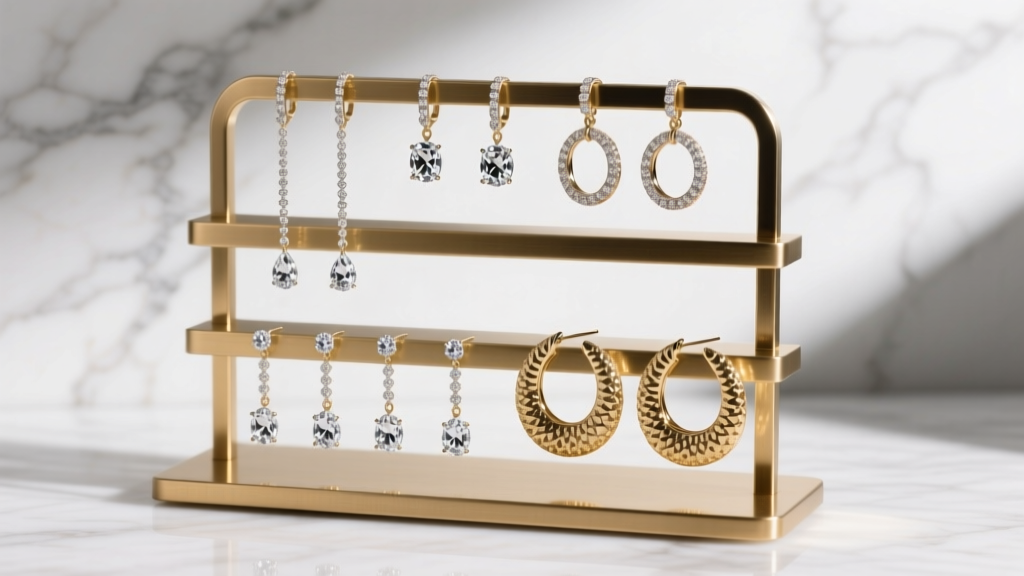
Dangle earrings require significant vertical real estate. A standard drop earring can range from 1.5 inches to over 4 inches in length. If you are utilizing a multi-tiered frame, the vertical distance between the tiers must be at least 5 inches to prevent the top tier's dangles from resting on the studs of the bottom tier. Tiered metal frames with a cascading waterfall design are ideal here, as they naturally stagger the vertical drop.
Large Hoops and Ear Cuffs
Large hoops (30mm and above) are notoriously difficult to store in standard hole-punched frames because their circular shape causes them to overlap and tangle with neighboring pieces. For large hoops, seek out an earring holder frame that features specialized horizontal notches or T-bar displays. Ear cuffs and climbers, which lack a traditional post, are best stored on small, velvet-lined trays integrated into the base of the frame, or clipped onto a dedicated wire mesh section.
Pro Tips for Tarnish Prevention and Maintenance
While an open-air earring holder frame improves visibility and prevents tangling, it does expose your jewelry to ambient air, which contains sulfur compounds that cause silver tarnish. To mitigate this without sacrificing the display aspect, incorporate passive environmental controls into your vanity setup.
- Anti-Tarnish Strips: Place 3M or Pacific Silvercloth anti-tarnish strips directly on the base of the frame or tucked behind the back tier. These strips absorb airborne sulfur and hydrogen sulfide, protecting the jewelry displayed in the immediate vicinity.
- Silica Gel Packets: If your frame is situated in a bathroom or a humid climate, affix small, breathable silica gel packets to the underside of the frame's base to control localized moisture spikes.
- Rotational Cleaning: Because acrylic builds static and attracts dust, wipe down your frame weekly with an anti-static microfiber cloth. Avoid harsh chemical glass cleaners, as ammonia-based solutions can degrade the structural integrity of both acrylic frames and porous gemstones like pearls.
Final Thoughts on Building Your Display
Selecting the right earring holder frame is an exercise in balancing aesthetic appeal with material science and precise dimensional planning. By prioritizing sealed or inert materials, matching hole sizes to standard jewelry wire gauges, and allocating the correct spatial geometry for your specific earring types, you will build a display that not only looks stunning on your vanity but actively preserves the condition and longevity of your jewelry collection. Start by auditing your current collection, measure your heaviest and longest pieces, and choose a frame that meets those exact technical requirements.


