Big Gold Ball Earrings: 2026 Trend Analysis & Styling Guide
Explore the 2026 trend of big gold ball earrings. Discover expert styling tips, material weights, gauge sizes, and face-shape matching frameworks.

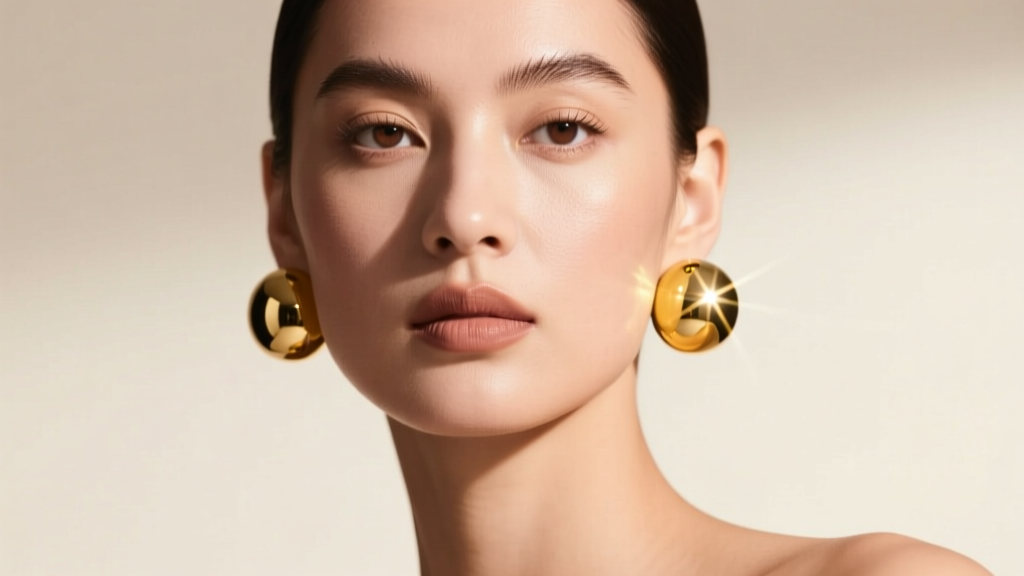
The jewelry landscape of 2026 has decisively pivoted from the understated whispers of "quiet luxury" to bold, sculptural maximalism. At the forefront of this shift are big gold ball earrings—a timeless silhouette that has been reimagined for the modern era. No longer just a vintage throwback, the oversized gold sphere is now a staple of contemporary ear curation, celebrated for its geometric purity and light-catching brilliance. However, pulling off this statement piece requires more than just slipping on a pair of hoops. It demands an understanding of metallurgy, structural integrity, and facial proportions.
The Resurgence of the Statement Sphere
Over the past few seasons, runway presentations and editorial spreads have heavily favored voluminous, three-dimensional jewelry. According to trend forecasters and Vogue Jewelry, the sphere represents a return to organic, celestial motifs, contrasting sharply with the sharp, angular lines that dominated the early 2020s. Big gold ball earrings act as portable reflectors, bouncing ambient light onto the face and creating a natural, flattering glow.
But the 2026 iteration of this trend is distinctly different from the heavy, solid gold bobs of the 1980s. Today’s designers are leveraging advanced jewelry-making techniques to create massive silhouettes that remain featherlight. This evolution has democratized the trend, allowing wearers to sport 30mm spheres without suffering from lobe fatigue or structural damage to their piercings.
Material & Weight Dynamics: The Engineering of the Sphere
When shopping for big gold ball earrings, the most critical factor is not just the karat, but the construction method. Gold is a dense metal; a solid 20mm sphere of 14k gold weighs approximately 12 grams per earring. For context, a standard comfortable lobe earring weighs between 2 and 4 grams. To combat this, jewelers utilize specific engineering techniques.
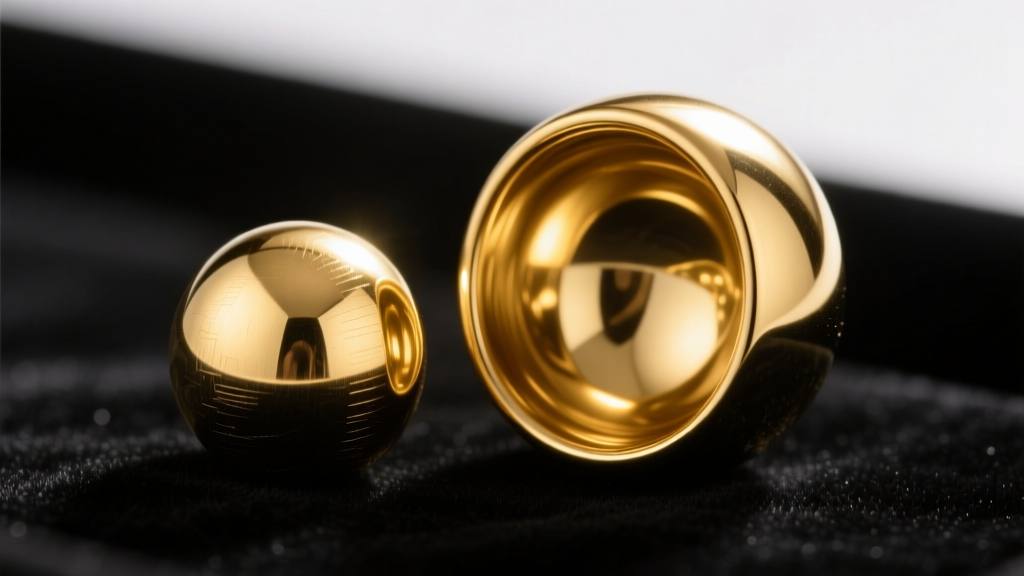
The Gemological Institute of America (GIA) notes that while 18k gold (75% pure) offers a richer, deeper yellow hue, it is significantly softer than 14k gold (58.5% pure). For high-polish spherical earrings that are prone to micro-scratches and surface dents, 14k gold is often the superior choice for everyday wear due to its enhanced durability.
Construction Comparison Chart
| Construction Method | Typical Diameter | Weight (Per Earring) | Durability Profile | Estimated Price Range (14k) |
|---|---|---|---|---|
| Solid Cast | 8mm - 12mm | 4g - 10g | High (Resists dents, heavy on lobe) | $400 - $900 |
| Hollow Electroformed | 15mm - 30mm | 1.5g - 3.5g | Low (Prone to denting, very lightweight) | $250 - $600 |
| Gold Vermeil (Sterling Core) | 15mm - 25mm | 3g - 6g | Medium (Plating wears over time) | $80 - $180 |
Expert Warning: Never place hollow electroformed gold earrings in an ultrasonic cleaner. The high-frequency vibrations can compromise the microscopic seams used during the electroforming process, trapping water inside the sphere and leading to irreversible internal corrosion.
Proportions & Face Shape Framework
The visual impact of big gold ball earrings is heavily dictated by the diameter of the sphere relative to the wearer's facial structure. A 25mm sphere will look like a subtle stud on a larger face, but overwhelmingly dominant on a petite one. Use this framework to select your ideal millimeter (mm) size:
- Round & Heart Face Shapes: Opt for medium-to-large spheres (18mm - 25mm). The circular geometry of the earring echoes the natural curves of the face, but the sheer volume draws the eye downward, creating an illusion of elongation. Avoid perfectly round, small 10mm studs, which can emphasize facial width.
- Oval Face Shapes: You have the most versatility. A dramatic 30mm hollow gold sphere will look incredibly avant-garde and balanced, while a classic 15mm solid ball provides elegant, everyday polish.
- Square & Angular Face Shapes: Soften a strong jawline with oversized, high-polish spheres (20mm+). The reflective, curved surface of the gold contrasts beautifully with sharp bone structure, softening the overall profile without adding harsh lines.
- Long & Rectangular Face Shapes: Stick to medium proportions (12mm - 18mm). Massive 30mm drop-style ball earrings will only elongate the face further. A wider, horizontally oriented ear curation works better here.
Structural Integrity: Posts, Backs, and Gauges
The most common failure point for big gold ball earrings is not the gold itself, but the post and backing system. A heavy sphere acts as a pendulum, putting immense leverage on the earlobe piercing.
Gauge Sizing and Post Thickness
Standard earlobe piercings are typically done at 20-gauge (0.81mm) or 18-gauge (1.02mm). If you are wearing solid gold balls larger than 12mm, the weight will cause a standard 20g post to bend, leading to an awkward, downward-facing droop. For spheres exceeding 15mm in solid gold, look for earrings featuring a 14-gauge (1.63mm) or 12-gauge (2.05mm) post. You may need to have your piercer gently stretch your lobe to accommodate the thicker metal, but the structural support is worth it.
The Backing System
Discard standard butterfly friction backs for heavy statement pieces. They lack the surface area to distribute weight, leading to localized pressure and "cheese-cutter" effects on the piercing hole. Instead, seek out:
- Omega Backs: These feature a hinged, curved paddle that snaps shut against the post, distributing the weight across a wider area of the back of the earlobe.
- Screw Backs: Ideal for medium-weight spheres, the threaded post and screw-on back ensure the earring will never accidentally fall off and get lost.
- Clip-On Conversions: For ultra-heavy vintage or solid 20mm+ pieces, a well-padded clip-on mechanism entirely bypasses the piercing, saving your lobes from stretching.
Styling the Statement: Ear Curation & Wardrobe Pairing
In 2026, the styling rule for big gold ball earrings is "isolation and contrast." Because the high-polish gold sphere commands so much visual attention, it should be the undisputed focal point of your ear curation.
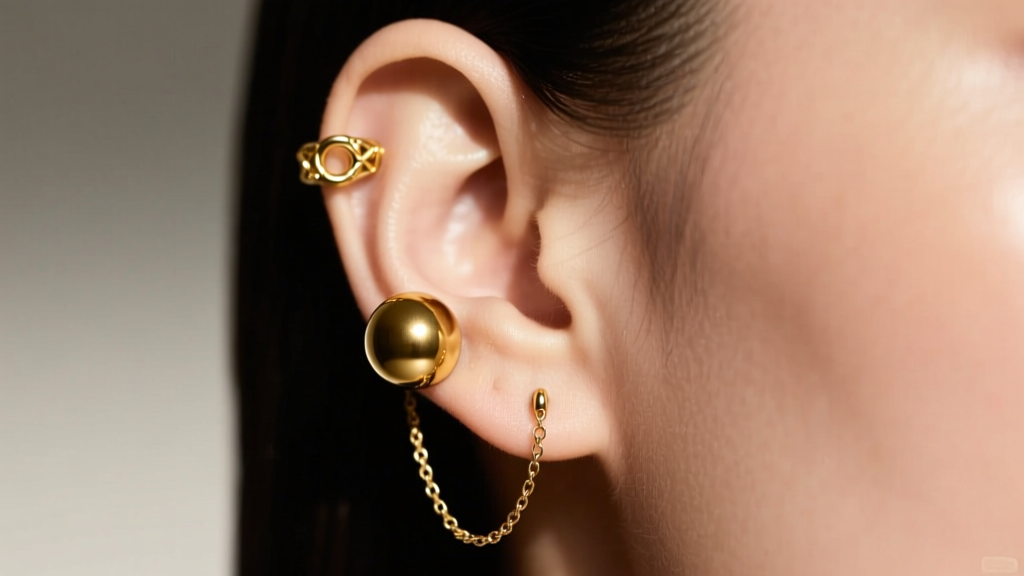
If you have multiple piercings, pair a large 20mm gold ball in your primary lobe piercing with a delicate, matte-finish 14k gold chain earring in your second hole, and a tiny, flush-set diamond cartilage stud in your helix. This creates a cascading effect that guides the eye upward without competing with the main sphere.
When it comes to necklines, big gold ball earrings thrive on negative space. They are best paired with structured blazers, deep V-necks, or strapless gowns. Avoid wearing them with heavily embellished collars, ruffled blouses, or chunky statement necklaces, which will create visual clutter and diminish the sculptural impact of the earrings. Treat the gold sphere not just as jewelry, but as a piece of wearable modern art that requires room to breathe.


