Celebrities With Earrings Men: 2026 Technical Style Guide
Analyze the exact technical specs, gauge sizes, and metal grades behind 2026's top male celebrity earring trends for a flawless, safe fit.

The Evolution of Male Ear Adornment: Beyond the Standard Stud
When analyzing the current landscape of celebrities with earrings men look to for inspiration, the conversation has fundamentally shifted from mere aesthetics to structural engineering and metallurgical integrity. In 2026, male ear adornment is no longer limited to the standard 20-gauge diamond stud. Icons like A$AP Rocky, Paul Mescal, Harry Styles, and Bad Bunny are pushing the boundaries of jewelry design, utilizing heavy baroque pearls, mismatched charm drops, and complex multi-piercing cartilage setups. However, replicating these high-impact looks requires a deep understanding of jewelry mechanics. Wearing a heavy drop earring on a standard friction-post backing is a recipe for lobe fatigue, fistula tearing, and lost investment pieces. This technical deep dive deconstructs the exact specifications—gauge sizes, weight distribution, and metal grades—required to safely and comfortably emulate today’s most prominent male earring trends.
The "Paul Mescal" Hoop: Gauge and Diameter Metrics
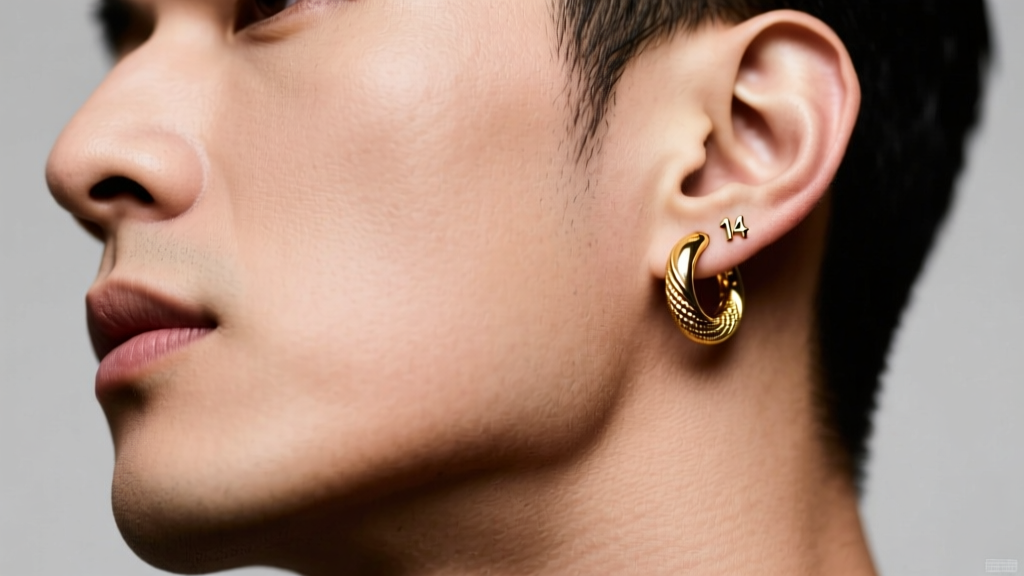
The minimalist, continuous hoop popularized by Paul Mescal and Jacob Elordi has become a staple in men's jewelry. However, the majority of mass-market hoops fail due to improper gauge sizing and poor clasp mechanics. Standard department store hoops are typically crafted at 20-gauge (0.81mm) or 18-gauge (1.02mm). At these thicknesses, the wire lacks the structural rigidity to withstand the friction of daily wear, sleeping, and physical activity, leading to warping and eventual snapping at the hinge or clasp.
Optimal Sizing for Structural Integrity
To achieve the substantial, masculine profile seen on screen and the red carpet, the technical baseline for a men's hoop is 16-gauge (1.29mm) to 14-gauge (1.63mm). A 14-gauge wire provides exceptional resistance to bending and ensures the hoop maintains its perfect circular geometry over time. When selecting the diameter, the placement on the earlobe dictates the visual impact:
- 10mm - 12mm (Huggie/Snug Fit): Sits flush against the lobe. Ideal for a subtle, everyday aesthetic that won't catch on clothing or headphones.
- 15mm - 20mm (Standard Drop): The most versatile range, providing visible movement and presence without excessive weight pulling on the fistula.
- 25mm+ (Statement Hoop): Requires a heavier gauge (12G or 10G) to prevent the bottom arc from sagging and distorting the earring's shape.
Furthermore, the closure mechanism is critical. Avoid "clicker" hinges for high-value gold hoops, as the internal tension spring is a common failure point. Instead, opt for seamless continuous rings (where the wire slides into a hollow tube) or segment rings with a precision-machined captive O-ring, both of which offer superior security for active lifestyles.
High-Impact Drops & Pearls: The A$AP Rocky Effect
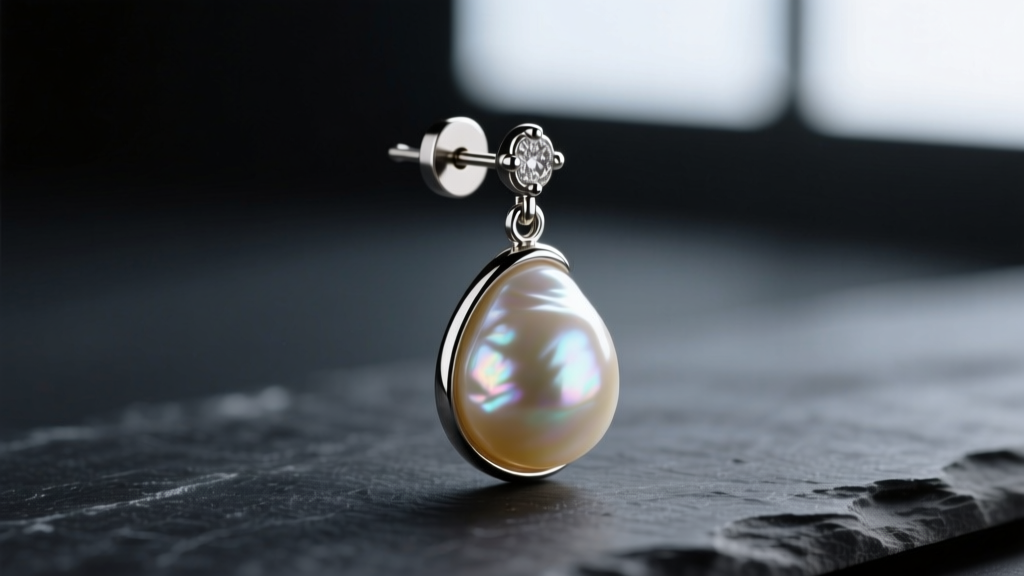
The integration of pearls and elongated diamond drops into men's fashion has been largely spearheaded by A$AP Rocky and Harry Styles. These pieces introduce a complex variable: pendulum weight distribution. Unlike a static stud, a drop earring acts as a lever against the earlobe. The longer the drop and the heavier the gemstone, the more torque is applied to the piercing channel.
Weight Distribution and Lobe Fatigue
A standard freshwater baroque pearl can weigh between 3 to 6 grams. When suspended from a 2-inch titanium or gold chain, the kinetic energy generated by simply walking or turning the head creates micro-tears in the healing or established fistula. Over time, this leads to "cheese-cutter syndrome," where the earring post slowly migrates downward, permanently elongating the piercing hole.
The Technical Solution: To mitigate lobe fatigue, high-end jewelers engineer drop earrings with a 14-gauge or 12-gauge post to increase the surface area distributing the weight. Additionally, utilizing a silicone O-ring backing or a specialized wide-disc La Pousette back provides a broader anchor against the rear of the lobe, dispersing the kinetic load and preventing the post from tilting forward. According to the Association of Professional Piercers (APP), maintaining proper jewelry weight and gauge is essential to preventing irreversible tissue thinning in the earlobe.
Material Science: Hypoallergenic Profiles for Men's Jewelry
Men's skin chemistry, particularly higher sebum production and increased sweat during physical activity, accelerates the oxidation and corrosion of inferior metals. Many celebrities are seen wearing pieces that appear to be silver but are actually high-karat gold or platinum alloys chosen specifically for their biocompatibility. Understanding metallurgical grades is non-negotiable when investing in luxury men's earrings.
| Metal Grade | Nickel Content | Corrosion Resistance | Best Use Case |
|---|---|---|---|
| ASTM F-136 Titanium | 0% (Implant Grade) | Exceptional | Initial piercings, cartilage, heavy drops |
| 14k / 18k Solid Gold | Varies (Alloy dependent) | High | Everyday lobe wear, luxury statement pieces |
| 316L Surgical Steel | 8% - 12% | Moderate | Temporary wear (Not recommended for sensitive skin) |
| Platinum (950) | 0% | Unmatched | Heirloom diamond settings, hypoallergenic needs |
Always verify that gold alloys are nickel-free. Many white gold pieces are plated with rhodium over a nickel-heavy base alloy; once the plating wears off from friction, it triggers severe contact dermatitis. For the safest, most durable option that mimics the look of white gold or silver, Implant Grade Titanium or Platinum are the undisputed industry standards.
Cartilage & Multi-Piercing Setups: The Bad Bunny Blueprint
Cartilage piercings—specifically the helix, flat, and conch—have become a defining element of the modern male aesthetic, heavily popularized by artists like Bad Bunny and Post Malone. Cartilage tissue is avascular (lacking direct blood supply) and significantly denser than lobe tissue, demanding entirely different jewelry mechanics to heal properly and remain secure.
Threadless vs. Internally Threaded: Securing High-Value Pieces
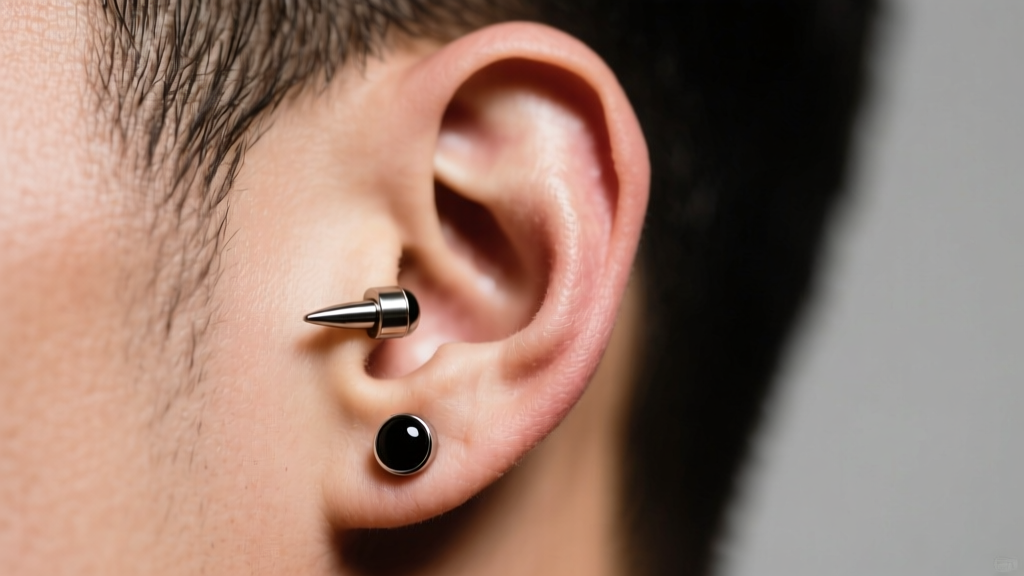
For cartilage setups, the traditional "butterfly" friction back is entirely obsolete and highly discouraged. It harbors bacteria and provides inadequate tension. The industry standard for high-end cartilage jewelry in 2026 relies on two distinct mechanical systems:
- Internally Threaded Jewelry: The screw mechanism is on the post, not the decorative end. This prevents the sharp threads from tearing the fistula during insertion. It is highly secure but requires precise alignment to avoid cross-threading.
- Threadless Push-Pin System: The decorative end features a slightly bent titanium pin that inserts into a hollow post. The tension created by the bent pin against the inner wall of the post creates a vacuum-like lock. This is the preferred method for securing expensive gemstone ends (like black onyx or sapphires) because it is virtually impossible to accidentally dislodge without intentional, simultaneous pulling from both sides.
When curating a cartilage setup, ensure all posts are cut to the exact millimeter of your tissue thickness (typically 6mm to 8mm for most male ears). A post that is too long will catch on hair and clothing, leading to irritation bumps (hypertrophic scarring), while a post that is too short will embed into the swelling tissue.
Sourcing & Maintenance: Building a Technical Capsule Collection
Building a collection inspired by top celebrities with earrings men admire requires a commitment to maintenance and ethical sourcing. When purchasing diamond drops or pearl studs, always demand documentation from the Gemological Institute of America (GIA) or equivalent gemological laboratories to verify the origin and quality of the stones. Lab-grown diamonds have become the standard for large-carat drop earrings, offering identical optical and physical properties to mined stones at a fraction of the cost and environmental impact.
The Maintenance Protocol
To maintain the structural integrity and brilliance of your pieces, implement a strict maintenance protocol:
- Ultrasonic Caution: Never use ultrasonic cleaners on baroque pearls, opals, or emeralds. The high-frequency vibrations will fracture the organic structure of the pearl and shatter oil-treated emeralds. Use a soft microfiber cloth and a mild, phosphate-free soap solution instead.
- Torque Checks: For internally threaded cartilage jewelry, use a specialized jewelry torque tool or padded pliers to ensure the decorative end is tightened to the manufacturer's specification every 30 days. Body heat and movement naturally loosen microscopic screw threads over time.
- Post Polishing: Micro-scratches on gold or titanium posts can harbor bacteria and irritate the piercing channel. Have a professional jeweler polish the posts with a high-grit rouge cloth annually to maintain a mirror finish that glides effortlessly through the fistula.
Conclusion
Emulating the earring styles of modern male icons is an exercise in precision engineering as much as it is an expression of personal style. By prioritizing heavy-duty gauge sizes, understanding the physics of weight distribution, and insisting on implant-grade metallurgy, you can build a sophisticated, high-impact earring collection that is as structurally sound as it is visually striking. The modern man's earring is no longer an afterthought; it is a calculated, technical masterpiece.


