The Best Orchid Earring Materials: Gold, Enamel & Titanium
Discover the best materials for orchid earrings. Compare gold, enamel, and titanium for weight, durability, and hypoallergenic properties in our expert guide.

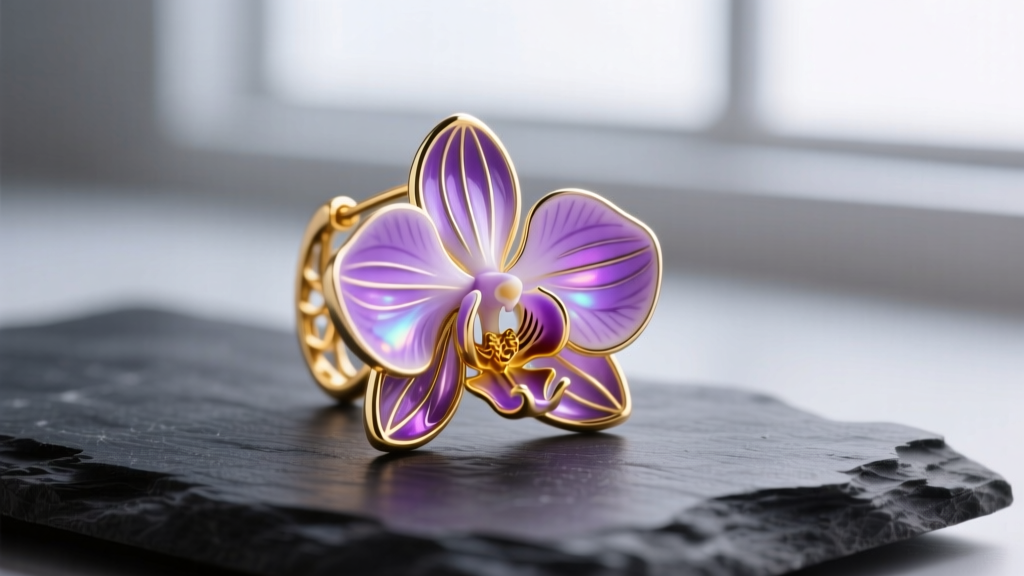
The Structural Paradox of Botanical Jewelry
When evaluating an orchid earring, jewelers and wearers alike face a unique metallurgical and design challenge. The Phalaenopsis and Cattleya orchid shapes, which dominate botanical jewelry, feature undulating, paper-thin petals and a dense, asymmetrical central column. Translating this organic complexity into wearable metal requires a deep understanding of material properties, structural integrity, and earlobe ergonomics. A poorly chosen material will either weigh down the lobe, causing painful stretching, or fail at the delicate petal edges during daily wear.
As of 2026, the landscape of botanical jewelry has expanded far beyond traditional cast metals. Advancements in 3D metal printing and advanced polymer resins have introduced new possibilities for the orchid earring market. However, the fundamental physics of ear-piercings remain unchanged: the human earlobe can comfortably support a maximum of 7 to 10 grams for extended daily wear before fatigue and tissue stretching occur. In this comprehensive guide, we dissect the three primary materials used in high-end orchid earrings—gold, enamel, and titanium—analyzing their specific alloys, failure modes, and ideal use cases.
Material Showdown: Gold vs. Enamel vs. Titanium
Selecting the right medium for an orchid earring depends heavily on the intended wear frequency, the wearer's metal sensitivities, and the desired aesthetic realism. Below, we break down the metallurgical realities of each option.
14k and 18k Gold: The Luxury Standard
Gold remains the premier choice for fine botanical jewelry, but not all karats are created equal when it comes to intricate floral shapes. According to the Gemological Institute of America (GIA), the purity of gold directly dictates its malleability and hardness.
- 18k Gold (75% Pure): While 18k gold offers a rich, warm hue that complements yellow and rose orchid designs, its Vickers hardness (typically around 125-140 HV) makes it too soft for paper-thin petal edges. An 18k gold orchid earring with protruding, delicate sepals is highly susceptible to micro-bending and deformation if dropped or snagged on clothing.
- 14k Gold (58.5% Pure): For structural integrity, 14k gold is the superior choice for orchid shapes. Alloyed with copper, silver, and zinc, 14k gold achieves a Vickers hardness of 160-180 HV. This added rigidity allows jewelers to cast petal edges as thin as 0.4mm without sacrificing durability. For daily wear orchid studs, 14k gold provides the optimal balance between luxury and structural resilience.
Enamel and Resin: The Color Specialists
Orchids are celebrated for their vibrant, variegated colors, making enamel a highly sought-after material for botanical earrings. However, the term "enamel" covers two vastly different chemical processes.
Vitreous Enamel (Cloisonné and Champlevé): This traditional technique involves fusing powdered glass to a metal substrate at temperatures exceeding 1,400°F (760°C). While vitreous enamel offers unparalleled color depth and UV resistance, it is inherently brittle. On an orchid earring, where the metal framework must be thin to mimic delicate petals, vitreous enamel is prone to chipping upon impact. It is best reserved for occasional-wear dangle earrings rather than daily studs.
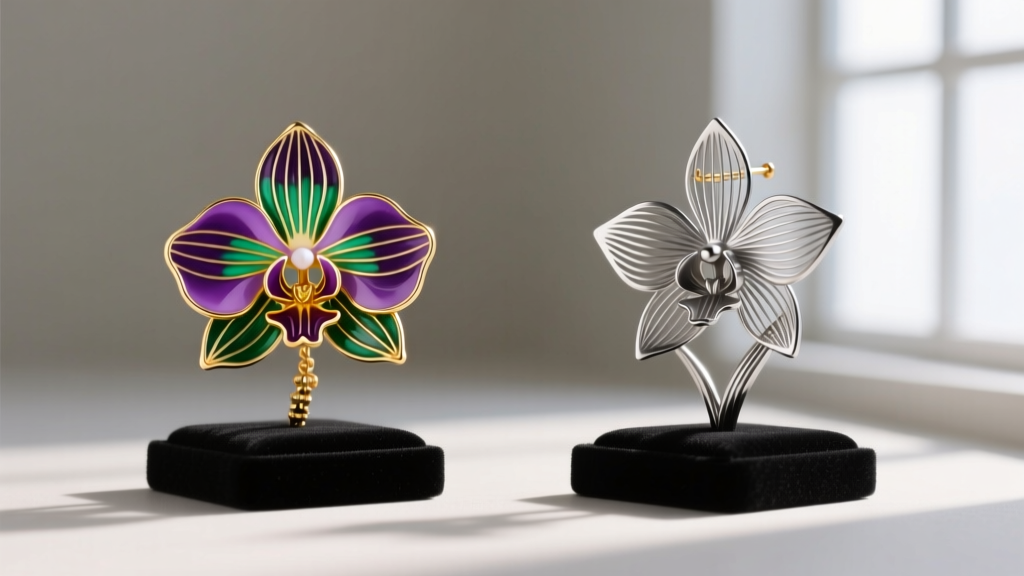
Cold Enamel (Epoxy Resin): Modern cold enamels, such as two-part epoxy resins, have revolutionized botanical jewelry. Cured at room temperature, these resins offer slight flexibility and high impact resistance. When set into a 14k gold or sterling silver orchid framework, cold enamel can withstand the minor shocks of daily wear without cracking, making it the pragmatic choice for vibrant, multi-colored orchid designs.
Grade 5 Titanium: The Modern Lightweight
For wearers with severe nickel allergies or those seeking ultra-lightweight cartilage options, titanium is the undisputed champion. However, pure titanium (Grade 2) is difficult to cast into intricate organic shapes and lacks the tensile strength required for thin earring posts.
The industry standard for high-end titanium orchid earrings is Grade 5 Titanium (Ti-6Al-4V), an alloy containing 6% aluminum and 4% vanadium. As detailed in ASTM International's B348 standard, Grade 5 titanium offers a tensile strength of up to 130 ksi (895 MPa), making it significantly stronger than stainless steel while remaining nearly 45% lighter. In 2026, the use of Direct Metal Laser Sintering (DMLS) allows jewelers to 3D-print Grade 5 titanium orchid earrings with internal lattice structures. This reduces the overall weight of a large, 30mm orchid drop earring to under 4 grams, eliminating earlobe fatigue entirely.
Weight, Gauge, and Ergonomics
The material of the orchid earring dictates not only its visual appeal but also its physical interaction with the piercing. The gauge (thickness) of the earring post must be matched to the material's strength and the piercing location.
| Material | Average Weight (Stud) | Standard Post Gauge | Structural Durability | Price Range (2026) |
|---|---|---|---|---|
| 14k Cast Gold | 3.5g - 6.0g | 20G (0.8mm) / 18G (1.0mm) | High (Resists bending) | $250 - $800 |
| 18k Cast Gold | 4.0g - 7.5g | 18G (1.0mm) / 16G (1.2mm) | Medium (Soft edges) | $400 - $1,200 |
| Vitreous Enamel on Silver | 2.5g - 5.0g | 20G (0.8mm) | Low (Brittle, chips easily) | $80 - $250 |
| Cold Enamel on 14k Gold | 3.0g - 5.5g | 20G (0.8mm) | High (Impact resistant) | $300 - $900 |
| Grade 5 Titanium (DMLS) | 1.5g - 3.5g | 18G (1.0mm) / 16G (1.2mm) | Very High (Rigid, lightweight) | $120 - $350 |
"When designing an orchid earring, the center of gravity is just as critical as the material. If the dense central column of the flower is cast in solid 18k gold, it will pull the earring forward, regardless of how light the petals are. Hollow-casting the center or utilizing titanium is essential for ergonomic balance."
Failure Modes and Maintenance
Understanding how different orchid earrings fail over time is crucial for both consumers and jewelers. Each material presents specific vulnerabilities that require targeted maintenance.
Gold: Solder Joint Fatigue and Edge Bending
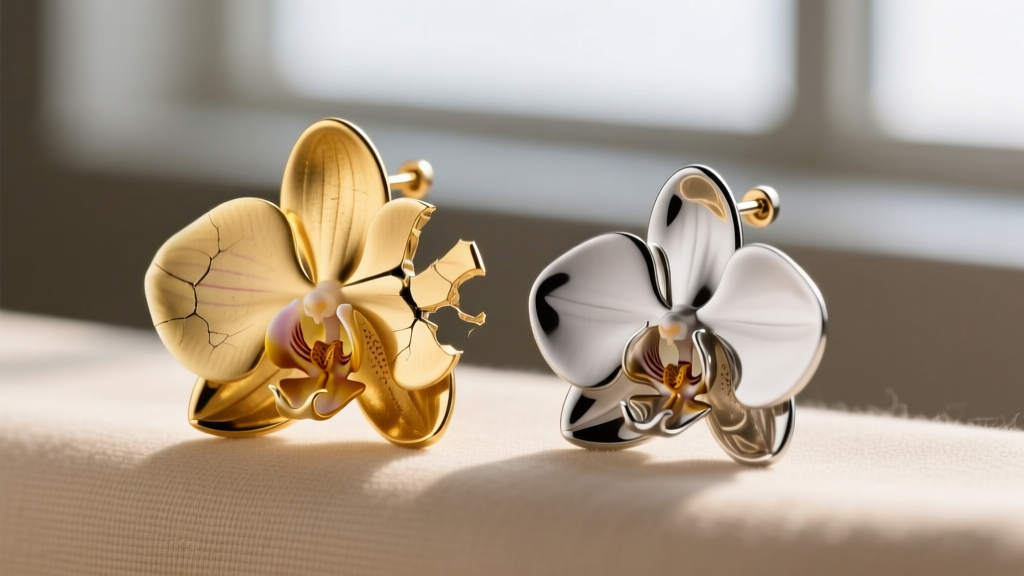
The most common failure point in a gold orchid earring is not the petal itself, but the solder joint where the post meets the flower's backing plate. Because orchid shapes are asymmetrical, they experience uneven torsional stress when the wearer brushes their hair or removes a shirt. Over time, this repetitive stress can cause micro-fractures in the solder. Furthermore, the ultra-thin edges of 18k gold petals will inevitably warp if stored loosely in a jewelry box. Maintenance tip: Always store gold orchid earrings in individual, hard-shell compartments to prevent edge crushing.
Enamel: Thermal Shock and UV Degradation
Vitreous enamel orchid earrings are highly susceptible to thermal shock. Moving from a freezing outdoor environment into a steamy bathroom can cause the glass enamel to contract at a different rate than the metal substrate, leading to hairline fractures known as crazing. Cold enamel (resin), while immune to thermal shock, can suffer from UV degradation. Prolonged exposure to direct sunlight over several years can cause white and pale pink resins to yellow. Maintenance tip: Clean enamel orchid earrings only with lukewarm water and a microfiber cloth; avoid ultrasonic cleaners, which will shatter vitreous enamel and cloud cold resins.
Titanium: Galling and Notch Sensitivity
While Grade 5 titanium is incredibly strong, it is prone to "galling" (cold welding) if the friction-fit post or threading is poorly machined. If a titanium orchid earring features a threaded post for a secure cartilage backing, cross-threading can permanently ruin the post. Additionally, titanium is notch-sensitive; a deep scratch on the earring post can become a stress concentrator, leading to a sudden snap under pressure. Maintenance tip: Never force a titanium threaded backing. If it catches, back it out and realign to prevent galling.
Final Verdict: Choosing Your Orchid Earring
The ideal orchid earring material is dictated by your lifestyle and anatomical needs. If you prioritize heirloom quality, rich color, and are willing to practice careful maintenance, a 14k gold orchid earring with cold enamel accents offers the best synthesis of durability and botanical realism. For those seeking an oversized, dramatic orchid drop for cartilage piercings, or for individuals with severe contact dermatitis, Grade 5 3D-printed titanium is the undisputed modern champion, offering unparalleled strength at a fraction of the weight. By matching the metallurgical properties to your specific wear habits, you can ensure your botanical jewelry remains as vibrant and resilient as the flower it mimics.


