Celine Earrings: 2026 Authentication & Material Deep Dive
Explore the metallurgy, gauge specs, and authentication markers of Celine earrings in 2026. An expert technical guide for collectors and buyers.

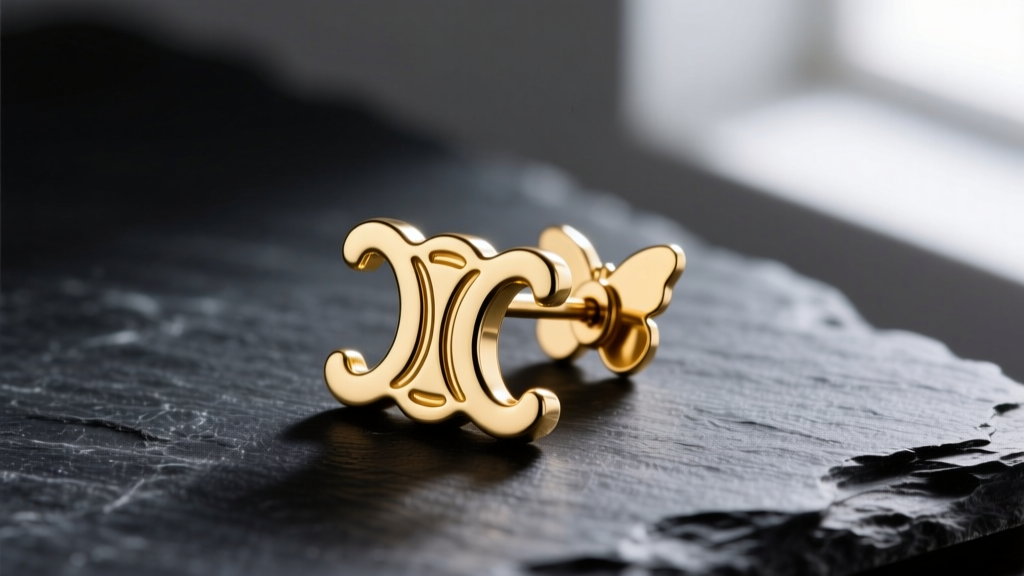
Under the creative direction of Hedi Slimane, Celine has transformed its jewelry offerings from supplementary fashion accessories into highly engineered, collectible hardware. For serious collectors and secondary market buyers in 2026, understanding the technical specifications of Celine earrings is no longer optional; it is a necessity for authentication and long-term preservation. This expert deep dive bypasses the marketing fluff to examine the exact metallurgical composition, structural mechanics, plating thickness, and failure modes of Celine's earwear, providing a definitive technical matrix for spotting counterfeits.
The Metallurgy of Celine Earrings: Beyond the Logo
Unlike fine jewelry brands that cast in solid 14k or 18k gold, Celine operates in the luxury fashion jewelry sector, meaning the core structural integrity relies on base metals. Authentic Celine earrings predominantly utilize a specific grade of jewelers' brass, often a free-machining brass alloy similar to CuZn39Pb3. This specific copper-zinc-lead ratio is chosen for its exceptional density, Vickers hardness, and ability to hold crisp, high-resolution cast details—crucial for the intricate symmetry of the iconic Triomphe motif and the Blason de Celine crest.
Counterfeit manufacturers frequently substitute this dense brass with cheap zinc alloys (often referred to as pot metal or Zamak). Zinc alloy is significantly lighter, more porous, and prone to micro-fractures along stress points, particularly where the earring post meets the decorative front. When evaluating a pair of Celine studs, the specific gravity and cold-to-the-touch thermal conductivity of dense brass are immediate tactile indicators of authenticity that zinc alloys simply cannot replicate.
Post Gauges and Clasp Mechanics: A Technical Breakdown
The structural interface between the earring and the earlobe is a common failure point in fashion jewelry. Celine engineers its earring posts to specific thickness tolerances to balance durability with wearer comfort. Most authentic Celine stud earrings feature a post gauge ranging from 0.9mm to 1.0mm (approximately 19-gauge to 18-gauge). This is notably thicker than the 0.7mm (22-gauge) wire used in lower-tier fashion jewelry, which often causes the 'cheese-wire effect,' migrating through the earlobe tissue due to the weight of the brass front.
Butterfly Backs vs. Omega Clips
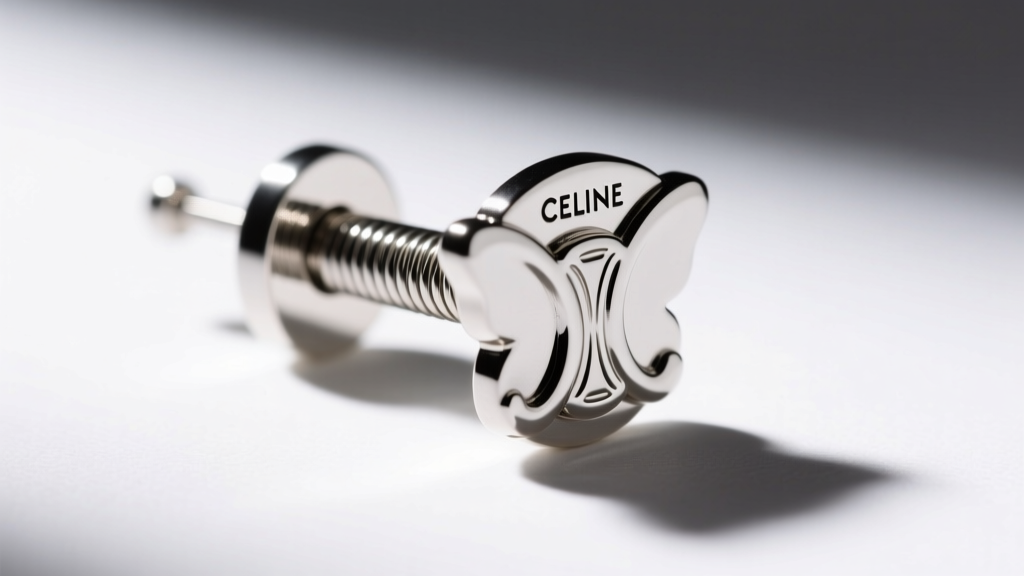
For standard studs, Celine employs high-tension butterfly backs stamped from brass rather than cast. The internal spring mechanism is calibrated to exert higher clamping force against the post groove, preventing the heavy earring fronts from drooping or falling out. For larger, heavier drop earrings and hoops, Celine utilizes Omega clips or hinged snap-backs with adjustable tension screws. A common failure mode in counterfeit Celine earrings is the use of generic, low-tension butterfly backs that fail to support the earring's center of gravity, causing the piece to tilt forward unnaturally on the ear.
Plating Thickness and Oxidation Failure Modes
The gold-tone and silver-tone finishes on Celine earrings are achieved through electroplating over the brass base. According to the FTC Jewelry Guides, gold plating must meet specific minimum thickness standards to be marketed without qualifiers. While standard flash plating in the fashion industry measures a mere 0.1 to 0.5 microns, Celine typically utilizes micron plating in the 2.0 to 3.0-micron range for its gold-tone hardware, often utilizing a palladium or rhodium underplate to act as a diffusion barrier and enhance the luminosity of the 18k gold top layer.
However, the true technical differentiator is the protective topcoat. Authentic Celine earrings are sealed using electrophoretic deposition (e-coating), a process that uses an electrical current to deposit a microscopic, uniform layer of clear polymer resin. This e-coat is what prevents the brass base from reacting with environmental sulfur and the chlorides in human sweat.
The Verdigris Failure Mode
When the e-coat is compromised through friction (common on the earring post and the interior of the butterfly back) or exposure to harsh chemicals, the underlying brass is exposed. As detailed by the Copper Development Association, brass alloys are highly susceptible to a reaction with sweat and moisture that produces copper carbonate, commonly known as verdigris. This manifests as a toxic, bright green crust on the earring post and the wearer's skin. If a purported Celine earring exhibits severe green oxidation on the post within months of wear, it is highly likely a counterfeit lacking the industrial e-coating process, or an authentic piece that has been aggressively over-polished, stripping the protective resin.
| Specification | Celine Earrings (Authentic) | Standard Fashion Jewelry | Counterfeit Celine |
|---|---|---|---|
| Base Metal | Jewelers Brass (CuZn39Pb3) | Zinc Alloy / Pot Metal | Lightweight Zinc Alloy |
| Plating Thickness | 2.0 - 3.0 microns (18k Gold) | 0.1 - 0.5 microns (Flash) | 0.5 microns (Low-grade) |
| Post Gauge | 0.9mm - 1.0mm (18g-19g) | 0.7mm - 0.8mm (20g-22g) | 0.8mm (Inconsistent) |
| Protective Coating | Electrophoretic E-Coat | Standard Clear Lacquer | None or Spray Lacquer |
| Weight Tolerance | High density, precise to 0.1g | Lightweight | 15-20% lighter than authentic |
2026 Authentication Matrix: Spotting Counterfeit Celine Earrings
As counterfeit manufacturing techniques have advanced, visual inspection of the logo is no longer sufficient. In 2026, professional authenticators rely on a matrix of micro-details and structural metrics to verify Celine earrings.
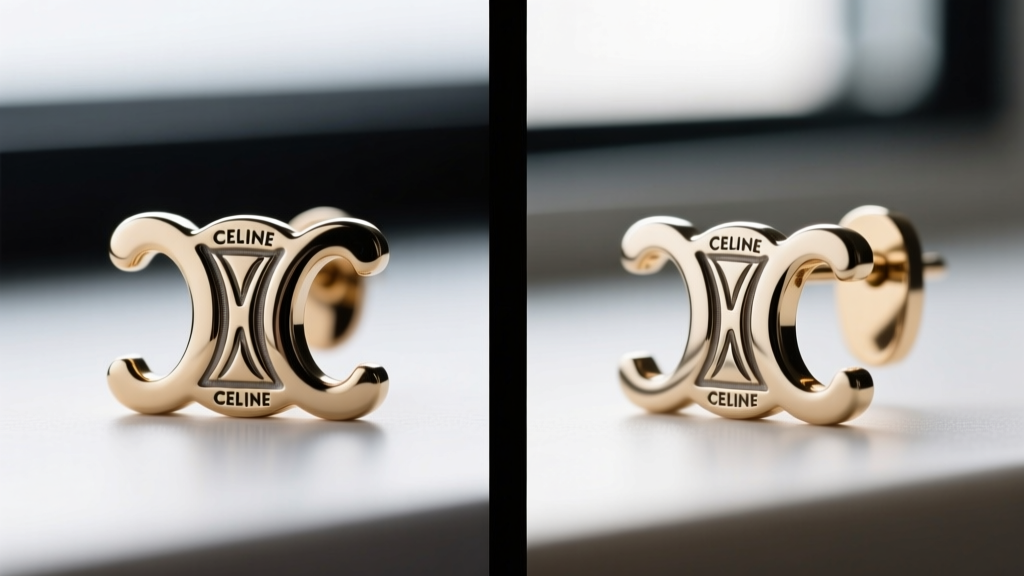
- Hallmark Kerning and Depth: The 'CELINE' stamp on the back of the earring or the butterfly back is laser-engraved or deeply struck. Authentic stamps feature precise, custom kerning (letter spacing) and a distinct sans-serif font. Counterfeits often use standard system fonts, and the engraving depth is shallow, appearing muddy under 10x magnification.
- Triomphe Symmetry and Beveling: The interlocking 'C' motif of the Triomphe is mathematically symmetrical. On authentic pieces, the edges are hand-finished with a microscopic bevel to catch the light. Fakes often have flat, sharp, or uneven edges due to poor casting molds and lack of post-cast tumbling.
- The 'Click' Test for Hinges: For Celine hoop earrings with hinged closures, the internal tension pin is engineered to produce a distinct, sharp 'click' upon closing. Fakes often feature loose hinge tolerances, resulting in a soft, muted closure that feels structurally insecure.
- Magnetic Susceptibility: Authentic Celine brass and gold plating are entirely non-magnetic. If the earring post or the butterfly back exhibits any magnetic pull, it indicates the use of cheap steel alloys, immediately flagging the piece as a counterfeit.
Investment and Secondary Market Pricing (2026 Data)
The secondary market for Celine earrings has stabilized in 2026, driven by the enduring popularity of the Triomphe canvas and hardware collections. Authentic Celine stud earrings (such as the small Triomphe or Blason studs) retail between $450 and $650 USD, depending on the complexity of the enamel work or crystal paving. On authenticated resale platforms like The RealReal and Vestiaire Collective, pristine examples with intact e-coating and original packaging command 65% to 80% of their retail value.
Pieces showing signs of brass exposure or verdigris on the posts suffer a 40% to 50% depreciation, as buyers factor in the cost of professional re-plating and e-coating. Rare, discontinued hardware variations from the Phoebe Philo era (pre-2018) operate in a separate tier, often fetching 150% to 200% above their original retail price due to their status as archival collector's items.
Preventative Care Protocols to Preserve the E-Coat
To maintain the structural and aesthetic integrity of Celine earrings, owners must adopt strict care protocols that protect the electrophoretic topcoat. Never use ultrasonic jewelry cleaners, ammonia-based solutions, or abrasive polishing cloths (such as treated silver cloths) on Celine fashion jewelry. These methods will instantly strip the microscopic e-coat, exposing the brass to rapid oxidation.
After every wear, wipe the earrings—specifically the posts and the butterfly backs—with a dry, lint-free microfiber cloth to remove sebum and sweat chlorides. Store the earrings in their original anti-tarnish flannel pouches in a low-humidity environment. If the e-coat inevitably wears off the earring post due to friction, apply a microscopic layer of clear, hypoallergenic nail polish to the post to act as a temporary barrier against verdigris, ensuring the longevity of both the jewelry and the wearer's earlobe health.


