How to Clean and Maintain Your Potara Earring Collection
Learn expert care, cleaning, and maintenance tips for your potara earring collection. Protect metals, secure cuffs, and keep gems sparkling.

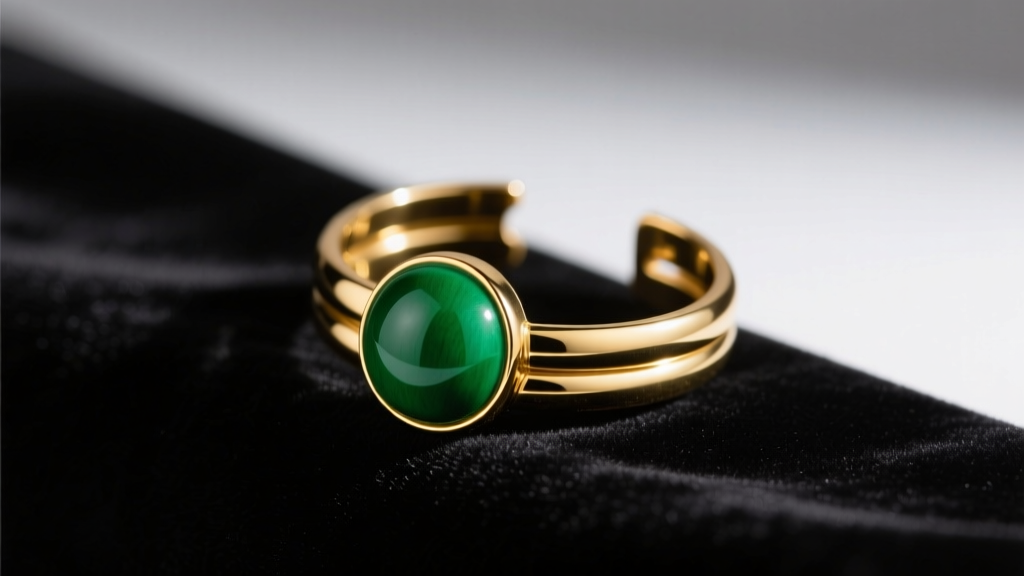
The potara earring has transcended its anime origins to become a staple in alternative, cosplay, and high-fashion jewelry collections. Characterized by their intricate cartilage wraps, tension-fit ear cuffs, dangling chains, and iconic spherical focal points, these pieces are as complex as they are striking. However, this structural complexity introduces unique maintenance challenges. Crevices trap sebum and cosmetics, tension cuffs suffer from metal fatigue, and mixed-material orbs (often enamel or resin) can be easily destroyed by standard jewelry cleaning methods.
Whether your collection features solid 925 sterling silver, 18k gold vermeil, or 316L surgical steel, preserving the structural integrity and visual brilliance of your pieces requires a specialized approach. In this comprehensive guide, we break down the exact protocols for cleaning, adjusting, and storing your potara earring designs to ensure they remain secure and stunning for years to come.
The Anatomy of a Potara Earring: Why Specialized Care is Needed
Unlike a standard stud or simple hoop, a typical potara earring design incorporates multiple failure points. The most common real-world iterations feature a primary ear cuff that relies on physical tension to grip the helix or auricle, connected via delicate 20-gauge or 22-gauge chains to secondary lobes or dangling spherical elements.
Because these pieces wrap around the ear's cartilage, they are constantly exposed to friction, hair products, and natural skin oils. The intricate wire-wrapping and micro-prong settings used to hold the signature 'orbs' create microscopic pockets where dead skin cells and cosmetic residue accumulate. Over time, this buildup not only dulls the metal but can also cause contact dermatitis if left unaddressed. Furthermore, the repeated bending required to put on and take off tension cuffs leads to work hardening, making the metal brittle and prone to snapping if not properly maintained.
Material-Specific Cleaning Protocols
Before applying any liquid or abrasive to your jewelry, you must identify the base metal and the decorative elements. The cleaning method that restores a solid stainless steel cuff will instantly ruin a gold-plated brass piece with enamel detailing. According to the Jewelers of America, matching the cleaning agent to the material's Mohs hardness and chemical reactivity is the golden rule of jewelry maintenance.
| Material / Component | Safe Cleaning Method | Strictly Avoid |
|---|---|---|
| 925 Sterling Silver | Mild soap, warm distilled water, microfiber cloth | Bleach, ammonia, toothpaste |
| 18k Gold Vermeil (Plated) | Damp microfiber cloth, gentle wiping | Ultrasonic cleaners, polishing pastes |
| 316L Surgical Steel | Soap and water, isopropyl alcohol for sanitizing | Chlorine-based solutions |
| Enamel / Resin Orbs | Dry or slightly damp microfiber cloth only | Ultrasonic cleaners, hot water, solvents |
| Cubic Zirconia (CZ) Stones | Warm soapy water, soft baby toothbrush | Harsh chemical dips |
Step-by-Step Wet Cleaning for Metals and Stones
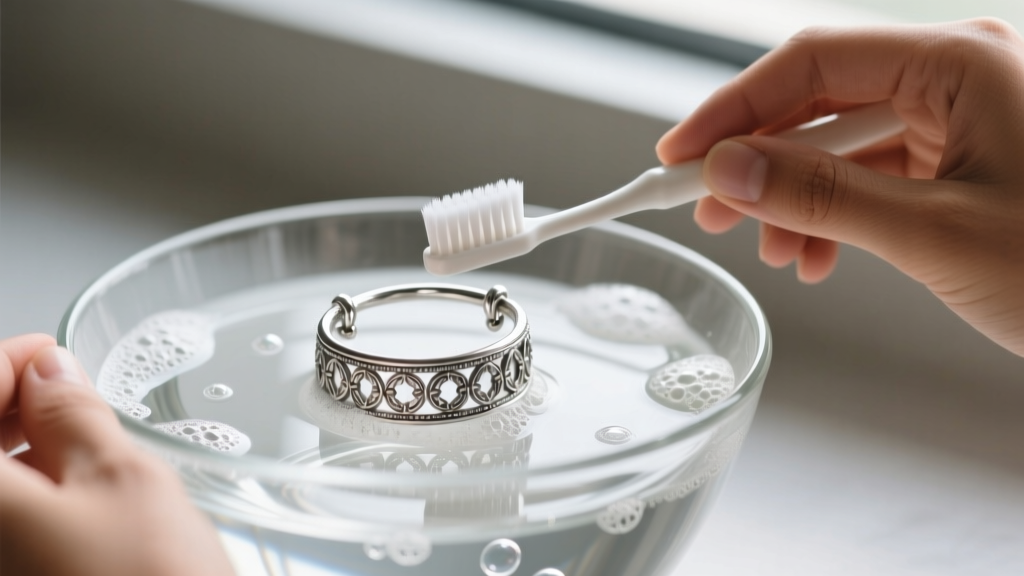
For pieces made of solid metals and durable stones (like CZ or glass), a wet cleaning is the most effective way to remove accumulated sebum and environmental pollutants. Follow this precise protocol:
- Prepare the Solution: Mix 4 drops of phosphate-free, lotion-free dish detergent into 1 cup of distilled water. Heat the water to approximately 85°F (29°C). Tap water contains minerals that can leave micro-scratches and water spots on polished metals.
- Soak Briefly: Submerge the metal and stone portions of the earring for exactly 3 to 5 minutes. Do not soak pieces with glued-in enamel or resin orbs, as the warm water can soften the jeweler's epoxy.
- Agitate Gently: Using an extra-soft baby toothbrush, gently sweep the bristles across the wire-wraps, chain links, and prong settings. Always brush away from the stone settings to avoid loosening them.
- Rinse and Dry: Rinse under a gentle stream of lukewarm distilled water. To dry intricate chain links and tension hinges without leaving lint behind, use a can of compressed air held 6 inches away, followed by a pat-down with a lint-free microfiber cloth.
For deep-set tarnish on solid silver, the Gemological Institute of America (GIA) recommends using a specialized silver polishing cloth impregnated with anti-tarnish agents, rather than liquid dips which can strip the patina from intricate engravings.
Maintaining Tension and Fit on Cartilage Cuffs
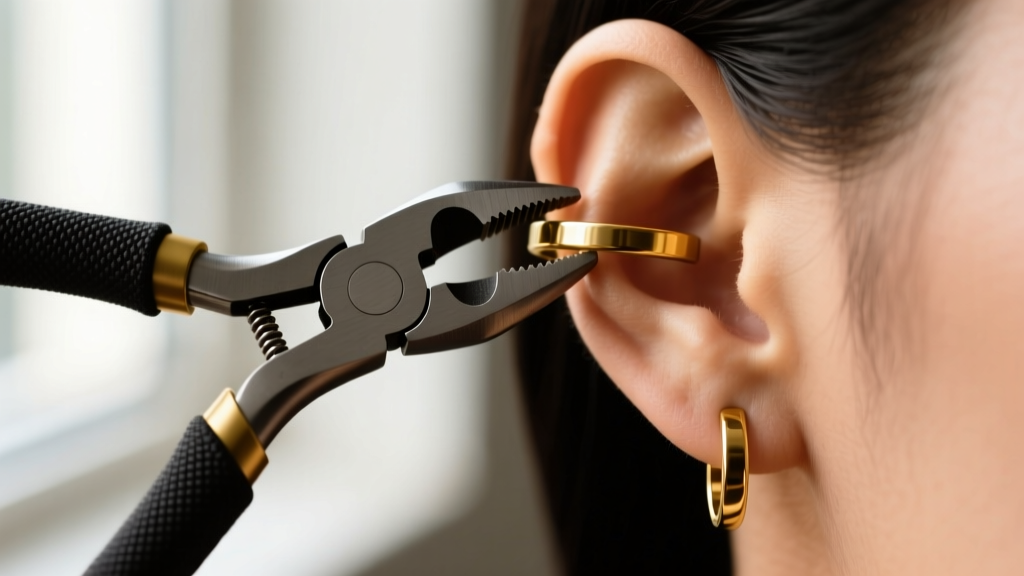
The defining feature of many potara earring styles is the ear cuff. Unlike pierced jewelry, cuffs rely on the spring tension of the metal to grip the ear. Over time, the natural expansion and contraction of the metal as you put it on and take it off will cause the cuff to loosen, increasing the risk of losing the piece.
To maintain the correct tension, you need to periodically adjust the cuff using the proper tools. Never use standard metal jewelry pliers, as the steel teeth will mar, scratch, and dent the surface of your earrings. Instead, invest in a pair of nylon jaw pliers.
If your cuff has become too loose, place the nylon jaws on the outer edges of the cuff and apply very gentle, incremental pressure to close the gap by a fraction of a millimeter. If it is too tight, gently expand it. For cuffs made from 18-gauge or 20-gauge brass or silver, this process should only be done once every few months. Repeatedly bending the metal back and forth will cause 'work hardening,' leading to metal fatigue and eventual snapping. If your cuff frequently loses tension, consider taking it to a jeweler to have a micro-hinge or silicone friction sleeve added for a more permanent, secure fit.
Proper Storage to Prevent Tarnish and Tangling
How you store your potara earring collection is just as critical as how you clean it. Sterling silver and brass are highly susceptible to tarnishing, a chemical reaction where sulfur compounds in the air (specifically hydrogen sulfide) react with the copper alloys in the metal to form silver sulfide—a black, dull layer on the surface.
The Anti-Tarnish Environment
To halt this chemical reaction, you must control the storage micro-climate. Avoid storing your earrings in PVC plastic bags or open-air jewelry dishes. Instead, utilize the following storage protocol:
- Barrier Protection: Store each piece individually in a zip-lock bag made of polyethylene. Polyethylene does not emit sulfur gases and prevents moisture accumulation.
- Chemical Interceptors: Place a 3M anti-tarnish strip inside each bag. These strips contain chemically treated particles that absorb and neutralize hydrogen sulfide and sulfur dioxide in the enclosed air, protecting the metal for up to 6 months.
- Moisture Control: Include a small silica gel desiccant packet in your main jewelry box to keep ambient humidity below 40%, drastically slowing the oxidation process.
- Tangle Prevention: Because potara styles often feature dangling chains, fasten any clasps before storage and lay them flat in a lined jewelry tray. Hanging them can stretch delicate 22-gauge chains over time.
Common Potara Earring Maintenance Mistakes
Even well-intentioned jewelry owners can inadvertently destroy complex pieces. Avoid these critical errors to preserve your collection:
- Using Ultrasonic Cleaners on Mixed Media: Ultrasonic cleaners use high-frequency sound waves to create cavitation bubbles in a liquid. While excellent for solid diamonds and platinum, the shockwaves will shatter enamel, crack resin orbs, and shake loose glued-in cubic zirconia stones commonly found in potara designs.
- Applying Toothpaste for Polish: Toothpaste contains hydrated silica, an abrasive with a Mohs hardness of around 7. This is harder than gold, silver, and brass, and will leave thousands of micro-scratches on your cuffs, permanently ruining the mirror finish.
- Spraying Cosmetics While Wearing: Hairspray, perfume, and setting sprays contain alcohols and polymers that will cloud resin orbs and degrade the protective rhodium plating on white gold or silver pieces. Always apply cosmetics and let them dry completely before putting on your earrings.
- Sleeping in Cuffs: The pressure of your head against a pillow can bend the tension wire of an ear cuff, warp the dangle chains, and cause the metal to dig painfully into your cartilage.
Final Thoughts on Longevity
A high-quality potara earring is a piece of wearable art that requires a mindful maintenance routine. By understanding the specific material composition of your cuffs, utilizing gentle and precise cleaning agents, and managing the physical tension of the ear wraps, you can keep your collection looking pristine. Implement these professional care strategies, and your favorite pieces will remain secure, brilliant, and ready to wear for every occasion.


