Crescent Hoop Earrings: An Expert Guide to Fit, Metals & Mechanics
Discover the engineering behind crescent hoop earrings. Our expert guide covers hinge mechanics, metal grades, gauge sizes, and weight distribution.

The Anatomy and Geometry of Crescent Hoop Earrings
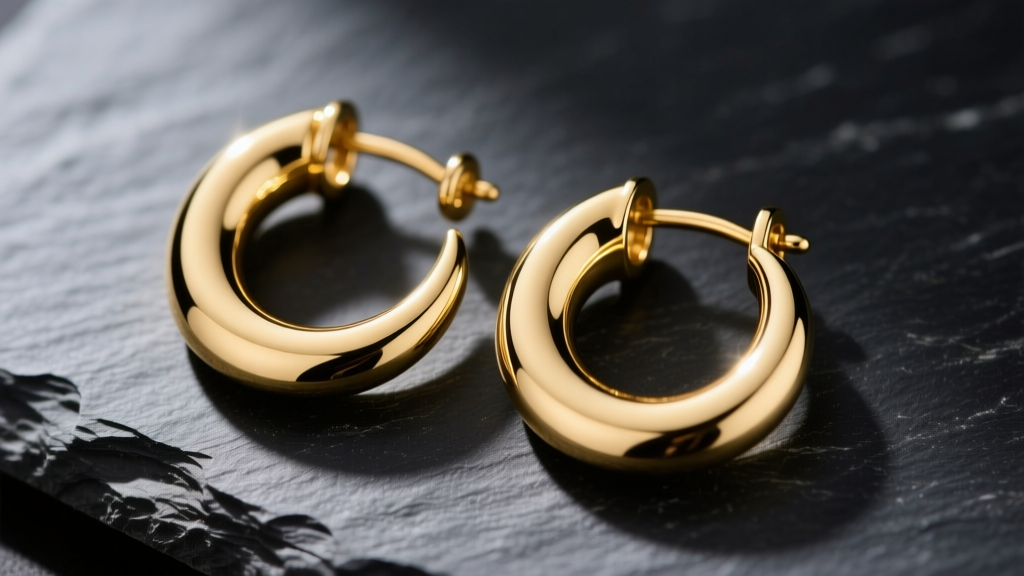
While standard continuous hoops form a full 360-degree circle, crescent hoop earrings (often referred to as half-hoops or semi-circles) are engineered with a specific geometric sweep, typically spanning between 160 and 180 degrees. This design is not merely aesthetic; it fundamentally alters the center of gravity and how the earring interacts with the earlobe's soft tissue.
A technically sound crescent hoop requires precise inner and outer diameter calculations. For a standard lobe piercing, the inner diameter (the clearance space between the post and the inner curve of the hoop) must be at least 10mm to 12mm. If the inner clearance is too tight, the earring will compress the earlobe, restricting lymphatic flow and causing localized edema. Conversely, an outer diameter exceeding 25mm on a half-hoop design shifts the pendulum effect, creating a fulcrum that places excessive sheer stress on the piercing fistula.
CAD Casting vs. Die-Stamping
The manufacturing method dictates the structural integrity of the crescent. High-end crescent hoops are typically CAD-cast (Computer-Aided Design) in solid metal, allowing for complex, tapered profiles that are thicker at the hinge for durability and thinner at the apex for visual lightness. Cheaper alternatives are die-stamped from sheet metal, resulting in uniform thickness, sharp inner edges, and a higher likelihood of metal fatigue at the bending points over time.
Metallurgy: Material Grades and Biocompatibility
Because the post and hinge of a crescent hoop remain in constant contact with the piercing channel, the metallurgy of the jewelry is critical. Contact dermatitis and delayed hypersensitivity reactions are frequently misattributed to 'dirty' piercings when they are actually the result of inferior metal alloys.
Implant-Grade Titanium (ASTM F136)
For sensitive or healing piercings, the gold standard is Ti-6Al-4V ELI (Extra Low Interstitial) titanium, certified to ASTM F136 standards. Unlike commercial-grade titanium, F136 strictly limits interstitial elements like oxygen and nitrogen, which dramatically increases the metal's fatigue strength and corrosion resistance in the saline, micro-aerobic environment of a piercing channel. It is entirely nickel-free and non-magnetic.
Gold Alloys: 14k vs. 18k
When selecting gold crescent hoops, understanding the alloy matrix is essential. Pure 24k gold is too malleable for jewelry mechanics. According to the Gemological Institute of America (GIA), 14k gold contains 58.5% pure gold, alloyed with copper, silver, and zinc for hardness. This makes 14k ideal for thin, 20-gauge posts that require high tensile strength to resist bending. 18k gold (75% pure) offers a richer color and higher hypoallergenic properties but is softer; therefore, 18k crescent hoops should feature thicker 18-gauge or 16-gauge posts to maintain structural integrity.
Expert Warning on Nickel: White gold is often alloyed with nickel to achieve its silver color. Even if rhodium-plated, the plating wears off at the friction points (the post and hinge), exposing the skin to nickel. Always verify that white gold crescent hoops are alloyed with palladium instead of nickel to comply with the EU Nickel Directive (EN 1811), which limits nickel release to 0.2 µg/cm²/week.
Hinge Mechanics and Closure Systems
The closure mechanism is the most common point of failure in crescent hoop earrings. Because the half-circle shape acts as a lever, any lateral pressure on the hoop transfers torque directly to the hinge. Below is a technical comparison of the three primary closure systems used in modern crescent hoops.
| Closure Type | Mechanism Description | Security Rating | Best Application |
|---|---|---|---|
| Snap-Hinge (Omega) | Uses a tension-based V-groove where the post snaps into a machined catch. | High | Standard earlobes; daily wear. |
| Clicker | Features a captive segment with a precision-milled ridge that locks into a hollow tube. | Very High | Cartilage, helix, and snug piercings. |
| Latch-Back | A traditional hinged hook that drops into a U-shaped wire catch. | Low to Medium | Occasional wear; prone to hair snagging. |
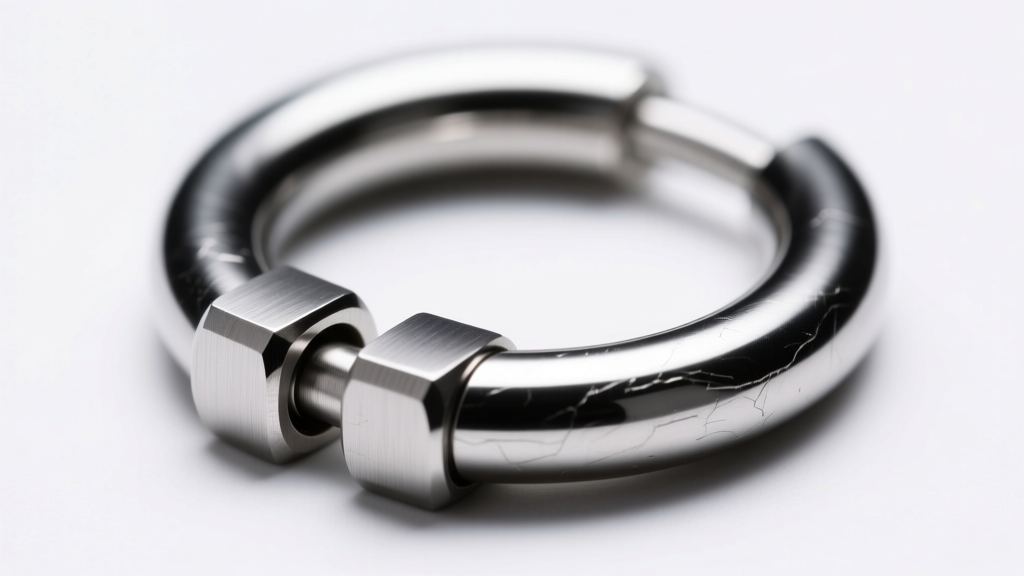
For cartilage placements, the clicker mechanism is vastly superior. The interlocking ridge provides an audible and tactile 'click' when seated, and because the closure is housed within a continuous tube, there are no protruding wire catches to snag on hair or clothing—a common issue that leads to traumatic tearing in helix piercings.
Gauge Sizing and Piercing Compatibility
Selecting the correct wire thickness (gauge) is crucial for both comfort and the long-term health of the fistula. The standard gauge sizing system is inverse; a higher number indicates a thinner wire.
- 20 Gauge (0.81mm): The standard for most commercial lobe earrings. Suitable only for lightweight, small-diameter crescent hoops. Using a heavy 14k gold crescent on a 20g post will cause the 'cheese-cutter effect,' where the thin wire slowly migrates downward through the earlobe tissue.
- 18 Gauge (1.02mm): The optimal balance of durability and comfort for standard lobe piercings. It provides enough cross-sectional area to support medium-weight hoops without stretching the piercing channel.
- 16 Gauge (1.29mm): The standard for cartilage, helix, and tragus piercings. Crescent hoops designed for the upper ear must utilize 16g wire to withstand the lateral pressure of sleeping or wearing headphones without bending the post.
Weight Distribution and Earlobe Sagging Prevention
The human earlobe is composed of fibrofatty tissue without cartilaginous support. Chronic exposure to heavy jewelry accelerates the breakdown of collagen and elastin fibers, leading to irreversible lobe sagging and elongated piercing slits.
The 4-Gram Rule
As a general biomechanical rule, daily-wear crescent hoops should not exceed 4 grams per earring. High-end jewelers achieve this by utilizing hollow-core electroforming for larger, statement-sized crescents, or by aggressively tapering the solid metal profile so the bulk of the weight sits close to the earlobe rather than at the bottom apex of the curve.
Silicone O-Ring Stabilization
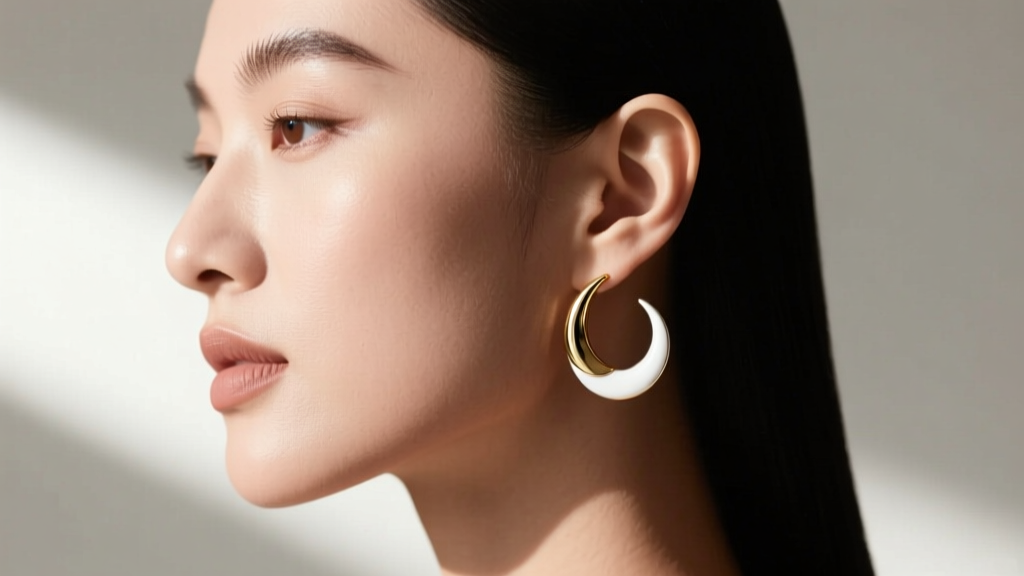
If you own a pair of front-heavy crescent hoops that tend to droop forward, an expert troubleshooting hack is to apply a 2mm silicone O-ring (often sold as earring backs or 'earlifters') behind the lobe. This acts as a structural shim, redistributing the fulcrum point and forcing the crescent to sit flush against the face without pulling on the bottom of the piercing channel.
Troubleshooting Common Crescent Hoop Failures
Even precision-engineered crescent hoop earrings can experience mechanical issues. Understanding these failure modes allows for proactive maintenance.
Hinge Loosening and Lateral Play
Over time, snap-hinges can develop lateral play, causing the post to sit slightly off-center from the catch. This is usually caused by microscopic metal wear at the V-groove. The Fix: A jeweler can gently compress the catch housing using parallel-jaw pliers with nylon inserts to tighten the tolerance. Never use standard steel pliers, as they will mar the precious metal finish.
Post Bending in Friction Closures
If your crescent hoop utilizes a straight friction post (butterfly back) rather than a hinge, the post is highly susceptible to bending if the earring is dropped or slept in. The Fix: Posts can be straightened using a brass mandrel and a rawhide mallet. Attempting to bend it back with your fingers will induce work-hardening in the metal, leading to a stress fracture and eventual snapping at the base of the post.
Sourcing and Pricing Tiers
When investing in crescent hoops, pricing is a direct reflection of manufacturing precision and material purity. Expect the following market tiers:
- Entry-Level ($25 - $60): Typically die-stamped 316L surgical steel or silver-plated brass. Hinges are often loose from the factory, and posts may contain trace nickel.
- Mid-Tier ($80 - $250): Solid 14k gold or ASTM F136 titanium. Features CAD-cast bodies, precise snap-hinges, and proper inner-lobe clearance. Brands like Maria Tash and BVLA dominate this technical space.
- Haute / Fine ($400+): 18k gold, hand-finished hinges, and often incorporating precision-set diamonds or gemstones along the crescent apex. The weight distribution in this tier is meticulously engineered to ensure the stones do not cause the hoop to invert.
By prioritizing exact gauge sizing, biocompatible metallurgy, and secure hinge mechanics over mere visual aesthetics, you ensure that your crescent hoop earrings remain a comfortable, structurally sound, and permanent fixture in your jewelry rotation.


