Engineering Crocheted Earrings: Thread, Wire & Hardware Guide
Master the structural engineering of crocheted earrings. Explore thread weights, wire gauges, stiffeners, and hypoallergenic hardware for lasting wear.

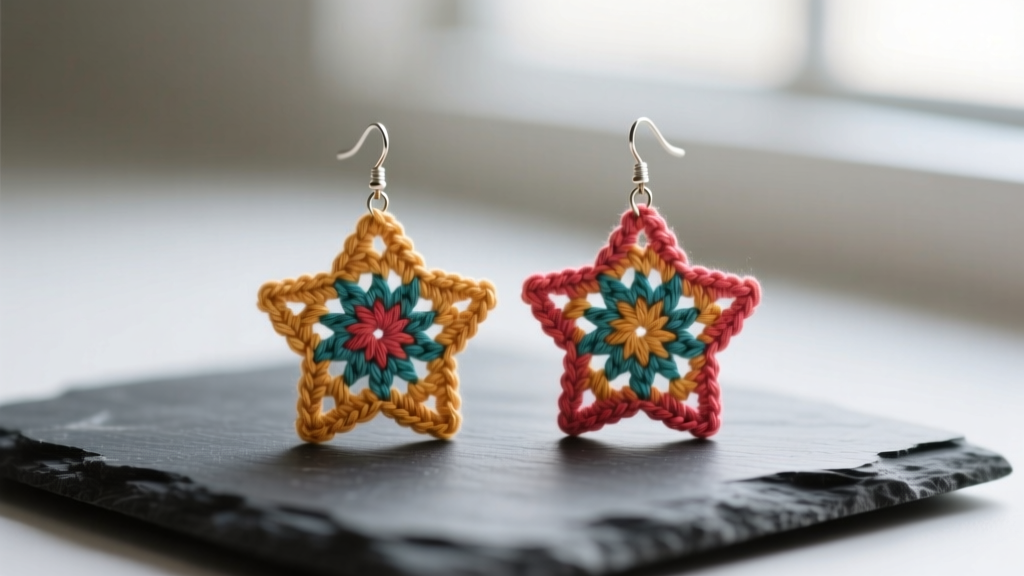
The Structural Challenge of Fiber Jewelry
Creating durable, wearable crocheted earrings requires navigating the intersection of textile arts and structural engineering. Unlike metal or resin jewelry, fiber is inherently flexible, porous, and susceptible to environmental degradation. When designing crocheted earrings, the artisan must solve for dynamic load (the swinging motion of an earring), moisture retention (sebum and sweat), and tensile stress at the hardware connection points. A beautifully stitched motif will quickly fail if the underlying material science and hardware integration are ignored. This guide deconstructs the technical specifications required to elevate handmade fiber earrings from fragile novelties to robust, daily-wear accessories.
Thread & Yarn Selection: Beyond Aesthetics
Mercerized Cotton vs. Synthetic Blends
The foundation of any micro-crochet earring is the thread. For structural integrity, mercerized cotton is the industry standard. The mercerization process treats cotton fibers with sodium hydroxide under tension, which permanently swells the cell walls, increases tensile strength by up to 30%, and creates a smooth, lustrous surface that resists pilling. According to the Craft Yarn Council's Standard Weight System, thread weights are categorized inversely by number; Size 10 (bedspread weight) and Size 20 (lace weight) offer the optimal balance of stitch definition and rigidity for earrings.
Conversely, synthetic blends (nylon or polyester) offer superior UV resistance and moisture-wicking properties but often lack the 'grip' required to hold complex three-dimensional shapes like picots or raised clusters. For structural motifs that require bending and posing, wire-cored threads—typically a 0.2mm to 0.3mm copper or aluminum core wrapped in nylon—allow the artisan to crochet flexible armatures directly into the piece.
Steel Hook Sizing and Tension Mechanics
Using standard aluminum or bamboo hooks for thread crochet introduces microscopic inconsistencies in tension. Steel crochet hooks, ranging from 0.6mm to 1.25mm, are mandatory for Size 20 and Size 30 threads. A tighter gauge (achieved by using a hook 0.1mm smaller than the manufacturer's recommendation) creates a denser fabric matrix that naturally resists sagging, reducing the reliance on heavy chemical stiffeners later in the process.
Armature & Stiffening Techniques
Unless the design is intentionally meant to drape (like a fiber tassel earring), crocheted earrings require stabilization. The choice of stiffener dictates the drape, water resistance, and longevity of the piece. Below is a technical comparison of the most effective stabilization methods used by professional fiber jewelers.
| Stabilizer Type | Composition / Ratio | Cure Time | Water Resistance | Best Application |
|---|---|---|---|---|
| Diluted PVA Glue | 1:1 PVA to Distilled Water | 8-12 Hours | Low | Flat, geometric lace motifs |
| Commercial Fabric Stiffener | Polyvinyl Acetate & Acrylic Emulsion | 4-6 Hours | Medium | Floral cups and ruffled edges |
| UV Jewelry Resin | 1-Part UV-Cured Epoxy | 60-90 Seconds | High (Waterproof) | High-wear studs and rigid pendants |
| Hidden Wire Armature | 28-Gauge Dead-Soft Copper | N/A (Mechanical) | High | Posable leaves, vines, and 3D shapes |
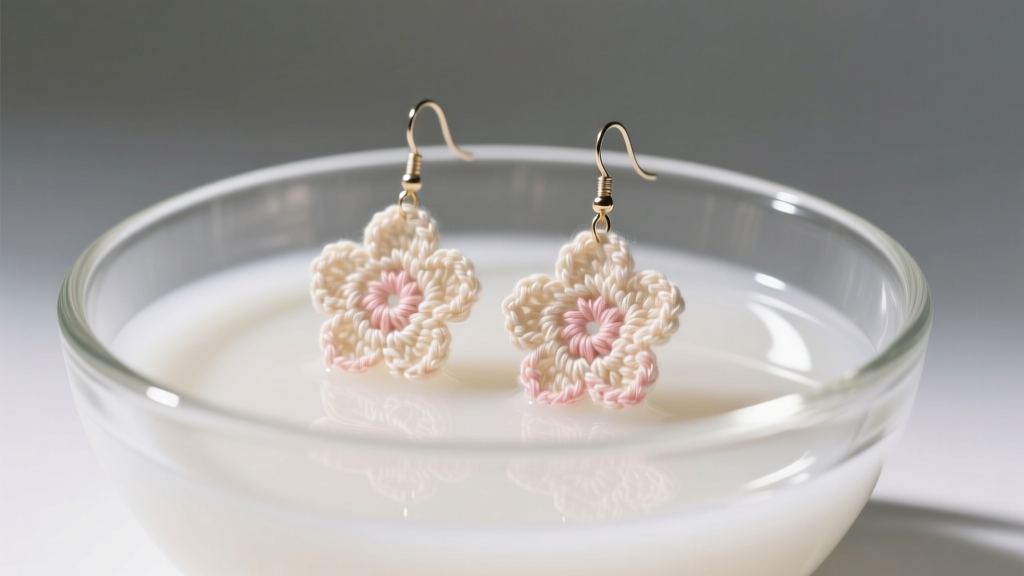
When applying liquid stiffeners, the 'dip and pin' method is superior to brushing. Brushing introduces micro-bubbles and disrupts the stitch alignment. Submerging the piece, gently squeezing out excess fluid, and pinning it to a foam blocking board with rust-proof T-pins ensures mathematical symmetry during the curing phase.
Hardware Integration: Preventing Tear-Out
The 'Cheese Wire' Effect and Jump Ring Gauges
The most common catastrophic failure in crocheted earrings is the jump ring slicing through the top loop of the fiber motif. This occurs due to the 'cheese wire' effect: dynamic swinging concentrates kinetic energy onto a microscopic surface area. If a jeweler uses a standard 22-gauge or 24-gauge jump ring, the thin wire will eventually abrade and sever the cotton thread.
To prevent this, the jump ring connecting the fiber to the ear wire must be a minimum of 18-gauge (1.0mm) in thickness, with 16-gauge (1.3mm) being optimal for heavier statement pieces. As detailed in the Rings & Things Wire Gauge Guide, the lower the gauge number, the thicker and stronger the wire. Furthermore, the jump ring should feature a flush-cut saw closure rather than a standard split, or ideally, be laser-soldered shut to eliminate any gaps that could catch and fray the delicate crochet threads.
Hypoallergenic Posts for Moisture-Trapping Fibers
Fiber is inherently porous and hygroscopic. Crocheted earrings will trap ambient humidity, sebum, and hair products against the earlobe. If the ear wire or post contains nickel or low-grade brass alloys, this trapped moisture accelerates galvanic corrosion and metal ion leaching, leading to severe contact dermatitis.
For any fiber jewelry that touches the skin, artisans must use implant-grade titanium (ASTM F136) or pure niobium ear wires. The Association of Professional Piercers (APP) Material Standards dictates that only these specific, highly biocompatible metals should be used in environments where moisture and bacteria are present. Niobium is particularly advantageous for crocheted earrings because it can be anodized using a simple voltage bath to perfectly color-match the dyed cotton threads.
Maintenance and Failure Mode Troubleshooting
Even perfectly engineered crocheted earrings require specific maintenance protocols to ensure longevity. Below is a diagnostic framework for common fiber jewelry failures and their technical solutions:
- Failure Mode: Edge Curling and Warping. Diagnosis: Uneven tension during the final rounds or improper blocking. Solution: Mist the piece with distilled water, pin it flat to a corkboard applying outward radial tension, and use a garment steamer (held 4 inches away) to heat-set the cotton fibers into the corrected geometry.
- Failure Mode: Rapid Discoloration at the Top Loop. Diagnosis: Oxidation from a base-metal jump ring reacting with skin oils absorbed by the thread. Solution: Replace all connection hardware with anodized niobium or titanium. To clean existing staining, apply a localized drop of 3% hydrogen peroxide using a micro-swab, then neutralize with distilled water.
- Failure Mode: Loss of Rigidity in Humid Climates. Diagnosis: PVA-based stiffeners are hygroscopic and will absorb atmospheric moisture, causing the earring to go limp. Solution: Seal the cured PVA piece with a micro-thin layer of aerosolized acrylic conformal coating or transition to a UV-resin dipping process for clients living in high-humidity environments.
By treating crocheted earrings not merely as craft projects, but as engineered textile structures, artisans can produce lightweight, hypoallergenic, and remarkably durable jewelry that withstands the rigors of daily wear.


