Cubic Zirconia Hoop Earrings: Material Guide & Base Metal Pairings
Discover the material properties of cubic zirconia hoop earrings. Compare CZ to diamond, and learn which base metals prevent tarnish and allergies.

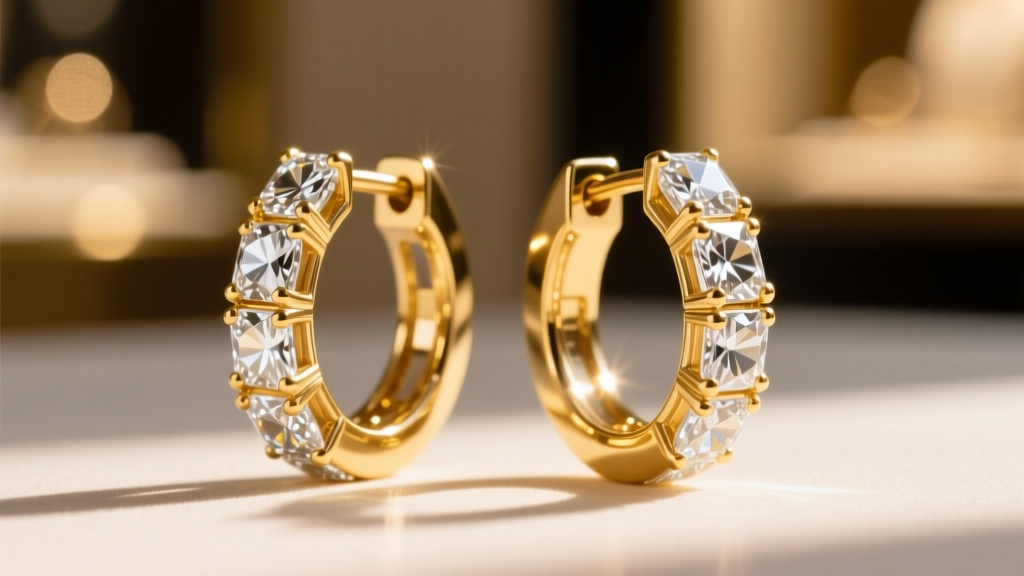
When shopping for affordable luxury, cubic zirconia hoop earrings remain a dominant force in the jewelry market. However, because the gemstone itself is a lab-created synthetic, the true variance in quality, longevity, and value lies entirely in the material science of the cut and the base metal used to forge the hoop. As of 2026, advancements in gem-cutting technology and metallurgical coatings have widened the gap between fast-fashion disposables and heirloom-quality demi-fine pieces. This guide deconstructs the optical properties of CZ and provides a definitive framework for selecting the right base metal pairings to ensure your hoops remain brilliant, structurally sound, and hypoallergenic.
Understanding Cubic Zirconia: Optical and Physical Properties
To evaluate CZ hoop earrings, you must first understand how the stone interacts with light and withstands daily wear. Cubic zirconia (ZrO₂) is engineered to mimic diamond, but its physical properties dictate a completely different wear-and-care protocol.
The Refractive Index and Dispersion Matrix
According to the Gemological Institute of America (GIA), cubic zirconia possesses a refractive index (RI) of 2.15 to 2.18, slightly lower than a diamond's 2.42. This means CZ returns slightly less white light. However, CZ has a dispersion rate of 0.058 to 0.066 (compared to diamond's 0.044). This higher dispersion is responsible for the intense, rainbow-colored 'fire' that gives CZ its signature sparkle. In hoop earrings, where stones are often set in continuous rows, this high dispersion creates a striking 'disco-ball' effect under direct lighting.
Mohs Hardness and Scratch Vulnerability
CZ ranks between 8.0 and 8.5 on the Mohs scale of mineral hardness. While this makes it harder than most everyday materials, it is significantly softer than diamond (10), moissanite (9.25), and sapphire (9). Practical implication: If you store your CZ hoops in a communal jewelry box alongside diamond or sapphire pieces, the harder gems will permanently scratch the facet junctions of your CZ, leading to a cloudy, abraded appearance over time.
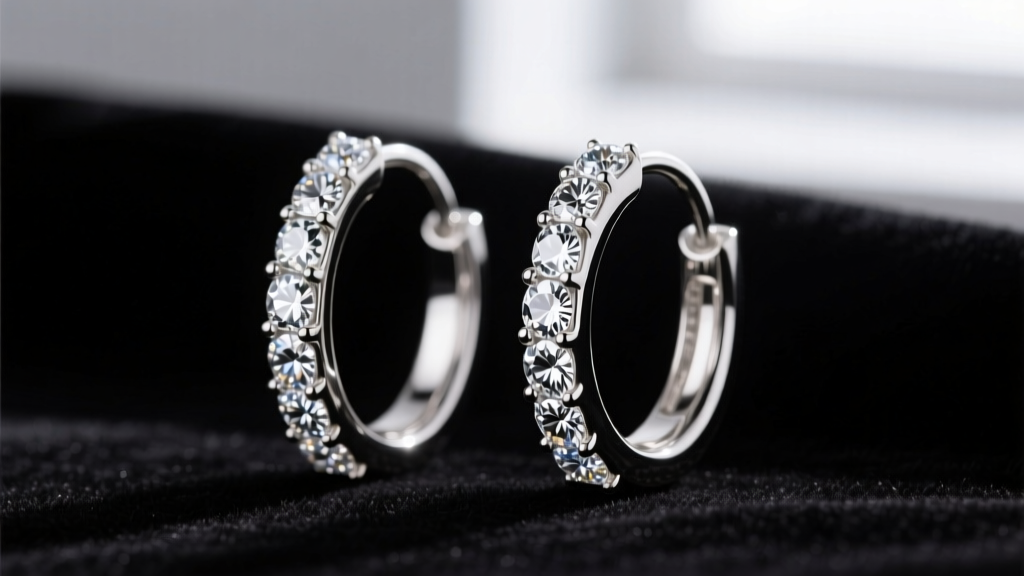
The Base Metal Matrix: What Holds Your CZ Hoops Together
Because cubic zirconia is relatively inexpensive to produce, the structural integrity and skin-safety of your earrings depend almost entirely on the base metal. Hoops are subject to high torsional stress—every time you open and close the clasp, the metal flexes. If the metal is too soft or poorly plated, the hoop will warp, and the stones will pop out.
Brass and Copper Alloys (The Fast-Fashion Trap)
Most CZ hoops under $25 are cast from brass or copper and flash-plated with a microscopic layer of gold or silver. These metals are highly malleable, meaning the hoop will easily bend out of its circular shape. Furthermore, as the flash plating wears off within weeks, the exposed copper reacts with the acidity in your skin, causing the dreaded 'green ear' effect and triggering contact dermatitis in sensitive wearers.
925 Sterling Silver and Rhodium Plating
Sterling silver (92.5% pure silver, 7.5% copper) is the industry standard for mid-tier CZ hoops. To prevent the copper content from tarnishing, high-quality manufacturers plate the silver with rhodium—a platinum-group metal that provides a brilliant, tarnish-resistant, and hypoallergenic barrier. When buying silver CZ hoops, always verify that the clasp mechanism is reinforced with a steel spring; pure silver springs lose their tension and fail to close securely.
Gold Vermeil vs. Gold Plated
The London Assay Office and international trade standards dictate that for a piece to be classified as 'Gold Vermeil,' it must feature a base of 925 sterling silver plated with at least 2.5 microns of 14k or 18k gold. Standard 'gold plated' jewelry has no thickness requirement and is often applied over brass. For CZ hoop earrings that you intend to wear daily, vermeil is the minimum acceptable standard for gold-toned metals, as the thicker plating resists the friction of the clasp and hair snagging.
Implant-Grade Titanium (ASTM F-136)
For cartilage piercings or highly sensitive lobes, titanium is the ultimate base metal. Unlike plated metals, solid titanium is anodized or treated with PVD (Physical Vapor Deposition) to achieve gold or rose-gold hues without using actual gold alloys. It is entirely nickel-free, immune to tarnish, and possesses a tensile strength that prevents the hoop from bending, thereby protecting the delicate CZ pave settings.
Comparative Data: Base Metals for CZ Hoop Earrings
| Base Metal | Plating / Composition | Tarnish Resistance | Hypoallergenic | Price Range |
|---|---|---|---|---|
| Brass / Copper | Flash gold/silver plating (<0.1 microns) | Low (Weeks) | No (Contains nickel/zinc) | $10 - $25 |
| 925 Sterling Silver | Solid alloy, often rhodium plated | Medium (Months/Years) | Mostly (Check for nickel) | $30 - $80 |
| Gold Vermeil | 2.5+ microns 14k/18k over 925 silver | High (Years) | Yes | $60 - $150 |
| Implant Grade Titanium | Solid ASTM F-136, Anodized or PVD | Permanent | Yes (100% Nickel-Free) | $40 - $120 |
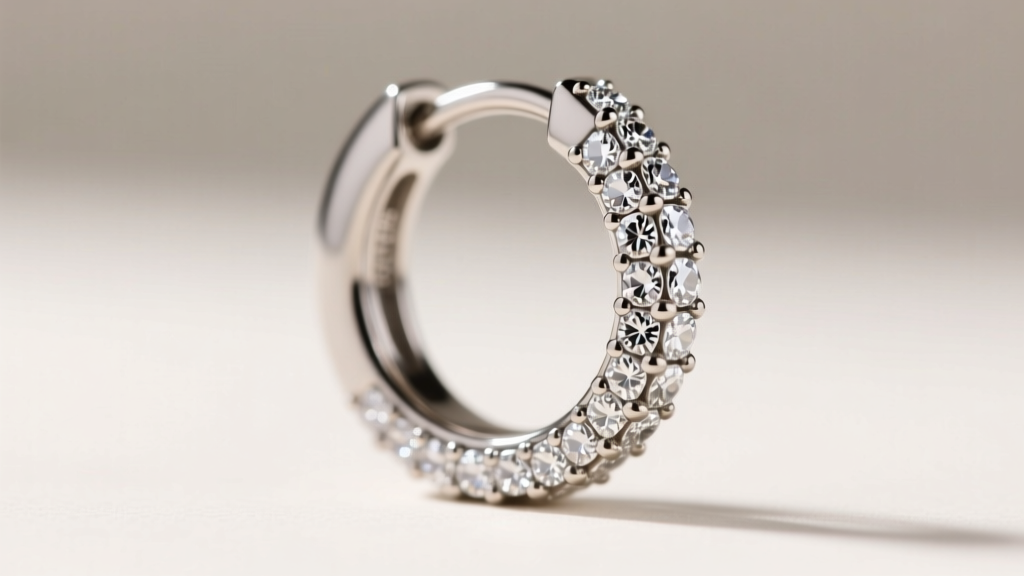
Setting Mechanics: Why Stones Fall Out of Hoops
The most common failure point in cubic zirconia hoop earrings is not the stone cracking, but the stones falling out. This is a direct result of setting mechanics interacting with the hoop's geometry.
- Micro-Pave Settings: In micro-pave, tiny metal beads are pushed over the girdle of the CZ to hold it in place. Because hoops are constantly subjected to bending forces when taken on and off, the metal stretches slightly. This stretching pulls the micro-beads away from the stone, causing it to drop. Expert Tip: If you buy pave CZ hoops, look for a thicker wire gauge (at least 1.5mm) to minimize flex.
- Channel Settings: The stones are set into a continuous metal trench with walls pushed over the edges. This is vastly superior for hoops, as the metal walls protect the CZ from impacts and do not rely on fragile individual prongs.
- Bezel Settings: A single rim of metal surrounds the entire circumference of the CZ. While it reduces the stone's light return slightly, it is the most secure setting for active wearers.
Cleaning and Maintaining CZ Brilliance
Cubic zirconia is highly oleophilic, meaning it has a strong affinity for attracting and holding onto oils, lotions, and sebum. When a microscopic layer of oil coats the pavilion (bottom) of the stone, it disrupts the light return, making the CZ look dull and cloudy.
Never use ultrasonic cleaners on pave or micro-pave CZ hoop earrings. The high-frequency vibrations can easily shake loose the tiny metal beads holding the stones, especially if the manufacturer used jewelers' epoxy to secure the settings.
The Optimal Cleaning Protocol:
1. Fill a small bowl with warm water and a few drops of grease-cutting dish soap (like Dawn).
2. Soak the hoops for 10 minutes to break down sebum and cosmetic buildup.
3. Gently scrub the back of the stones with a soft-bristled baby toothbrush.
4. Rinse under lukewarm tap water and dry immediately with a lint-free microfiber cloth to prevent water spots on the metal.
By prioritizing the metallurgical foundation and understanding the optical quirks of the stone, you can confidently select cubic zirconia hoop earrings that deliver lasting brilliance without the diamond price tag.


