Are Donut Earrings Worth It? A Budget & Value Guide
Discover if chunky donut earrings offer real value. We break down pricing tiers, metal grades, hollow vs. solid builds, and cost-per-wear for 2026.

The Anatomy of a Donut Earring: What Are You Paying For?
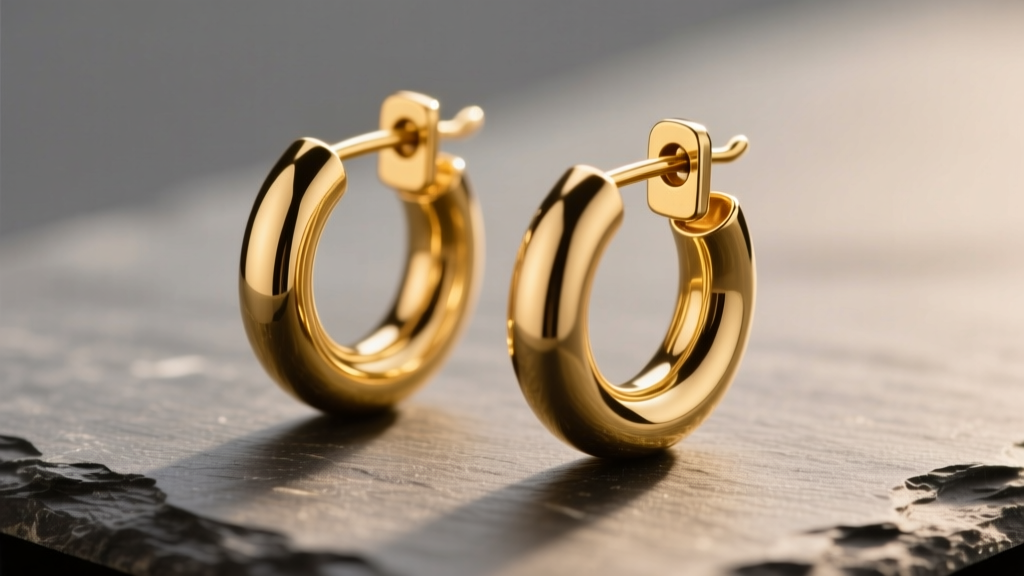
Donut earrings, characterized by their thick, tubular, torus-like silhouette, have dominated ear styling for several seasons and remain a staple in 2026 capsule collections. Unlike traditional wire hoops that rely on a thin 1mm to 2mm cross-section, donut hoops feature a tube diameter typically ranging from 4mm to 12mm. This substantial profile catches the light differently, offering a bold, continuous reflective surface that mimics the look of heavy luxury. But when assessing budget and true value, visual appeal is only half the equation. The real financial assessment lies in the manufacturing method, metal purity, and structural integrity.
According to the Gemological Institute of America (GIA), understanding the karatage and alloy composition is critical when evaluating gold jewelry investments. In the context of donut earrings, the sheer volume of metal required to create a 10mm tube means that material costs scale exponentially compared to standard wire hoops. Therefore, the market has bifurcated into two distinct manufacturing camps: hollow electroformed tubing and solid cast tubing. Knowing which one you are buying is the single most important factor in determining whether you are getting a fair deal or overpaying for trapped air.
Material Grades & Pricing Tiers in 2026
When shopping for donut earrings, the base metal dictates both the upfront cost and the long-term value retention. Below is a breakdown of the current market pricing for a standard medium-sized donut hoop (25mm inner diameter with a 6mm tube thickness).
| Material | 2026 Price Range | Expected Lifespan | Hypoallergenic Rating |
|---|---|---|---|
| 316L Stainless Steel | $35 - $80 | 10+ Years | Excellent (Surgical grade) |
| 925 Sterling Silver | $60 - $140 | 5-10 Years (Requires polishing) | Good (Watch for nickel mixes) |
| Gold Vermeil (over Silver) | $85 - $180 | 1-3 Years (Plating wears off) | Moderate (Depends on wear) |
| Solid 14k Gold (Hollow) | $250 - $450 | 5+ Years (Prone to denting) | Excellent |
| Solid 14k Gold (Cast) | $600 - $1,200+ | Generational | Excellent |
For budget-conscious buyers, 316L stainless steel offers the highest objective value. It is highly resistant to tarnish, waterproof, and structurally rigid. However, if you are seeking the warmth of gold, you must decide between the temporary brilliance of vermeil and the permanent investment of solid 14k gold.
Hollow vs. Solid Tubing: The Durability Trade-Off
The most common point of failure for budget and mid-tier donut earrings is structural collapse. To keep a pair of 14k gold 30mm donut hoops under the $400 mark, manufacturers use electroforming or thin-sheet stamping to create a hollow tube. This technique drastically reduces the gram weight of the gold, lowering the retail price. The immediate benefit is comfort; a hollow 8mm tube earring is lightweight and won't drag on your earlobe.
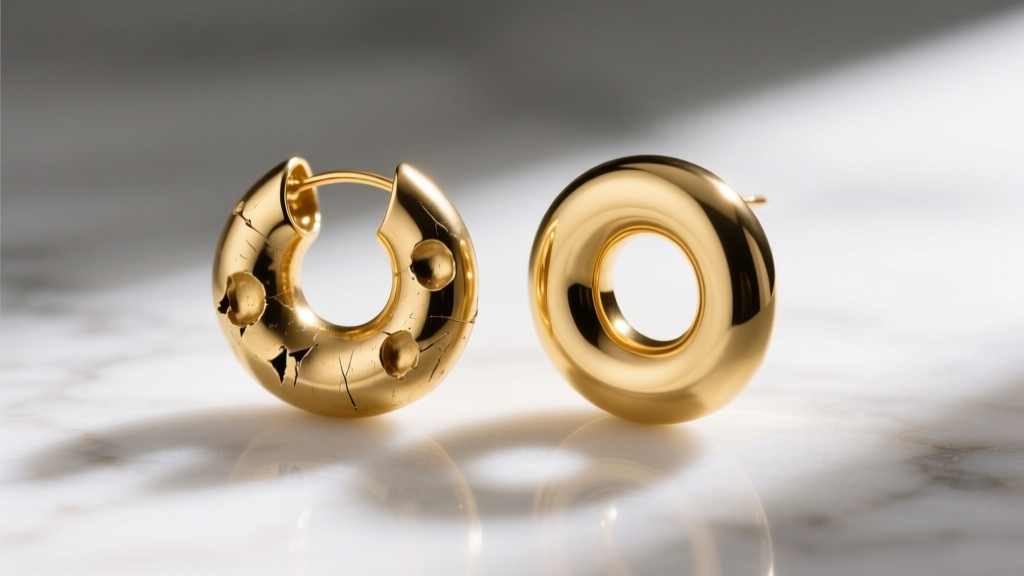
The severe drawback, however, is vulnerability. Hollow tubing is essentially a thin shell of metal. A single accidental drop onto a hard bathroom tile, or the pressure of sleeping on them, can cause a permanent crease or dent. Once a hollow donut earring dents, it cannot be hammered out or repaired by a jeweler without risking the structural integrity of the seam. Conversely, cast or semi-solid donut earrings weigh significantly more and cost three to five times as much, but they offer generational durability. They can be polished, buffed, and reshaped indefinitely.
Gauge Sizes and Post Thickness
Because donut earrings possess a larger surface area, they are inherently heavier and catch on hair and clothing more frequently than minimalist hoops. This necessitates a robust post and clasp system. Standard 20-gauge (0.8mm) posts will easily bend under the torque of a chunky 10mm donut tube. When evaluating value, inspect the post thickness: you should look for a minimum of 18-gauge (1.0mm) for hollow designs, and 16-gauge (1.2mm) to 14-gauge (1.6mm) for solid cast designs.
Furthermore, the clasp mechanism must be a heavy-duty hinged snap closure with a secure click, or an Omega-back saddle clasp. Friction-backed butterfly posts are entirely unsuitable for donut earrings, as the weight distribution will cause the earring to slowly slide off the post throughout the day.
Cost-Per-Wear Analysis: Are They a Smart Investment?
To truly assess the budget value of donut earrings, we must apply a Cost-Per-Wear (CPW) framework. The formula is simple: Total Cost / (Estimated Wears per Year × Years of Usable Lifespan).
- The Budget Vermeil Route: A $120 pair of hollow gold vermeil donut hoops worn twice a week (104 times a year). Due to friction and exposure to skin oils, the plating on the high-contact post and inner hoop will likely wear through to the silver base within 18 months. CPW = $120 / 156 wears = $0.76 per wear.
- The Solid Steel Route: A $50 pair of 316L stainless steel donut hoops worn three times a week (156 times a year) for 5 years before you decide to change your style. CPW = $50 / 780 wears = $0.06 per wear.
- The Investment Solid Gold Route: A $800 pair of solid 14k cast donut hoops worn 100 times a year for 10 years (and retaining a 40% resale melt/design value at the end). CPW = ($800 - $320 residual) / 1000 wears = $0.48 per wear.
This data reveals a counterintuitive truth: high-quality surgical steel actually offers a better mathematical CPW than mid-tier vermeil, while solid gold acts as a store of value rather than a sunk cost. The true 'trap' in the donut earring market is the $150-$300 range, where you are often paying a premium for brand markup on hollow, easily damaged gold-plated brass or thin vermeil.

Final Verdict: Where to Spend and Where to Save
When building your jewelry wardrobe, allocate your budget based on your wearing habits. If you view donut earrings as a seasonal trend and plan to rotate them out after a year, save your money and opt for high-polish 316L stainless steel or heavy gold-plated brass with a protective e-coating. You will get the exact same visual impact for a fraction of the price, without the heartbreak of denting a precious metal.
However, if you are seeking a signature, everyday hoop that will become a permanent fixture in your rotation, bypass the hollow electroformed options entirely. As recommended by the Jewelers of America, investing in solid alloys ensures that your pieces can withstand the rigors of daily maintenance and professional polishing. Save up for a semi-solid or fully cast 14k gold pair with a 14-gauge post and a secure hinge clasp. The upfront cost is steep, but the structural permanence and cost-per-wear ratio make it a definitive victory for long-term value.


