Door Knockers Earrings: Best Metals & Weight Guide
Discover the best metals for door knockers earrings. Compare gold, titanium, and steel for weight, durability, and lobe comfort in this expert guide.

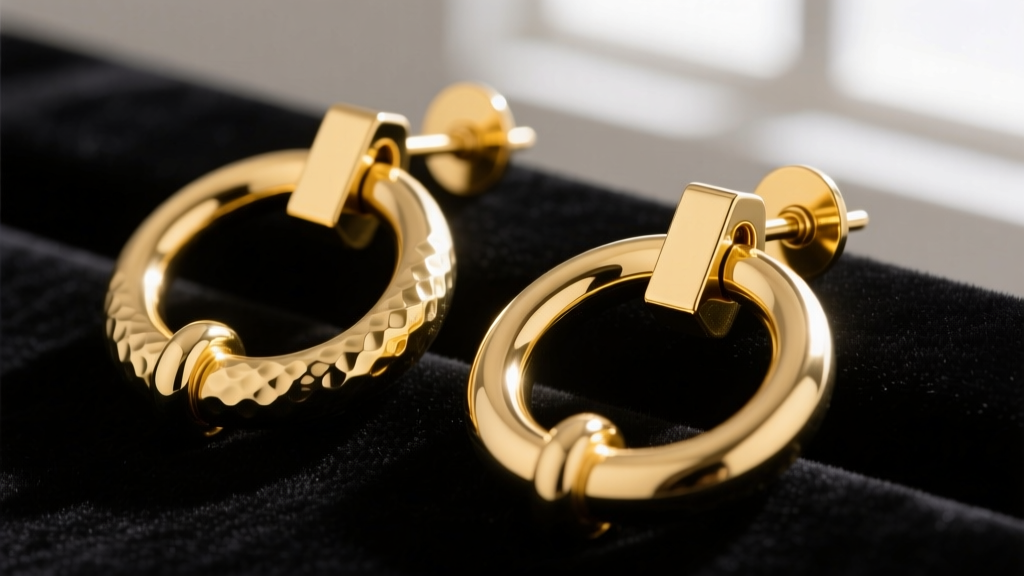
The Renaissance of the Statement Hoop
Door knockers earrings are experiencing a massive cultural and sartorial renaissance in 2026. Once the undisputed crown jewels of 1980s and 90s hip-hop fashion, these bold, geometric, and unapologetically large statement pieces have transitioned from archival vintage markets to contemporary high-fashion runways. Characterized by their thick, shield-like, or spherical hoop designs, they demand attention. However, their substantial volume introduces a unique set of structural and metallurgical challenges that standard stud or huggie earrings simply do not face.
When you scale up jewelry to the proportions of a classic door knocker, material choice ceases to be purely an aesthetic decision—it becomes an engineering necessity. The wrong metal can lead to severe contact dermatitis, while improper weight distribution and inadequate post gauges can cause irreversible earlobe damage. In this comprehensive guide, we break down the exact material properties, density metrics, and hardware specifications you need to evaluate before investing in a pair of heavy statement hoops.
The Physics of Earlobe Stress
Before comparing specific alloys, it is crucial to understand the biomechanics of wearing heavy jewelry. The human earlobe is composed of fibrofatty tissue without cartilage, making it highly pliable but vulnerable to sheer force. When a heavy earring hangs from a thin post, it creates a concentrated point of pressure at the bottom of the piercing tract. In the professional piercing community, this is known as the "cheese cutter effect."
If a pair of door knockers weighs 25 grams but utilizes a standard 20-gauge (0.8mm) post, the downward kinetic force will slowly migrate the piercing downward, eventually tearing through the lobe entirely. Therefore, the ideal material for door knockers earrings must balance three competing factors: low density (to minimize weight), high tensile strength (to prevent the post from bending), and biocompatibility (to prevent allergic reactions in stretched or stressed tissue).
Material Breakdown: What Works and What Fails
14k vs. 18k Solid Gold
Gold is the traditional metal of choice for premium door knockers, but not all karats are created equal when dealing with heavy statement pieces. Pure 24k gold is far too soft and dense (19.3 g/cm³) for structural jewelry.
- 18k Gold (75% pure): With a density of roughly 15.6 g/cm³, 18k gold is heavy and luxurious. A solid 18k gold pair of large door knockers can easily exceed 40 grams, requiring specialized lobe supports. Furthermore, 18k gold is relatively soft; the posts can bend if caught on clothing.
- 14k Gold (58.5% pure): Alloyed with higher percentages of copper, zinc, or silver, 14k gold is significantly harder and more durable. It is the superior choice for the structural components of heavy earrings, offering excellent resistance to warping while maintaining a rich, warm hue.
Implant-Grade Titanium (ASTM F136)
For those with metal sensitivities or those seeking maximum comfort, titanium is the undisputed champion. According to the Association of Professional Piercers (APP), implant-grade titanium (specifically ASTM F136) is entirely nickel-free and highly biocompatible. More importantly for door knockers, titanium has a remarkably low density of 4.43 g/cm³—roughly one-third the weight of 14k gold. A massive, oversized titanium door knocker will feel virtually weightless on the lobe, eliminating the risk of migration while providing immense tensile strength that prevents the post from bending.
Surgical Stainless Steel (316L)
316L stainless steel remains the workhorse of mid-tier statement jewelry. It is highly polished, resists tarnishing, and is incredibly affordable. However, steel is dense (approx. 8.0 g/cm³), meaning large steel door knockers will have a noticeable, heavy swing. While generally safe for healed piercings, 316L steel contains trace amounts of nickel. If you have a known nickel allergy, prolonged wear of heavy steel earrings can trigger contact dermatitis, a well-documented reaction noted by the American Academy of Dermatology.
Brass and Base Metal Alloys (The Danger Zone)
Fast-fashion door knockers are frequently cast in brass or zinc alloys and plated with a microscopic layer of gold. Avoid these at all costs. The high copper content in brass reacts with sweat and skin oils, causing oxidation that turns the skin green. Worse, as the plating wears off on heavy pieces, the exposed base metals frequently cause severe allergic contact dermatitis and localized infections.
Comparative Data: Density, Cost, and Safety
Use the table below to compare the physical properties of common metals used in large-scale statement hoops.
| Material | Density (g/cm³) | Min. Recommended Gauge | Avg. Price Range (Statement Pair) | Hypoallergenic Rating |
|---|---|---|---|---|
| Implant-Grade Titanium | 4.43 | 16G or 14G | $80 - $250 | Excellent (Nickel-Free) |
| 14k Solid Gold | 12.9 - 14.6 | 16G or 14G | $600 - $2,500+ | Very Good |
| 18k Solid Gold | 15.6 | 14G (due to softness) | $1,200 - $4,000+ | Very Good |
| 316L Stainless Steel | 8.00 | 14G | $30 - $120 | Moderate (Contains Nickel) |
| Brass / Base Alloy | 8.4 - 8.7 | N/A (Avoid) | $10 - $40 | Poor (High Allergy Risk) |
Critical Hardware: Posts, Gauges, and Backings
The metal of the hoop is only half the battle; the hardware that anchors it to your body is equally critical. Standard earrings use 20-gauge (0.81mm) or 22-gauge (0.64mm) posts with friction "butterfly" backings. This setup will catastrophically fail on a pair of 20-gram door knockers.
Gauge Thickness
For any earring exceeding 10 grams, the absolute minimum post thickness should be 18-gauge (1.0mm). For classic, oversized door knockers weighing 15 to 30 grams, you must seek out 16-gauge (1.2mm) or 14-gauge (1.6mm) posts. This thicker wire distributes the downward force across a wider surface area of the piercing tract, neutralizing the cheese cutter effect.
Clasp and Backing Mechanics
Friction backs rely on tension, which is easily overcome by the momentum of a swinging hoop. Instead, look for these specialized backings:
- Omega Clip-Backs: These feature a hinged, curved wire that snaps into a locking catch. They provide excellent support for heavy hoops and distribute some of the weight to the upper cartilage of the ear, not just the piercing hole.
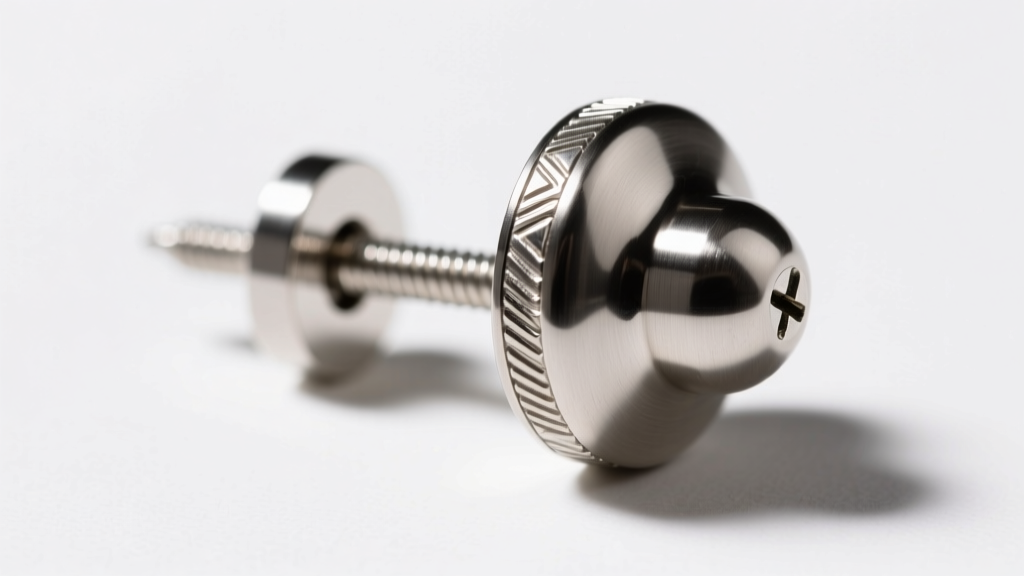
- Screw-Backs with Silicone O-Rings: The gold standard for heavy posts. The backing threads directly onto the post, making it impossible to fall off. Adding a tiny silicone O-ring between the backing and the earlobe provides friction grip and a comfortable cushion.
- Locking Bullet Clutches: These feature an internal disc mechanism that grips the post tightly, requiring a deliberate squeeze to release. They are a massive upgrade over standard butterfly backs.
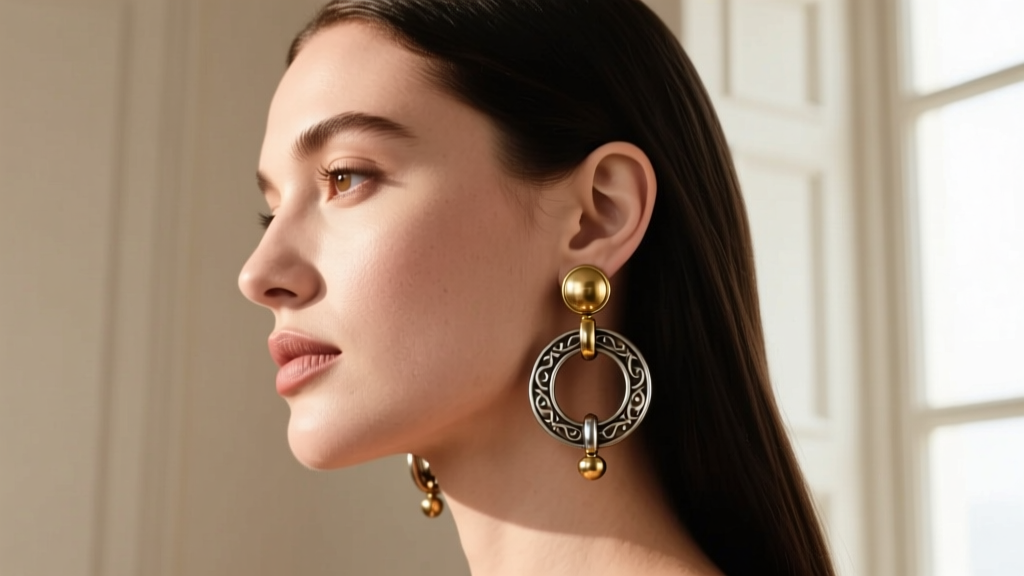
Lobe Care and Weight Distribution Framework
Even with perfectly engineered titanium or 14k gold door knockers, prolonged wear of heavy jewelry requires a proactive lobe care routine to maintain tissue elasticity and prevent permanent stretching.
- The 6-Hour Rotation Rule: Avoid wearing heavy statement hoops for more than 6 to 8 hours continuously. Swap to lightweight studs or huggies in the evening to allow the fibrofatty tissue of the lobe to decompress and restore blood flow.
- Silicone Support Patches: For events requiring all-day wear, utilize invisible silicone earring support patches (such as Bling Wraps). These adhesive pads stick to the back of the earlobe, creating a wider, reinforced base that absorbs the sheer force of the heavy metal.
- Nighttime Lobe Massage: After removing heavy door knockers, gently massage the earlobes with a drop of pure jojoba or vitamin E oil. This promotes tissue repair and maintains the elasticity of the piercing tract.
- Monitor for Migration: Inspect your piercings weekly. If the hole appears elongated, oval-shaped, or if you can see the edge of the jewelry through the bottom layer of skin, immediately cease wearing heavy hoops and switch to 14k or titanium studs for at least 30 days to allow the tract to tighten.
Final Verdict: Choosing Your Pair
Door knockers earrings are an investment in both style and structural integrity. If budget allows and weight is a primary concern, ASTM F136 Titanium offers an unbeatable combination of featherlight comfort, immense strength, and total biocompatibility. For those seeking the traditional luxury and warmth of precious metals, 14k Solid Gold provides the necessary hardness to prevent bending, provided it is paired with a 16-gauge post and an omega or screw-back clasp. By prioritizing metallurgical properties and proper hardware over mere aesthetics, you can rock bold, archival-inspired statement hoops safely and comfortably for decades to come.


