How to Stop Dangly Gold Earrings From Stretching Your Lobes
Stop dangly gold earrings from stretching your lobes. Expert troubleshooting for weight distribution, wire gauge, and earlobe support solutions.

The Hidden Physics of Lobe Stretching
Dangly gold earrings are a staple of fine jewelry, but their beauty often comes with a hidden physical toll: earlobe stretching, micro-tearing, and chronic inflammation. Because gold is an exceptionally dense metal (19.32 grams per cubic centimeter), even moderately sized solid gold drops can exert continuous downward shear force on the delicate collagen matrix of your earlobe.
If your favorite dangly gold earrings are pulling your piercings forward, causing the fistula to thin, or frequently slipping out due to bent wires, you are dealing with a structural physics problem, not a personal one. The human earlobe is composed of areolar connective tissue and fat, lacking the structural cartilage found in the upper ear. When a heavy object is suspended from a single puncture point, gravity works relentlessly to elongate the tissue. In this comprehensive troubleshooting guide, we break down the exact metallurgical and mechanical reasons behind these failures and provide professional solutions to salvage your jewelry and protect your anatomy.
The "Cheese-Cutter" Effect: Wire Gauge vs. Earlobe Tissue
The most common culprit behind stretched lobes is the standard 20-gauge French wire. A 20-gauge wire measures exactly 0.81 millimeters in diameter. When you hang a 6-gram solid gold dangle earring from a 0.81mm wire, the entire gravitational load is concentrated onto a surface area of roughly 0.65 square millimeters at the bottom of the piercing.
This extreme concentration of pressure creates what jewelers and dermatologists refer to as the "cheese-cutter effect." Just as a thin wire easily slices through a block of brie cheese under minimal pressure, a thin 20-gauge gold wire slowly migrates downward through the earlobe tissue over months and years of wear. The tissue attempts to heal behind the migrating wire, resulting in an elongated, slit-like piercing hole that can eventually tear through the bottom edge of the lobe entirely.
Troubleshooting Chart: Diagnosing Dangle Earring Failures
Before applying a fix, you must accurately diagnose the mechanical failure point of your specific dangly gold earrings. Use the diagnostic matrix below to identify your primary issue and its corresponding structural solution.
| Symptom | Root Cause | Mechanical Fix |
|---|---|---|
| Earring droops forward, pointing at the floor | Wire gauge too thin; anterior lobe tissue stretched | Upgrade to an 18g or 16g leverback; apply adhesive lobe patches |
| Earring slips out of the ear entirely during wear | 20g French wire lacks tension; no secondary clutch mechanism | Add 5mm silicone O-ring stoppers or switch to a hinged continuous hoop |
| The ear hook bends out of its "S" shape easily | High karat gold (22k/24k) has low yield strength | Have a jeweler re-solder the drop onto a work-hardened 14k or 18k hook |
| Lobe feels tender, red, or warm after 2 hours | Shear force inflammation or contact dermatitis from nickel alloys | Switch to hollow-form drops; verify alloy is nickel-free (palladium white gold) |
| Hair constantly tangles in the earring wire | Open French wire design catches on loose hair strands | Convert findings to an Omega-back or a locking leverback clasp |
Structural Fixes: Upgrading the Suspension System
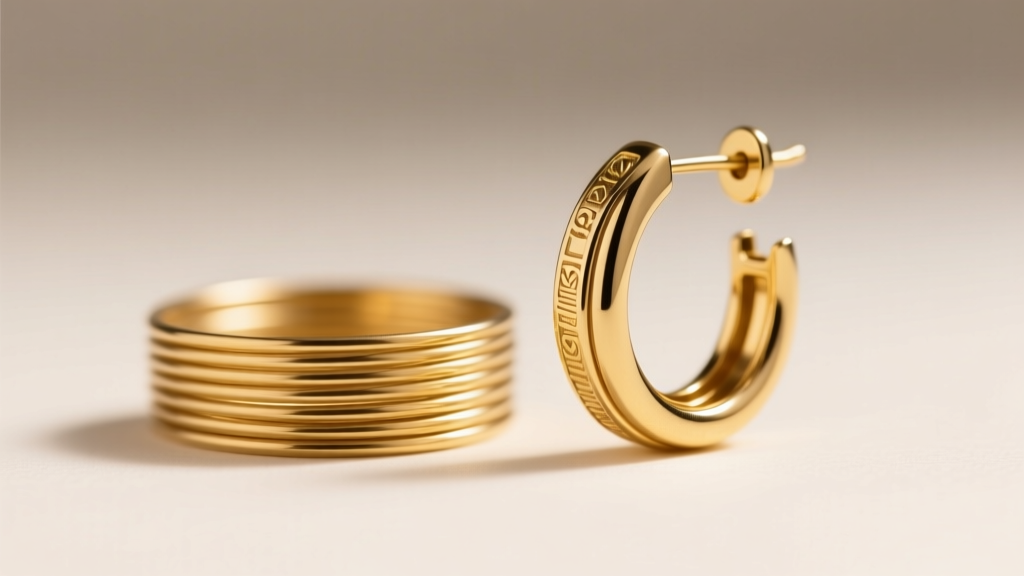
The most effective permanent solution for heavy dangly gold earrings is to increase the cross-sectional area of the wire passing through the ear. By moving from a standard 20-gauge (0.81mm) wire to an 18-gauge (1.02mm) wire, you increase the load-bearing surface area by 56%. If you upgrade to a 16-gauge (1.29mm) wire, the surface area increases by over 150%, drastically reducing the pounds-per-square-inch (PSI) exerted on the fistula.
However, you cannot simply bend a thicker wire into a standard French hook, as the resulting earring will look clunky and may not fit standard piercings without stretching them further. Instead, the correct approach is to change the finding type. Leverback clasps naturally utilize thicker 18-gauge or 16-gauge wires because the hinged mechanism requires the structural integrity of a heavier gauge. Furthermore, leverbacks distribute a portion of the earring's weight against the back of the ear's cartilage ridge, rather than suspending 100% of the mass directly from the bottom of the earlobe hole.
For post-style dangle earrings (where the drop hangs from a rigid metal post rather than a wire hook), the issue is often a lack of posterior support. Standard butterfly friction backs have a tiny surface area (rough 3mm diameter). Swapping these for jumbo 7mm silicone friction backs or flat metal disc clutches distributes the compressive force across a much wider area of the posterior lobe, preventing the post from digging into the skin and causing necrosis or pressure sores.
External Support Systems: Patches and Sleeves
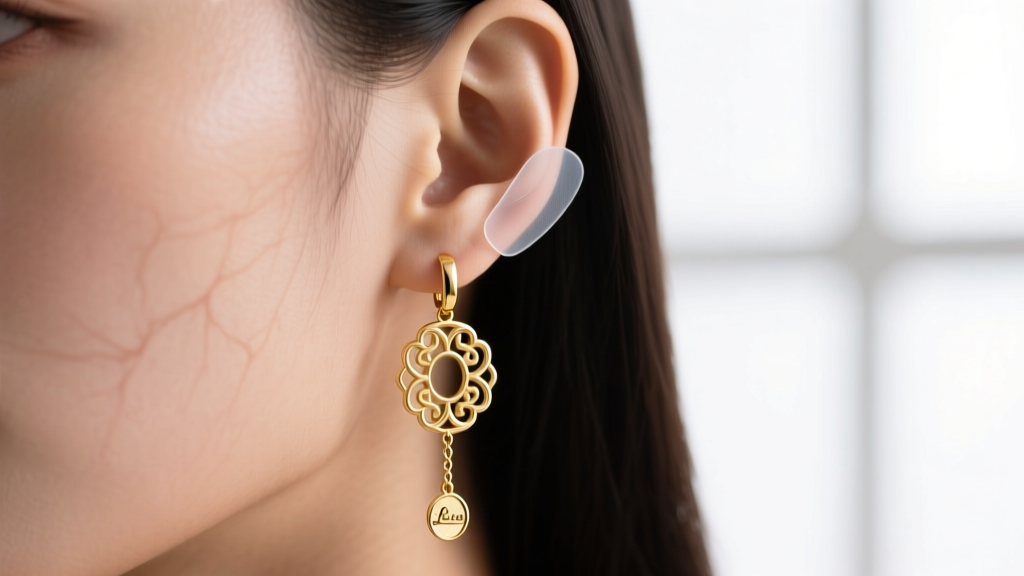
When the dangly gold earrings are simply too heavy to be supported by the earlobe tissue alone (typically anything exceeding 8 grams per ear), external support systems become mandatory. The gold standard in the jewelry industry for this issue is the use of adhesive lobe support patches, such as the popular brand Lobe Wonder.
These patches are 12mm medical-grade, hypoallergenic adhesive discs with a reinforced center puncture. When applied to the back of the earlobe, the patch acts as a structural splint. The downward shear force of the heavy gold earring is transferred from the 0.81mm fistula into the patch, which then distributes that force across a 113 square millimeter surface area of healthy skin and underlying tissue. This effectively eliminates the cheese-cutter effect and allows the earlobe to sit naturally, even when wearing massive, solid gold chandelier dangles.
For those who prefer a non-adhesive solution, clear silicone earlobe support sleeves (often called "lobe lifters") slide onto the earring post or hook behind the ear. These tiny, dome-shaped silicone bumpers push against the back of the ear, physically lifting the front of the earring upward to counteract the downward pull of gravity.
Material Integrity: The Yield Strength Problem in High-Karat Gold
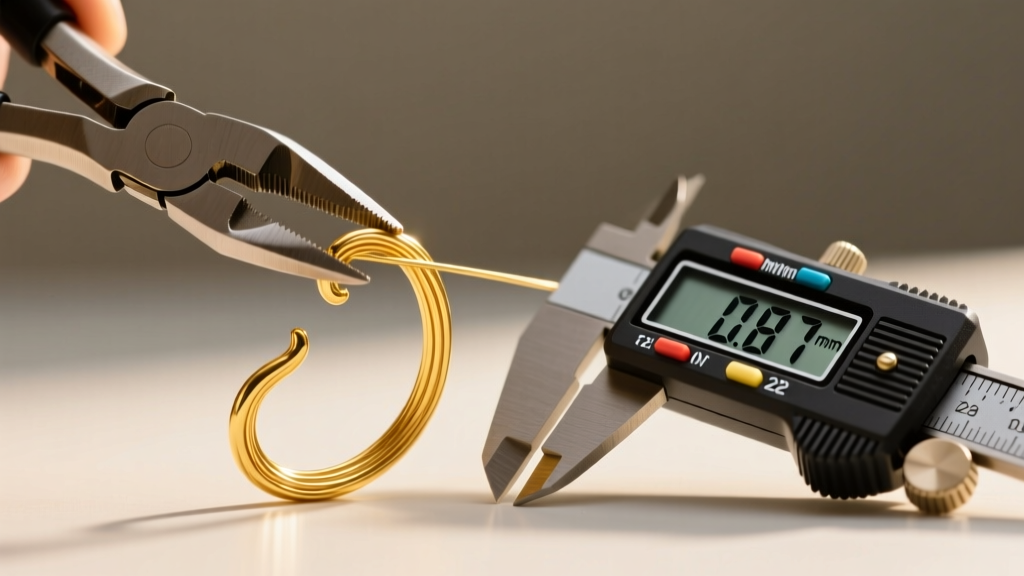
A frequent point of failure in luxury dangly gold earrings is the deformation of the ear wire itself. Many consumers assume that higher karat gold is inherently "better" and more durable. In reality, when it comes to structural jewelry findings, high-karat gold is a liability.
Pure 24-karat gold has a yield strength of roughly 25 to 50 Megapascals (MPa). It is highly malleable and ductile. According to the Gemological Institute of America (GIA), alloying gold with metals like copper, silver, or zinc drastically increases its hardness and tensile strength. A standard 14-karat gold alloy (58.5% gold) can exceed 300 MPa in yield strength, especially when work-hardened during the wire-drawing process.
If you purchase artisanal dangly gold earrings where the entire piece—including the hook—is crafted in 22k or 24k gold, the hook will bend under the weight of the drop. Once the hook bends, the tension required to keep it inside the ear is lost, resulting in the earring slipping out and being lost. The professional troubleshooting protocol for this is to have a master jeweler cut off the high-karat hook and laser-weld or solder a work-hardened 14k or 18k gold leverback in its place. Manufacturing standards from industry leaders like Stuller dictate that ear wires must be tempered and alloyed for spring-back memory; pure gold simply lacks the crystalline structure to provide this mechanical memory.
Weight Reduction Techniques: Hollow-Form and Electroforming
If you love the visual volume of large, oversized dangly gold earrings but your lobes cannot withstand the physical mass, you need to investigate alternative manufacturing techniques. Solid cast gold drops over 1.5 inches in length will almost always cause tissue damage over time.
To solve this, high-end jewelers utilize electroforming or hollow-forming. Electroforming involves 3D printing or carving a wax model of the earring, coating it in a conductive layer, and then using an electrolytic bath to deposit a hard, microscopic shell of gold over the wax. The wax is subsequently melted out, leaving a perfectly detailed, structurally rigid gold shell that weighs up to 70% less than a solid cast piece. Hollow-forming involves stamping two thin sheets of 14k or 18k gold in a hydraulic press and laser-soldering the seams together. Both techniques allow you to wear massive, dramatic gold dangles that weigh a mere 2 or 3 grams, completely bypassing the need for structural troubleshooting or lobe patches.
Preventing Tangling and Snagging
The final major issue with dangly gold earrings is the open nature of the French wire, which acts as a perfect hook for catching loose hair, scarves, and sweater threads. This snagging doesn't just damage your hair; it creates sudden, violent yanks on the earlobe, leading to acute tearing.
To troubleshoot this, avoid open French wires entirely if you have long, textured, or layered hair. Opt instead for hinged continuous hoops where the dangle is suspended from the bottom of a seamless hoop, or Omega-back findings, which feature a hinged, enclosed wire that snaps flush against the ear post. These enclosed suspension systems eliminate the "hook" that catches on external materials, ensuring your gold drops remain secure and your earlobes remain unharmed.


