Wearing an Earring on Left Ear: Meanings & 2026 Trends
Discover the historical meaning of an earring on left ear, how the 2026 asymmetry trend killed the old codes, and expert styling frameworks.


For decades, the simple act of wearing an earring on left ear carried a heavy, unspoken cultural script. Depending on the decade, the side of your head you chose to adorn could signal your sexual orientation, your subcultural affiliations, or your adherence to traditional gender norms. But as we navigate the style landscape of 2026, those archaic codes have been entirely dismantled. Today, choosing to wear a single earring on the left ear is no longer a covert signal—it is a deliberate, high-impact styling choice rooted in asymmetry, visual weight, and modern curation.
In this comprehensive trend analysis, we will decode the historical baggage of the left-ear earring, explore the technical specifications of single-ear styling, and provide a structural framework for mastering asymmetrical jewelry placement in 2026.
The Historical Code: What an Earring on Left Ear Used to Mean
To understand the current trend, we must first dissect the history. In the 1970s and 1980s, Western pop culture adopted a covert signaling system, often summarized by the deeply problematic and reductive rhyme: "Left is right, and right is wrong." Under this mid-century framework, a heterosexual man wearing an earring would exclusively pierce his left ear, while the right ear was reserved as a subtle identifier for gay men navigating hostile social climates.
This binary coding persisted well into the 1990s and early 2000s, heavily influencing how jewelry was marketed and perceived. However, as noted by Vogue's analysis on modern jewelry trends, the rigid gender codes and orientation markers of the late 20th century have entirely dissolved in contemporary fashion. The resurgence of men wearing pearls, diamond studs, and structural ear cuffs has rendered the "left vs. right" debate obsolete. In 2026, wearing an earring on the left ear simply means you favor asymmetrical balance or are highlighting a specific curated ear stack.
The 2026 Shift: Asymmetry and the Death of the Binary
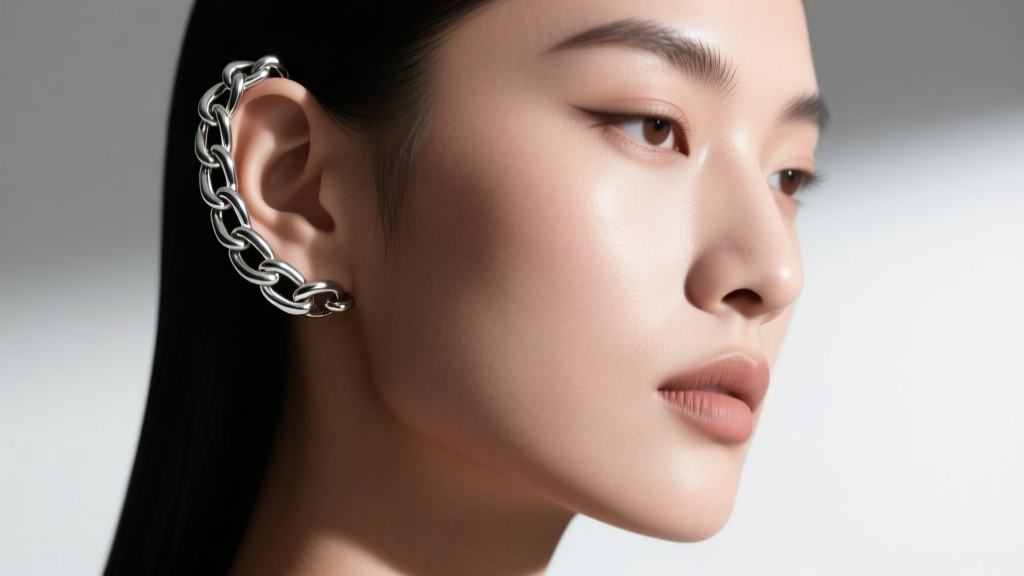
The defining jewelry trend of 2026 is intentional asymmetry. Rather than mirroring earrings on both lobes, style icons and everyday enthusiasts are treating the left ear as a standalone canvas. This approach draws the eye, creates a focal point in portraiture and profile views, and allows for heavier, more avant-garde pieces that might overwhelm the face if worn bilaterally.
When you isolate an earring on the left ear, you are engaging in what stylists call "visual anchoring." Because the left side of the face is often perceived in psychological studies as more emotionally expressive (due to right-brain hemisphere control), placing a striking piece of jewelry—such as a 14k solid gold chain-link ear cuff or a solitary baroque pearl drop—on the left ear naturally commands attention during conversation.
Framework: Balancing an Asymmetrical Left-Ear Stack
Wearing a single statement piece on the left ear requires balancing your overall visual weight so you don't look lopsided. We use the Visual Weight Index (VWI) to style asymmetrical ears:
- High VWI (7-10): Shoulder-duster earrings, heavy gauge chain hoops, or multi-piece ear cuffs. Balance strategy: Wear a bold signet ring or a heavy cuff bracelet on your right wrist to create a diagonal line of tension across the body.
- Medium VWI (4-6): Standard huggies, medium drop earrings, or a dual-lobe stud stack. Balance strategy: Keep the right ear bare but wear a textured or layered necklace that sits slightly off-center.
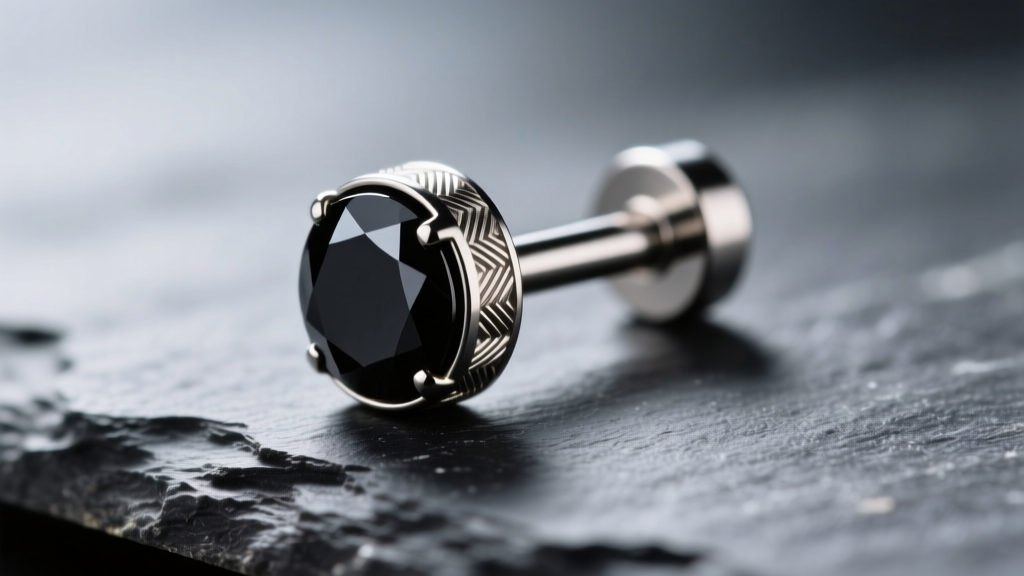
- Low VWI (1-3): A simple 2mm diamond or onyx stud. Balance strategy: This requires no counterbalance. It acts as a subtle accent rather than a focal point.
Material & Gauge Guide for Single-Statement Left Ear Pieces
When committing to a single, high-impact earring on the left ear, material integrity is paramount. A solitary earring is scrutinized more closely than a symmetrical pair, meaning cheap plating or poor finishing will be immediately obvious. Furthermore, if you are utilizing cartilage placements (like the helix or tragus) alongside the lobe to build a left-ear stack, you must adhere to strict biocompatibility standards.
According to the Association of Professional Piercers (APP), implant-grade titanium (ASTM F136) is the gold standard for fresh piercings, while 14k or 18k solid gold is ideal for long-term wear in healed lobes. Avoid gold-plated brass or standard "surgical steel" (which often contains nickel and violates the EU Nickel Directive for prolonged skin contact).
| Piercing Placement | Standard Gauge Size | Recommended Material (2026) | Estimated Price Range (Quality) |
|---|---|---|---|
| Standard Lobe | 20g (0.8mm) or 18g (1.0mm) | 14k/18k Solid Gold, Platinum | $80 - $450+ |
| Helix / Cartilage | 16g (1.2mm) | ASTM F136 Titanium, Niobium | $40 - $150 |
| Tragus / Conch | 16g (1.2mm) | Implant-Grade Titanium | $50 - $200 |
| Ear Cuff (Non-Pierced) | N/A (Adjustable) | Sterling Silver, Vermeil | $35 - $120 |
Crucial Sizing Note: If you are buying a statement stud for a standard lobe piercing, verify the post thickness. Many high-end jewelers craft men's or gender-neutral studs at 18g or 16g for durability. Forcing a 16g post into a healed 20g lobe piercing can cause micro-tears and irritation bumps. Always check the millimeter gauge before purchasing a solitary investment piece.
Trend Forecast: Top 3 Left-Ear Styles Dominating 2026
Style guides like GQ's earring handbook emphasize that modern jewelry is about architectural silhouette rather than mere sparkle. If you are dedicating your left ear to a singular style narrative this year, these are the three dominant silhouettes:
1. The Structural Ear Cuff
For those who want the aesthetic of a curated left-ear stack without the commitment of multiple cartilage piercings, the structural ear cuff is the ultimate 2026 hack. Look for cuffs made of rigid sterling silver that wrap around the mid-helix, featuring architectural lines or oxidized detailing. Because they rely on tension rather than a piercing, they can be easily removed, making them ideal for corporate environments where asymmetrical styling might still raise conservative eyebrows.
2. The Solitary Baroque Pearl Drop
The pearl has been entirely reclaimed from its traditional, feminine-coded origins. A single, irregular baroque pearl suspended from a minimalist gold wire on the left earlobe offers a striking contrast between organic imperfection and sharp tailoring. This look pairs exceptionally well with structured blazers and high-collared knitwear, providing a necessary organic softness to rigid menswear or androgynous silhouettes.
3. The Industrial-Inspired Threader
Threader earrings—featuring a delicate chain that pulls through the lobe and dangles down the neck—are dominating avant-garde streetwear. Worn exclusively on the left ear, a 14k gold threader with a matte black onyx terminal creates a sleek, vertical line that elongates the jaw and neck. This style requires a healed, healthy lobe, as the friction of the chain can irritate sensitive tissue.
Conclusion: Wear It How You Want
The historical anxiety surrounding an earring on the left ear is a relic of a bygone era. In 2026, jewelry is an exercise in personal architecture, not a covert signaling system. Whether you are anchoring a heavy silver chain cuff to your left helix or threading a solitary diamond through your lobe, the key to pulling off asymmetrical styling lies in understanding visual weight, investing in biocompatible materials, and wearing the piece with absolute intentionality. The left ear is no longer a code; it is a canvas.


