Earring Size Guide: How Metal Density Impacts Piercings
Discover how metal density and weight dictate your ideal earring size. Learn material limits for cartilage and lobe piercings to prevent migration.

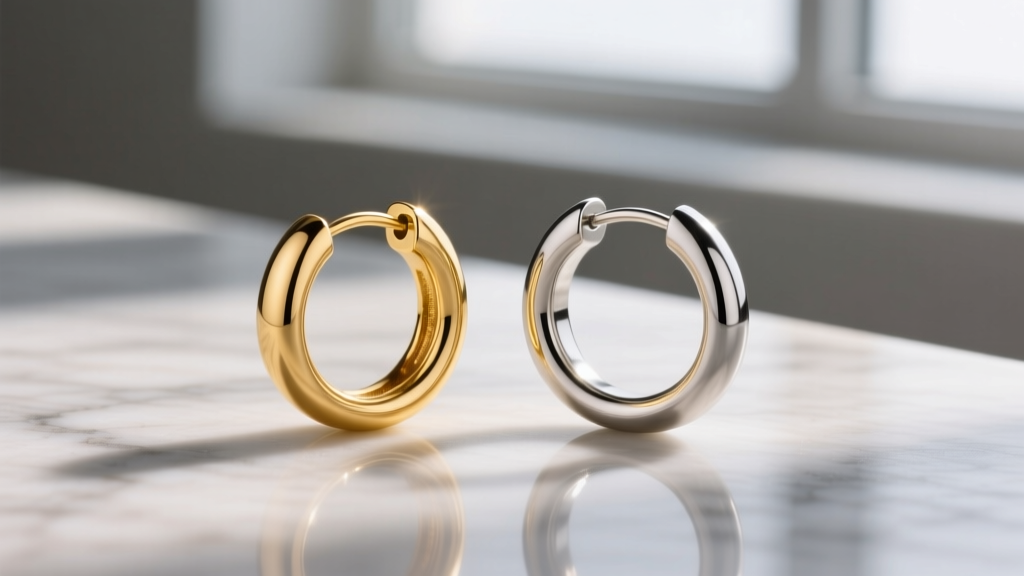
When selecting the perfect body jewelry, most consumers focus exclusively on aesthetics, diameter, and drop length. However, the intersection of material science and anatomy plays a critical role in long-term piercing health. Your ideal earring size is not just a matter of visual preference; it is strictly governed by the volumetric mass and density of the metal you choose. A 20-millimeter hoop in lightweight titanium behaves entirely differently on a helix piercing than a 20-millimeter hoop in solid platinum. Understanding how metal density dictates earring size limits is essential for preventing tissue migration, the dreaded cheese-cutter effect, and structural warping.
The Physics of Piercings: Weight vs. Tissue Tolerance
Every piercing site has a specific load-bearing threshold. Earlobes, composed of soft tissue and fat, can support significantly more weight than cartilage, which is a dense, rigid connective tissue with limited blood supply. When an earring size exceeds the weight tolerance of the tissue, gravity creates constant downward tension. Over time, this tension causes the fistula (the piercing channel) to stretch and migrate downward.
To understand this dynamic, we must look at the specific gravity (density) of common jewelry metals, measured in grams per cubic centimeter (g/cm³). The higher the density, the heavier the metal per unit of volume. Consequently, high-density metals require strict earring size limitations, especially for cartilage placements like the helix, tragus, or conch.
| Material | Density (g/cm³) | Max Cartilage Hoop Size | Max Lobe Drop Size | Avg. Price Range (Per Piece) |
|---|---|---|---|---|
| Platinum (950) | 21.45 | 8mm | 25mm | $400 - $1,200+ |
| 18k Solid Gold | 15.60 | 10mm | 30mm | $250 - $800 |
| 14k Solid Gold | 13.50 | 12mm | 35mm | $120 - $450 |
| Niobium | 8.57 | 16mm | 45mm | $40 - $90 |
| ASTM F136 Titanium | 4.50 | 25mm+ | 60mm+ | $30 - $80 |
According to guidelines established by the Association of Professional Piercers (APP), minimizing weight in fresh and healing piercings is paramount to avoiding rejection. Even in fully healed piercings, chronic weight stress from an oversized, dense metal hoop can lead to delayed migration.
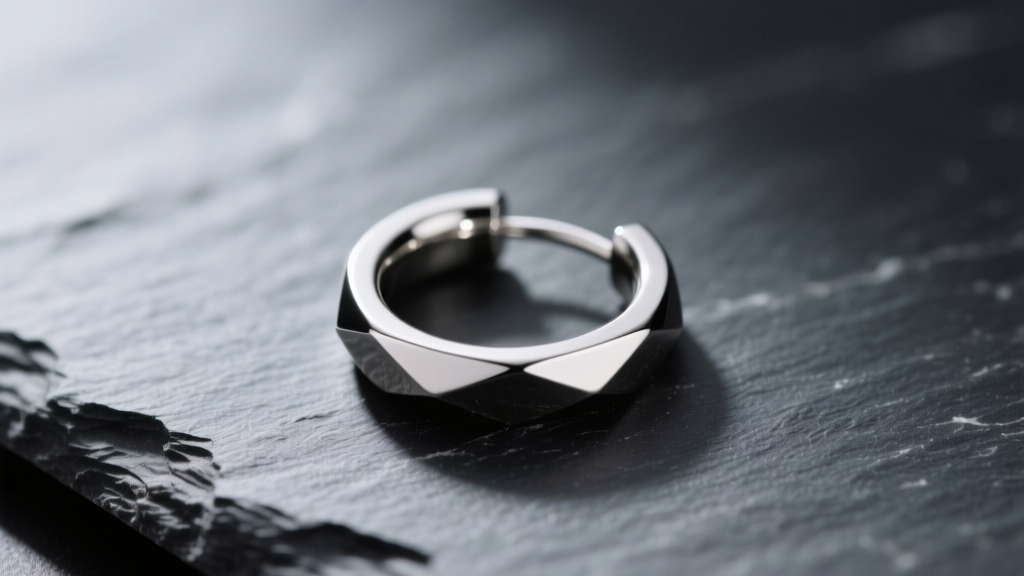
Heavyweight Metals: Sizing Limits for Gold and Platinum
Platinum and high-karat gold are the pinnacles of luxury jewelry, prized for their hypoallergenic properties and rich luster. However, their extreme density makes them challenging for larger earring sizes. Platinum, with a density of 21.45 g/cm³, is nearly five times heavier than titanium. If you commission a solid platinum 20mm seamless hoop for a helix piercing, the sheer gravitational pull will place immense stress on the 16-gauge fistula.
The Cheese-Cutter Effect
When a heavy, thin-gauge wire rests in a cartilage piercing, it acts like a cheese wire slicing through a block of cheddar. The tissue attempts to heal the micro-tears caused by the weight, but the constant downward force outpaces the body's regenerative capabilities. The result is a slow, painful migration that eventually splits the cartilage entirely. To safely wear platinum or 18k gold in cartilage, you must restrict your earring size to small, snug-fitting huggies (8mm to 10mm) or lightweight studs.
The Hollow Tubing Solution
Master jewelers utilize a structural workaround to offer larger earring sizes in heavy metals: hollow tubing. By manufacturing a hoop from a 2mm thick hollow tube rather than a solid 2mm wire, the jeweler reduces the overall weight of the piece by up to 70% without sacrificing the visual thickness or structural integrity of the jewelry. If you desire a 20mm 14k gold helix hoop, always opt for hollow-tubed constructions to keep the weight within safe anatomical limits.
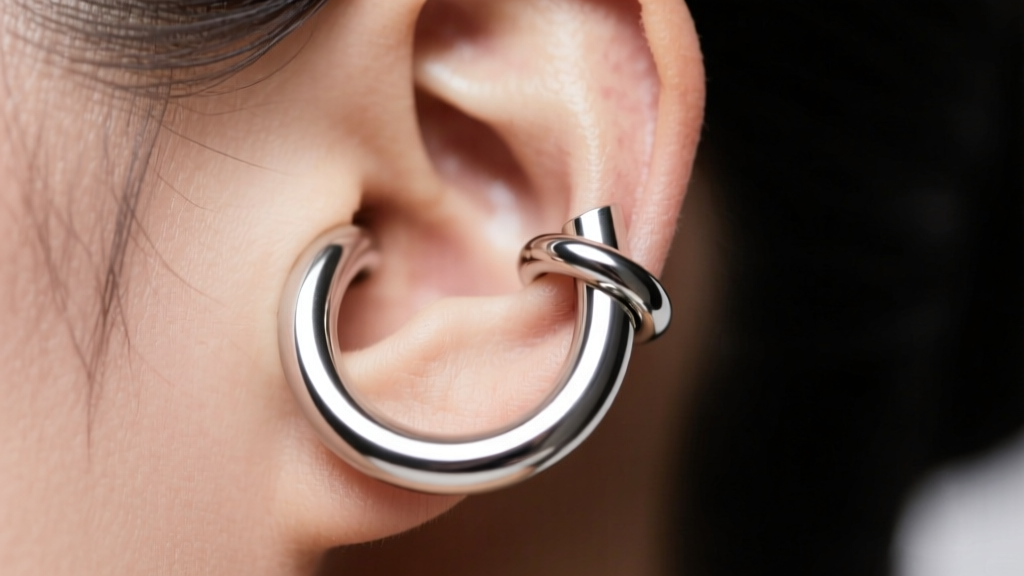
Lightweight Champions: Titanium and Niobium for Oversized Fits
If your aesthetic demands dramatic, oversized earring sizes—such as 25mm to 30mm hoops for a conch or daith piercing—you must pivot to low-density metals. ASTM F136 implant-grade titanium is the undisputed champion of lightweight body jewelry. With a density of just 4.50 g/cm³, titanium allows for massive earring sizes that would cause immediate rejection if crafted in gold or steel.
Titanium also boasts an exceptional strength-to-weight ratio. A large-diameter titanium hoop will not warp, bend, or lose its circular tension, even when subjected to the friction of sleeping or wearing headphones. Niobium, while slightly heavier than titanium at 8.57 g/cm³, is another excellent choice. It is highly malleable, allowing piercers to customize the exact angle and fit of larger hoops, and it can be anodized to produce a vibrant spectrum of colors without the use of toxic dyes or platings.
Gauge Thickness and Structural Integrity
Earring size is a two-dimensional metric: it encompasses both the diameter (or drop length) and the gauge (wire thickness). As the diameter of a hoop increases, the gauge must scale proportionally to maintain structural integrity, particularly in softer metals. The Gemological Institute of America (GIA) notes that pure gold and high-karat alloys are inherently soft and malleable.
If a jeweler crafts a 30mm hoop using a delicate 20-gauge (0.8mm) 14k gold wire, the hoop will easily bend out of shape the first time it catches on a sweater. To prevent structural failure, follow this gauge-to-diameter scaling framework:
- Small Huggies (8mm - 12mm): 18-gauge (1.0mm) or 16-gauge (1.2mm) is sufficient for most metals.
- Medium Hoops (14mm - 20mm): Require a minimum of 16-gauge (1.2mm) in gold, or 14-gauge (1.6mm) in softer alloys like silver.
- Large Hoops (22mm - 30mm+): Demand 14-gauge (1.6mm) or 12-gauge (2.0mm) wire to prevent warping, unless crafted from high-tensile titanium.
Scaling the gauge adds metal volume, which subsequently adds weight. This creates a delicate balancing act: you must increase the gauge to support a larger earring size, but doing so in a dense metal will push the jewelry past the tissue's weight tolerance. This is precisely why large-diameter, thick-gauge jewelry should almost exclusively be crafted from titanium or hollow-tubed gold.
Expert Sizing Matrix by Piercing Type
To synthesize these material properties into an actionable decision framework, use the following matrix when shopping for your next piece of body jewelry. Always cross-reference the metal's density with the specific anatomy of your piercing.
- Helix / Forward Helix: Highly susceptible to migration. Stick to 8-12mm hoops in 14k/18k gold, or up to 16mm in titanium. Avoid solid platinum hoops entirely.
- Conch: Can support larger earring sizes due to the broader tissue base. 16-20mm in gold is generally safe, provided the gauge is 14g or thicker to distribute the weight.
- Daith: A complex fold of cartilage that requires precise sizing. 10-12mm is standard. Because daith jewelry is constantly exposed to friction, titanium is recommended for its scratch resistance and lightweight properties.
- Earlobes: The most forgiving placement. Lobes can easily support heavy, oversized 18k gold drops and solid platinum statement pieces, provided the piercing is fully mature and not stretched beyond standard 18g/16g dimensions.
Conclusion
Choosing the correct earring size is an exercise in applied physics. By respecting the density of your chosen metal and matching it to the load-bearing capabilities of your specific piercing, you ensure both the longevity of your jewelry and the health of your anatomy. Whether you are investing in a heavy, luxurious 14k gold lobe drop or a massive, lightweight titanium conch hoop, let material science guide your aesthetic choices.


