Earrings and Gifts: Hanford 2026 Jewelry Value Guide
Discover how to assess true value when shopping for earrings and gifts. Hanford buyers can use this 2026 guide for metal grades, pricing, and craftsmanship.

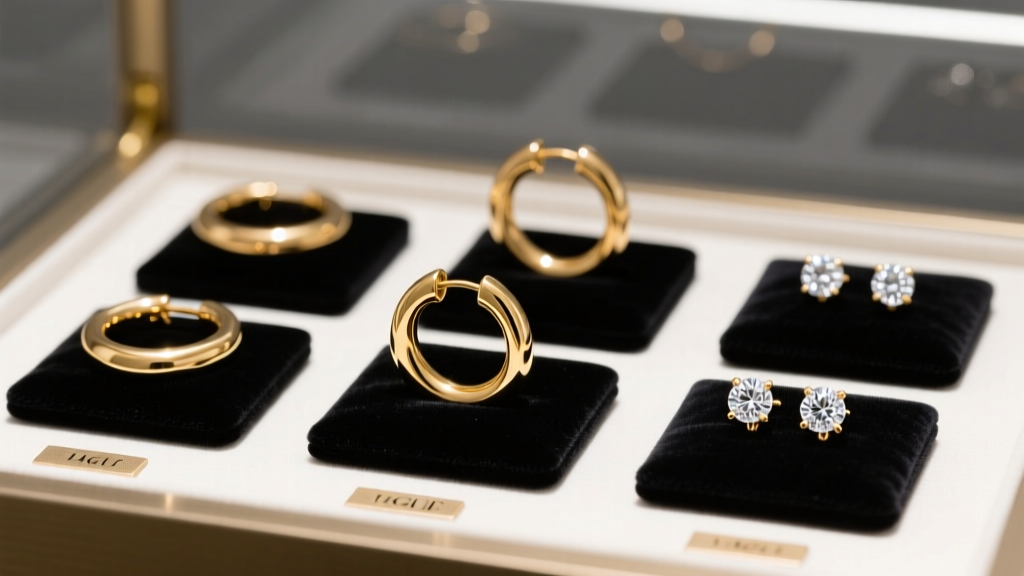
When evaluating fine jewelry, the intersection of quality, craftsmanship, and regional market dynamics plays a massive role in what you ultimately pay. For those searching for the perfect earrings and gifts, Hanford shoppers and Central Valley buyers face a unique landscape in 2026. While local Kings County boutiques offer the undeniable benefit of in-person customer service and immediate gratification, understanding the hard metrics of jewelry valuation is essential to ensure you are not overpaying for subpar materials. Whether you are purchasing a milestone pair of diamond studs, everyday gold huggies, or cartilage-friendly titanium hoops, this comprehensive value assessment guide will equip you with the metallurgical and gemological data needed to make an informed investment.
The 2026 Jewelry Market: Navigating Regional vs. Digital Value
The jewelry market has shifted dramatically over the last few years. In regional markets like Hanford, California, brick-and-mortar jewelers carry overhead costs that differ significantly from coastal metropolitan hubs or direct-to-consumer online brands. However, local jewelers provide essential services such as professional ultrasonic cleaning, prong tightening, and custom sizing that online retailers cannot match. When assessing value, you must factor in these post-purchase services. A pair of 14k gold drop earrings purchased locally might carry a 15% to 20% premium over an identical online pair, but this premium often includes a lifetime maintenance warranty. According to the Jewelers of America, establishing a relationship with a certified local gemologist ensures that your gifts are backed by verifiable grading reports and ethical sourcing guarantees, which is a critical component of true long-term value.
Precious Metal Valuation: What You Are Actually Paying For
The foundation of any high-quality earring is its metal composition. In 2026, gold prices remain a significant factor in retail jewelry pricing, making it vital to understand alloy purity. Pure 24k gold is too soft for earring posts and settings; therefore, it is alloyed with metals like copper, silver, and zinc to increase durability.
- 14k Gold (58.5% Pure Gold): The standard for most high-quality earring posts and clasps. It offers an excellent balance of rich color and structural rigidity, making it ideal for tension settings and thin wire hoops.
- 18k Gold (75% Pure Gold): Softer and more expensive, 18k gold is preferred for bezel settings and intricate cast designs where extreme malleability is required. It is also highly hypoallergenic.
- Argentium Silver (96% Pure Silver): A massive upgrade over traditional 925 Sterling Silver. Argentium replaces some copper with germanium, making it highly tarnish-resistant and brighter than standard silver. If a Hanford boutique offers Argentium silver earrings, it is a strong indicator of a curator who values modern metallurgical advancements.
2026 Material Benchmark & Durability Matrix
| Material Grade | Purity / Composition | Best Earring Application | Relative 2026 Cost Index |
|---|---|---|---|
| 14k Yellow Gold | 58.5% Au, 41.5% Alloy | Standard posts, huggies, wire wraps | $$$ |
| 18k Yellow Gold | 75.0% Au, 25.0% Alloy | Bezel set studs, luxury drops | $$$$ |
| Platinum 950 | 95.0% Pt, 5.0% Ru/Ir | Heavy diamond studs, secure prongs | $$$$$ |
| 925 Sterling Silver | 92.5% Ag, 7.5% Cu | Fashion hoops, seasonal gifts | $ |
| ASTM F136 Titanium | Grade 23 Ti-6Al-4V ELI | Initial cartilage piercings, sensitive lobes | $$ |
Gemstone Economics: Lab-Grown Diamonds and Moissanite
If your gift involves diamonds, the 2026 market is heavily dominated by lab-grown alternatives. The Gemological Institute of America (GIA) notes that lab-grown diamonds possess the exact same chemical, physical, and optical properties as mined diamonds. For a classic pair of 1.00 Carat Total Weight (CTW) stud earrings, a natural diamond pair with F color and VS1 clarity can easily exceed $4,500. In contrast, an identical lab-grown pair (created via Chemical Vapor Deposition or CVD) will typically retail between $500 and $800. This represents a massive value proposition for gift-givers who prioritize visual perfection and size over geological rarity.
Alternatively, Moissanite (silicon carbide) offers a different value tier. Rated at 9.25 on the Mohs hardness scale, it is exceptionally durable for daily wear. Moissanite exhibits double refraction, giving it a fiery, rainbow-like brilliance that differs from a diamond's white light return. For budget-conscious shoppers seeking maximum sparkle in a halo or cluster earring design, Moissanite remains an unbeatable value.
Structural Integrity: Gauges, Clasps, and Findings
A common oversight when buying earrings as gifts is ignoring the structural hardware. The "findings"—the posts, wires, and clasps—dictate the comfort and security of the piece. Understanding gauge sizes is non-negotiable for assessing quality.
Post and Wire Gauge Standards
The jewelry industry uses the American Wire Gauge (AWG) system, where a higher number indicates a thinner wire. Standard lobe piercings are typically done at 20-gauge (0.81mm) or 18-gauge (1.02mm). If you are buying earrings for a newly pierced ear or a cartilage placement (like a helix or tragus), you must look for 16-gauge (1.29mm) or 14-gauge (1.63mm) jewelry to prevent the "cheese-cutter effect," where a thin wire slowly migrates through the tissue.
Clasp Security Mechanisms
The value of an earring is severely compromised if it falls out and is lost. Standard "butterfly" friction backs are notorious for loosening over time due to hair brushing and clothing changes. When assessing high-value gifts, demand superior clasp mechanisms:
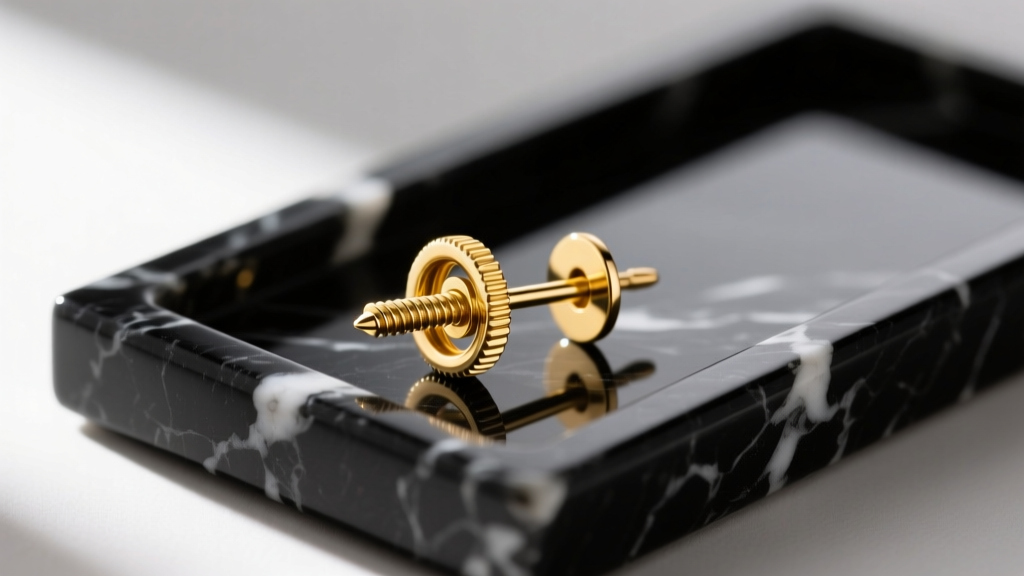
- La Pousette (Screw-Back): Features a tiny locking mechanism that clicks into a groove on the post. This is the gold standard for expensive diamond studs.
- Leverback: Ideal for drop and dangle earrings, the hinged wire snaps securely into a closed loop, preventing the earring from slipping out of the lobe.
- Hinged Snap (Clicker): Commonly used in huggies and cartilage hoops, providing a seamless look with a secure, audible click when closed.
Hallmarks and FTC Disclosure Guidelines
True value assessment requires verifying authenticity. The Federal Trade Commission (FTC) mandates strict guidelines for jewelry labeling. Any piece of gold jewelry sold in the United States must bear a quality mark (e.g., 14k, 585) and a registered trademark of the manufacturer. If a local vendor or online boutique is selling "gold" earrings without a clear hallmark stamped directly onto the post or clasp, consider it a major red flag. Furthermore, any gemstone treatments—such as fracture filling, laser drilling, or heat treatment—must be explicitly disclosed, as these processes significantly impact the stone's long-term durability and resale value.
A Practical Framework for Gifting Earrings
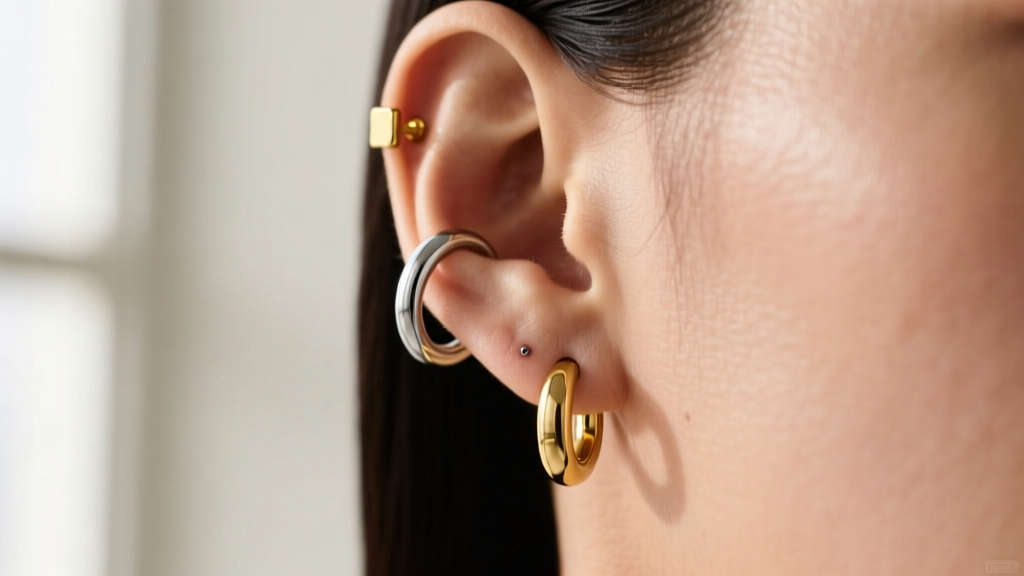
Beyond the raw materials, the true value of a jewelry gift lies in its wearability. Use this quick framework to match the earring style to the recipient's lifestyle and anatomy:
- For Active Lifestyles: Opt for 14k gold or platinum huggies, or flush-set bezel studs. Avoid long dangles or exposed prongs that can catch on athletic wear or equipment.
- For Sensitive Skin / Metal Allergies: Strictly avoid white gold that is rhodium-plated over a nickel alloy. Instead, gift ASTM F136 implant-grade titanium, niobium, or high-purity 18k yellow gold.
- For Face Shape Optimization: Angular face shapes (square or heart) benefit from the softening curves of teardrop dangles and rounded hoops. Round face shapes are beautifully elongated by geometric drops or linear threader earrings.
Final Verdict: Maximizing Your Regional Jewelry Budget
Shopping for earrings and gifts in Hanford requires a blend of local appreciation and hard-nosed material analysis. By prioritizing superior alloys like 14k gold and Argentium silver, demanding secure clasp mechanisms like the La Pousette, and leveraging the incredible value of lab-grown diamonds, you can secure heirloom-quality pieces without falling victim to inflated retail markups. Always ask for GIA or AGS grading reports for center stones, verify FTC-mandated hallmarks, and ensure the gauge thickness matches the recipient's specific piercing anatomy. Armed with these 2026 benchmarks, your next jewelry investment will be as structurally sound as it is visually stunning.


