Evaluating Gold 80's Earrings: A Technical Collector's Guide
Master the technical appraisal of gold 80's earrings. Explore 1980s gold alloys, omega clasp mechanics, hallmark identification, and structural integrity.

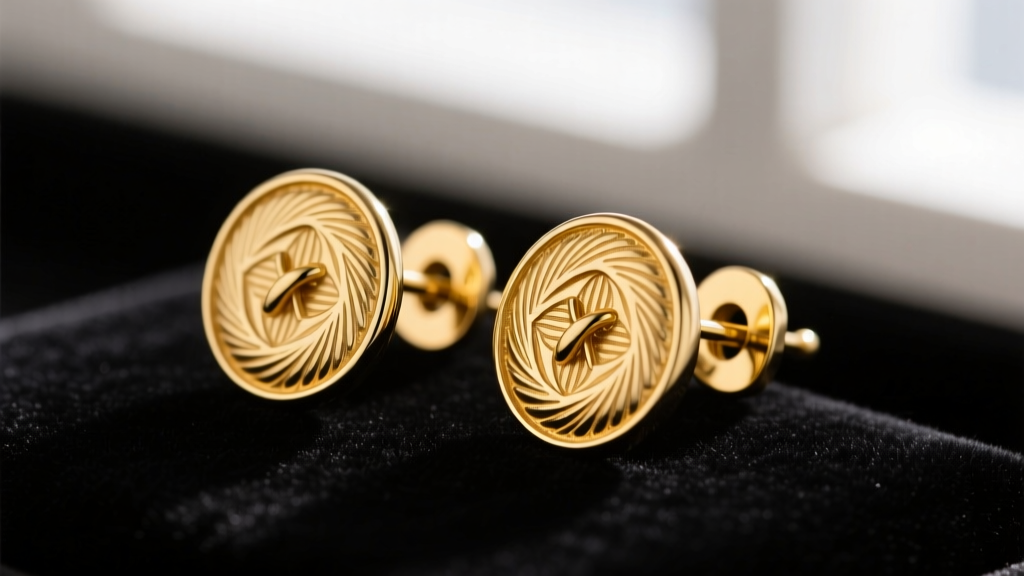
The 1980s represented a watershed era in jewelry manufacturing, characterized by bold geometric silhouettes, the mainstreaming of tri-color gold, and significant advancements in metallurgical casting. As we navigate the vintage market in 2026, 1980s jewelry has officially crossed the 40-year threshold, transitioning from mere 'secondhand' accessories to highly sought-after true vintage collectibles. For serious collectors and appraisers, evaluating gold 80's earrings requires moving beyond aesthetic appreciation into a rigorous technical analysis of alloy composition, clasp engineering, and hallmark forensics.
The Metallurgy of 1980s Gold Alloys
Unlike contemporary jewelry, which often relies on standardized, palladium-bleached white golds or highly specific rose gold copper ratios, 1980s yellow gold alloys exhibited distinct regional variations. The decade saw a massive influx of Italian gold into the American and European markets. Italian manufacturers frequently utilized a slightly higher copper-to-silver ratio in their 14-karat (58.5% pure gold) alloys compared to their American counterparts. This resulted in the signature 'warm' or 'rich' yellow hue that defines vintage Italian pieces from this era.
According to the Gemological Institute of America (GIA), the specific trace elements in vintage alloys can also affect long-term tarnish resistance and structural brittleness. Earrings from the late 1980s that were subjected to early electroforming techniques sometimes exhibit microscopic porosity if the wax mandrel was not perfectly vaporized during the casting process.
Comparative Alloy Breakdown: US vs. Italian 14K
| Alloy Type | Gold Content | Copper / Silver Ratio | Visual Hue | Tarnish Susceptibility |
|---|---|---|---|---|
| 1980s US 14K | 58.5% | ~30% Copper / ~11.5% Silver | Pale, bright yellow | Moderate |
| 1980s Italian 14K | 58.5% | ~35% Copper / ~6.5% Silver | Warm, deep yellow | Higher (requires polishing) |
| 1980s European 18K | 75.0% | ~15% Copper / ~10% Silver | Rich, buttery yellow | Low |
Structural Engineering: Clasp Mechanics and Failure Modes
The structural integrity of vintage earrings relies heavily on the clasp mechanism, and the 1980s was the golden age of the omega back (also known as a French clip). While standard friction posts and butterfly backs were common for lightweight studs, heavy 1980s 'button' earrings and large geometric clips required the load-bearing support of an omega clip.
The Omega Back Mechanism
An omega back consists of a hinged, U-shaped wire loop that snaps over a central post or a dedicated soldered nub. The tension is maintained by a microscopic beryllium-copper spring hidden inside the hinge barrel. When evaluating gold 80's earrings with this clasp, appraisers must check for spring fatigue. After four decades of use, the beryllium-copper spring can lose its elasticity, causing the clip to sit loosely against the earlobe. Furthermore, the hinge pin—often crafted from a harder steel alloy to prevent bending—can wear down the softer gold barrel over time, resulting in lateral wobble.
Screw-Back Limitations
Screw-back earrings were highly prevalent in the early-to-mid 1980s, particularly for high-carat diamond studs. The standard post gauge for these was 18-gauge (1.02mm) or 16-gauge (1.29mm) to support the threading. A common failure mode in surviving 1980s screw-backs is thread stripping. Because the threads are cut directly into the gold post, repeated cross-threading by users degrades the grooves, rendering the nut useless. Restoration requires laser-welding a new 14-gauge threaded post, a delicate procedure that risks heat damage to adjacent gemstones.
Hallmark Forensics: Dating and Authenticating 80s Pieces
Accurate authentication of 1980s gold earrings requires a granular understanding of international hallmarking laws. The Lang Antiques Hallmark Guide emphasizes that maker's marks alone are insufficient for dating; one must cross-reference assay stamps and regional legal requirements active during the decade.
The Italian Hallmarking System (Post-1968 Law)
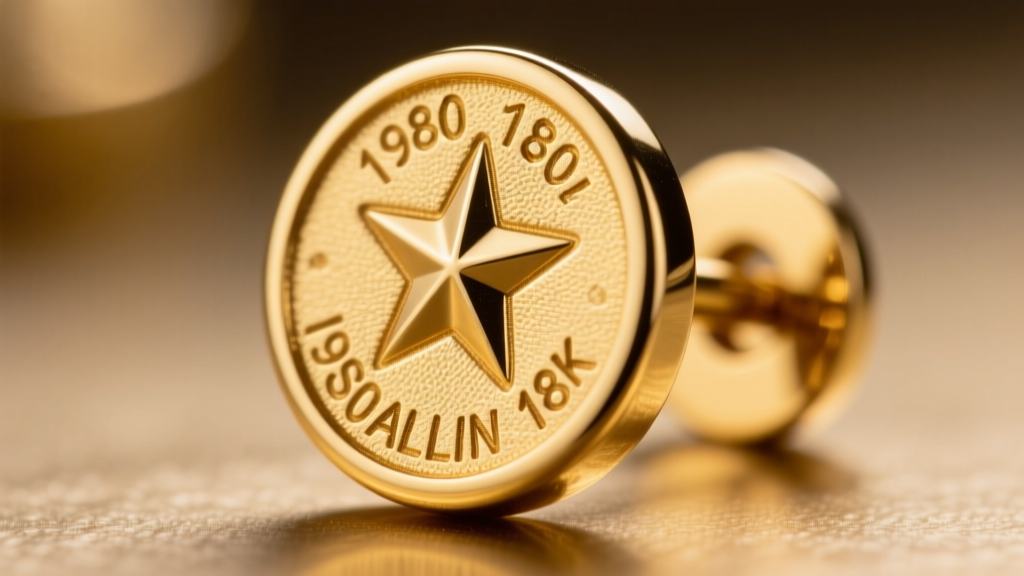
Italy's strict hallmarking law, established in 1968 and fully enforced throughout the 1980s, provides a forensic roadmap for collectors. A genuine Italian 1980s earring will typically feature three distinct stamps:
- The Star Symbol: Denotes the Republic of Italy.
- The Karat Stamp: Usually '750' for 18k or '585' for 14k.
- The Manufacturer/Province Code: A number followed by a two-letter province code (e.g., 123 VI for a specific manufacturer in Vicenza, or 45 AR for Arezzo).
Counterfeiters often stamp generic '14K ITALY' marks on modern castings. A true 1980s piece will show microscopic tooling marks around the stamp edges, indicating it was struck with a manual or pneumatic punch before the final polish, whereas modern laser-engraved fakes will exhibit perfectly uniform, shallow depths under 10x loupe magnification.
American and British Marks
In the United States, the 1980s saw the enforcement of the National Stamping Act, requiring a registered maker's mark alongside the karat stamp. However, US marks lack the date letters found in British hallmarks. British 1980s earrings will feature the Crown (for gold), the karat number (e.g., 375 for 9k, 750 for 18k), and the specific Assay Office mark (e.g., the Leopard's Head for London), alongside a date letter corresponding to the exact year of assay, making UK pieces significantly easier to date to the exact month of production.
Manufacturing Techniques: The Electroforming Revolution
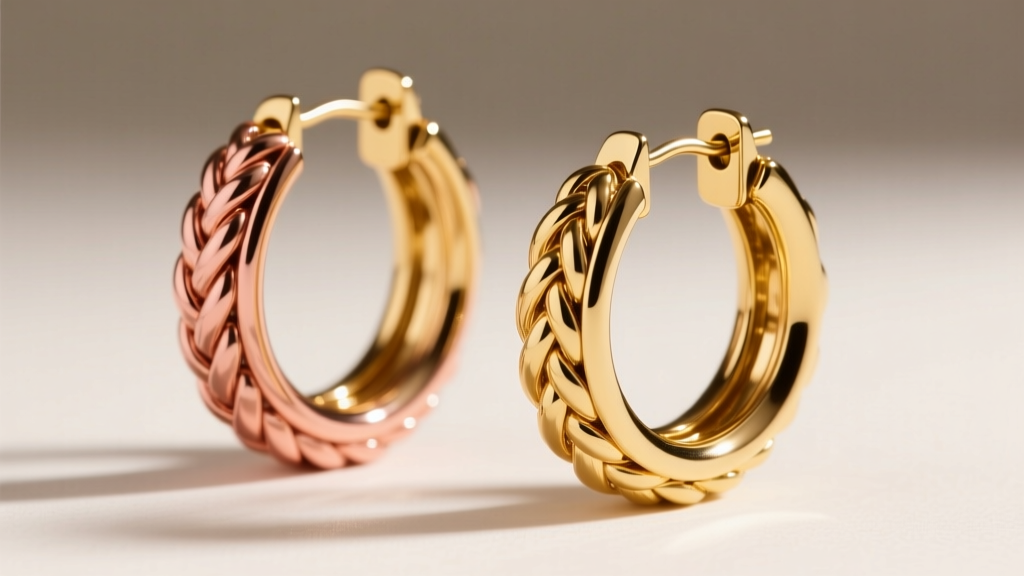
You cannot discuss gold 80's earrings without addressing the 'door knocker' and oversized geometric hoop trends. Solid cast gold earrings of this size would be prohibitively heavy, causing severe earlobe tearing. To solve this, the 1980s popularized electroforming.
Electroforming involves coating a wax mandrel with a conductive graphite layer and submerging it in an electrolytic bath, where pure gold or 18k gold is deposited atom by atom onto the surface. Once the gold shell reaches the desired thickness (usually between 0.2mm and 0.5mm), the piece is heated to melt out the wax, leaving a hollow, incredibly lightweight, yet structurally rigid gold shell.
Identifying and Appraising Electroformed Pieces
When evaluating large 1980s hoops or textured button earrings, tap them gently with a resin-tipped loupe stick. A solid cast piece will emit a dull, dense thud, while an electroformed piece will produce a faint, high-pitched 'tink.' While electroforming allowed for the intricate woven rope textures and tri-color gold braiding iconic to 1980s hoops, it introduced a critical vulnerability: impact denting. Because the gold shell is hollow and exceptionally thin, dropping an electroformed earring on a hard surface can cause irreversible collapsing. Furthermore, traditional soldering techniques cannot be used to repair broken hinge pins on electroformed earrings, as the localized heat will melt the thin shell and cause structural failure. Repairs require specialized laser welding under argon gas shielding.
Collector's Framework: Valuation and Wearability in 2026
As vintage gold 80's earrings continue to appreciate, their valuation is no longer tied strictly to their melt weight. Collectors now apply a 'design premium' to pieces featuring high-precision Florentine engraving, complex tri-color gold weaving, and intact, original maker's marks from defunct 1980s Italian design houses.
For wearability, buyers must assess the post gauge and clasp tension. Many modern piercings are stretched to 16-gauge or 14-gauge due to contemporary body jewelry trends. Standard 1980s posts, typically cut at 20-gauge (0.81mm) or 18-gauge (1.02mm), may cause 'cheese-cutter' migration in stretched lobes. Upgrading the posts to 14-gauge titanium or thicker 14k gold wire via laser welding is a standard, cost-effective restoration that preserves the vintage aesthetic while ensuring anatomical safety for the modern wearer.
Ultimately, mastering the appraisal of 1980s gold earrings requires a synthesis of metallurgical science, mechanical engineering analysis, and historical hallmark forensics. By looking past the bold, nostalgic aesthetics and examining the microscopic realities of the alloy and the clasp, collectors can accurately authenticate, preserve, and value these iconic pieces of late-20th-century jewelry history.


