Snake Stud Earrings: Troubleshooting Catching, Bending & Tarnish
Are your snake stud earrings catching on hair or bending? Learn expert troubleshooting tips for post stability, scale tarnish, and secure backing.

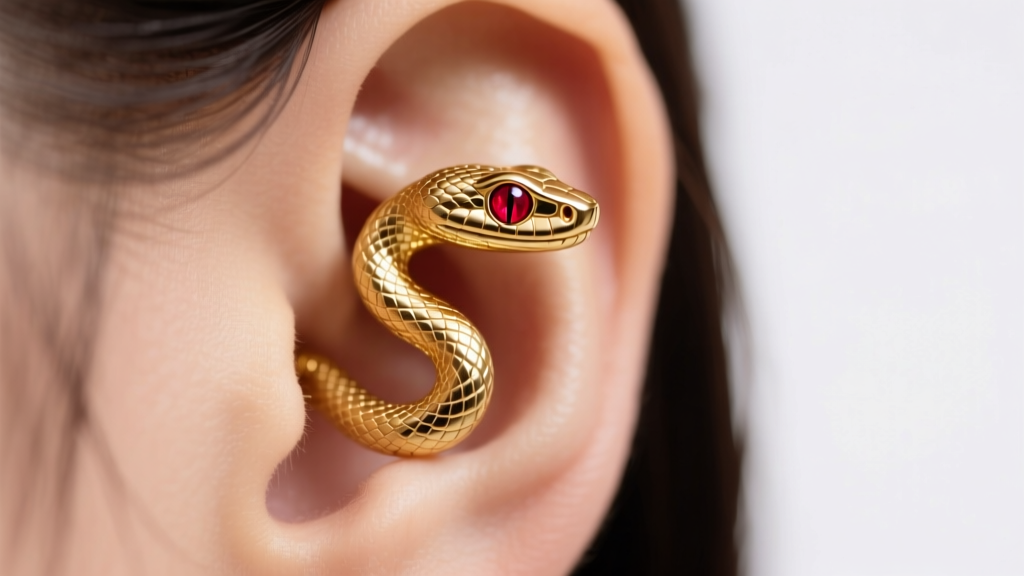
The Unique Anatomy of Snake Stud Earrings (and Why They Fail)
Snake stud earrings are a staple in serpent-inspired jewelry, offering a bold, symbolic, and intricate aesthetic. However, from a structural engineering perspective, three-dimensional animal studs present unique mechanical and chemical challenges that flat or geometric studs do not. The serpentine design—characterized by a dense, heavy head, a coiled or winding body, and a tapered tail—creates an asymmetrical center of gravity. When paired with standard jewelry manufacturing techniques, this asymmetry leads to three primary failure modes: post bending, chronic snagging, and trapped tarnish.
As a domain expert in jewelry mechanics and metallurgy, I have analyzed hundreds of customer complaints regarding 3D creature studs. In this comprehensive troubleshooting guide, we will dismantle the specific engineering flaws of snake stud earrings and provide actionable, data-backed solutions to restore their wearability and luster.
Troubleshooting Issue #1: The "Front-Heavy" Droop & Bent Posts
The most frequent complaint regarding snake stud earrings is the "forward droop." Because the snake's head is often cast in solid metal and features micro-pave or glued gemstone eyes, the front of the earring is significantly heavier than the post. Over time, the leverage exerted by the heavy head causes the metal post to bend downward, making the earring sit awkwardly on the earlobe or, worse, causing the post to snap entirely.
Gauge Thickness & Vickers Hardness Matrix
To solve the bending issue, you must evaluate both the gauge (thickness) of the post and the Vickers Hardness (HV) of the metal alloy. Standard 20-gauge (0.81mm) sterling silver posts have a Vickers hardness of roughly 60-70 HV, making them entirely inadequate for supporting a 3D snake head. Upgrading the material and the gauge is non-negotiable for long-term wear.
| Post Gauge | Diameter (mm) | Recommended Metal Alloy | Vickers Hardness (HV) | Load-Bearing Verdict for 3D Snake Studs |
|---|---|---|---|---|
| 20G | 0.81mm | 925 Sterling Silver | ~65 HV | Fail: Will bend within weeks of daily wear. |
| 18G | 1.02mm | 14k Yellow/White Gold | ~125 HV | Pass (Lobes): Minimum standard for healed lobes. |
| 16G | 1.29mm | Implant-Grade Titanium (ASTM F136) | ~330 HV | Pass (Cartilage & Lobes): Virtually unbendable. |
The Fix: If your current snake studs are bending, take them to a local bench jeweler to have the posts laser-welded and replaced with 18k gold or titanium 18-gauge or 16-gauge posts. Furthermore, abandon standard friction "butterfly" backs. The heavy front end will slowly push the friction back off the post, leading to lost earrings. Switch to La Pousette backs (which use a dual-spring locking mechanism) or silicone O-ring stoppers to secure the heavy snake head firmly against the ear.
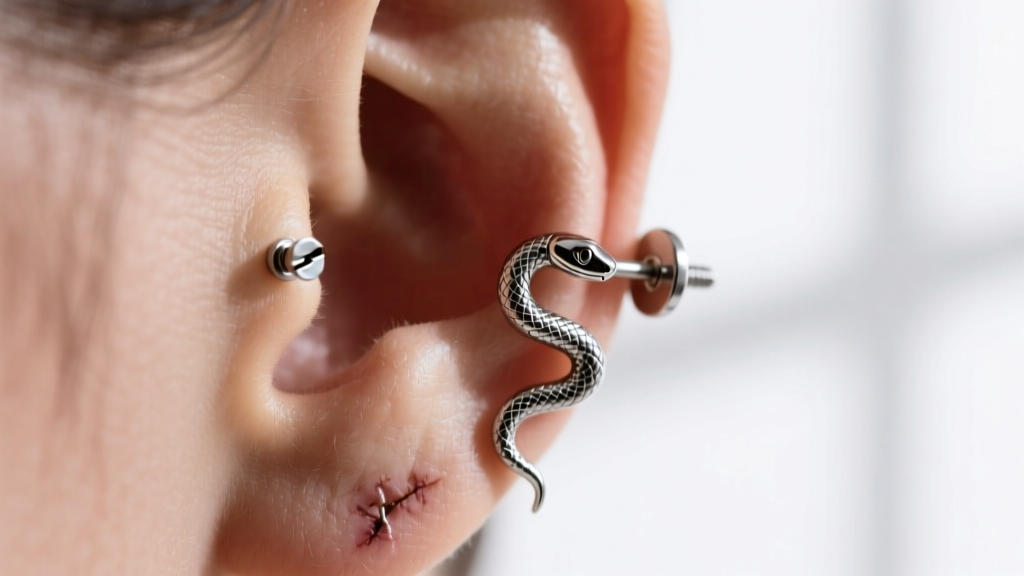
Troubleshooting Issue #2: Snagging on Hair and Knitwear
Snakes are naturally depicted in coiled, winding, or striking positions. While visually striking, the negative space between the coils and the protruding tail act as microscopic hooks. This "Coil Catch" phenomenon results in painful tugs on the earlobe and damaged hair. According to the Association of Professional Piercers (APP), jewelry with excessive protrusions or negative space is highly discouraged for active individuals or those with long, fine hair due to the risk of traumatic tearing.
Design Modifications & Styling Hacks
If you already own a highly textured, 3D coiled snake stud and refuse to part with it, implement these troubleshooting strategies:
- The Bas-Relief Swap: When shopping for replacements, opt for "bas-relief" snake designs. These feature the snake motif carved into a flat, solid disc (like a coin). You retain the serpentine aesthetic without the negative space that catches on knitwear.
- Tail Tucking: Some high-end jewelers design the snake tail to wrap entirely around the post base, eliminating the protruding tip. If your snake's tail extends outward, a jeweler can carefully file and round the tip to a smooth, flush dome.
- Gemstone Security: Snake eyes are often set with tiny rubies or emeralds. Prong settings on these micro-gems are notorious for catching on silk and wool. Request a jeweler to bezel-set or flush-set the eyes to eliminate microscopic snags.
- Hair Management: When wearing deeply coiled 3D snake studs, utilize a silicone ear-hugger cuff over the earring back to prevent hair from sliding behind the ear and tangling in the post and coil base.
Troubleshooting Issue #3: Tarnish Trapped in the Scales
Sterling silver (92.5% silver, 7.5% copper) is the most common metal used for affordable snake jewelry. However, the copper content reacts with sulfur and moisture in the air (and human sweat) to form silver sulfide—the black tarnish that plagues jewelry. On a smooth band, wiping away tarnish takes seconds. On a snake stud, the intricate, overlapping scales create hundreds of microscopic crevices where silver sulfide accumulates, turning your jewelry a dull, dirty gray.
Expert Warning: Never use commercial "silver dip" liquids (thiourea-based chemical baths) on snake studs with gemstone eyes. These harsh chemicals will strip the rhodium plating and dissolve the jeweler's epoxy used to glue micro-gems into the snake's head, causing the eyes to fall out.
The Safe, Deep-Clean Protocol
To safely remove tarnish from the deep crevices of your snake stud earrings without damaging the structural integrity or gemstones, follow this step-by-step metallurgical cleaning process:
- Prep the Solution: Mix a few drops of mild, phosphate-free dish soap (like Dawn) into a bowl of warm distilled water. Avoid tap water, as chlorine and hard minerals can leave microscopic spots.
- The Soak: Submerge the earrings for exactly 3 to 5 minutes. This softens the sebum, dead skin cells, and cosmetic buildup trapped between the scales, which often acts as a binder for the tarnish.
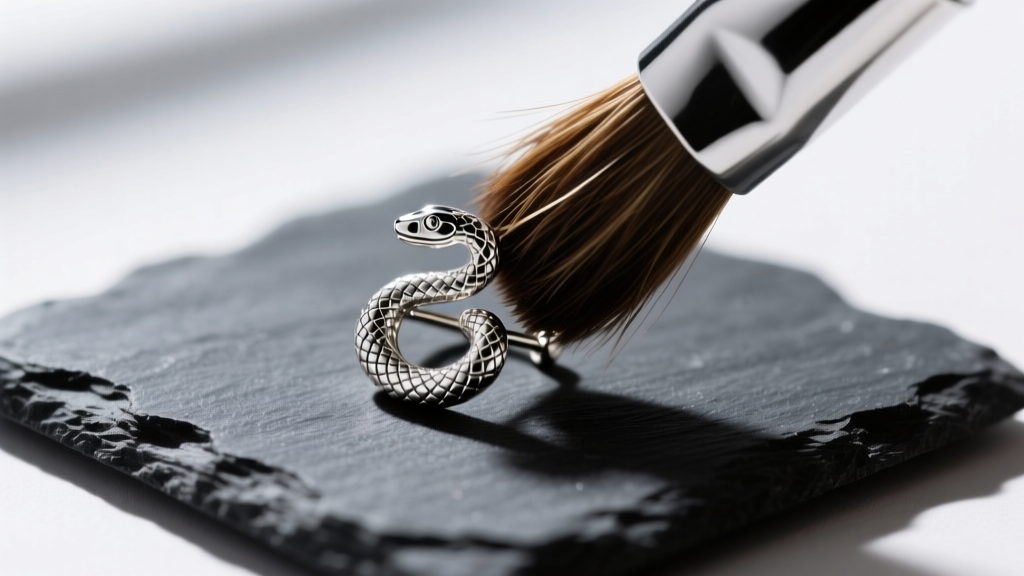
- Agitation: Using a soft horsehair detailing brush (never a hard-bristled toothbrush, which will scratch high-polish gold and silver), gently agitate the bristles into the scale grooves in a circular motion.
- Chemical Polish (Optional): For stubborn black silver sulfide, apply a tiny dot of non-abrasive silver polishing cream to a cotton swab and carefully trace the snake's spine and outer scales. Avoid the eye sockets entirely.
- Drying: Blast the earring with compressed air or a jewelry steamer to force moisture out of the deep crevices. Trapped moisture against the post will cause localized oxidation and skin irritation.
For more in-depth information on maintaining precious metals and ensuring gemstone security during cleaning, refer to the Gemological Institute of America (GIA) Jewelry Cleaning Guide.
Material Upgrades: When to Replace Your Snake Studs
Sometimes, troubleshooting is a losing battle against poor manufacturing. If your snake stud earrings are made of brass or copper with a thin flash-plating of silver or gold (usually less than 0.05 microns thick), the friction of the scales against your skin and hair will wear the plating off within months. Once the base metal is exposed, it will cause contact dermatitis and turn your earlobes green.
The Upgrade Path: Invest in solid 14k/18k gold or Implant-Grade Titanium (ASTM F136). Titanium is entirely nickel-free, biocompatible, and immune to the sulfide tarnishing that ruins silver scales. While the upfront cost is higher (expect $80 to $250+ for quality solid gold serpent studs), the elimination of bending, tarnishing, and allergic reactions makes it a lifelong investment.
Final Verdict: Mastering Serpent Jewelry
Snake stud earrings require more maintenance and structural awareness than standard geometric studs, but their symbolic power and intricate beauty make them worth the effort. By upgrading to an 18-gauge or 16-gauge post, utilizing locking La Pousette backs to combat the front-heavy droop, choosing bas-relief designs to prevent snagging, and implementing a gentle horsehair-brush cleaning regimen, you can transform your problematic serpent jewelry into a flawless, everyday staple. Respect the metallurgy, and your jewelry will respect you.


