Earring Butterfly Back Stuck or Falling Out? Troubleshooting Guide
Learn how to safely remove a stuck earring butterfly back, prevent lost studs, and stop earlobe infections with our expert troubleshooting guide.

The Anatomy of an Earring Butterfly Back and Why It Fails
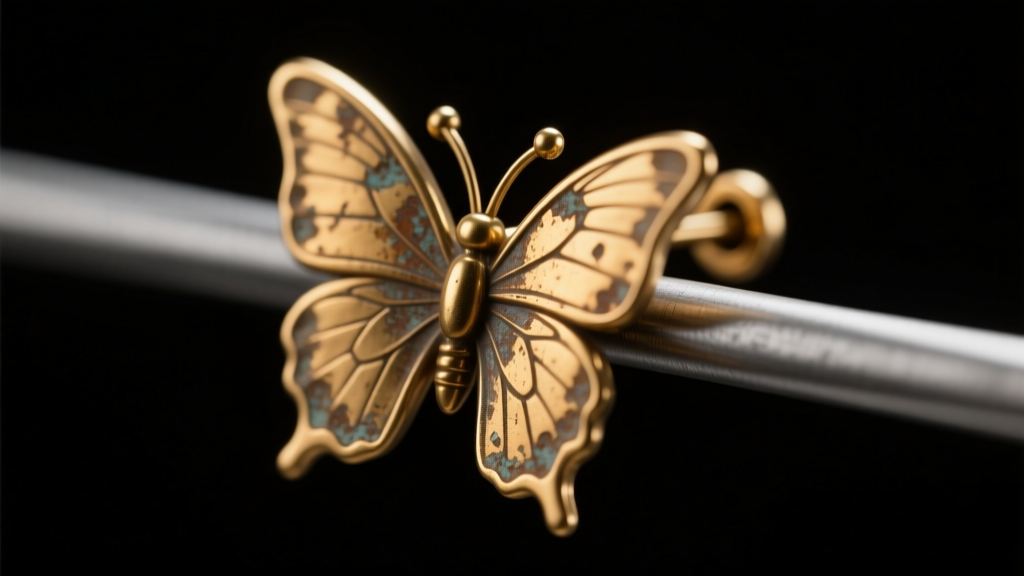
The earring butterfly back, also known as a friction back or push back, is the most ubiquitous earring securing mechanism in the world. Yet, it is fundamentally flawed. Designed with two small metal scrolls that grip the grooved post of a stud, the butterfly back relies entirely on metal tension to stay in place. Over time, this tension degrades. If you are constantly losing your favorite diamond studs or battling a clutch that refuses to budge, you are experiencing the mechanical limitations of friction-based jewelry.
Most commercial butterfly backs are stamped from brass or nickel-silver alloys and plated with a thin layer of gold or rhodium. When the plating wears away, the base metal is exposed to moisture, sebum, and oxygen. This leads to oxidation and microscopic swelling, which is the primary reason an earring butterfly back becomes permanently fused to the post. Furthermore, the repeated action of pushing the back on and off the post causes metal fatigue in the scrolls, leading to a loss of grip and inevitable lost earrings.
Troubleshooting: How to Remove a Stuck Earring Butterfly Back
There is nothing more panic-inducing than realizing your earring back is jammed against your earlobe, especially if the piercing is tender or newly healed. The buildup of sebum (skin oils), keratin (dead skin cells), and metal oxides creates a hardened, cement-like barrier in the clutch mechanism. Before you resort to pliers and risk tearing your earlobe, try these professional troubleshooting methods.
The Rubber Glove Grip Method
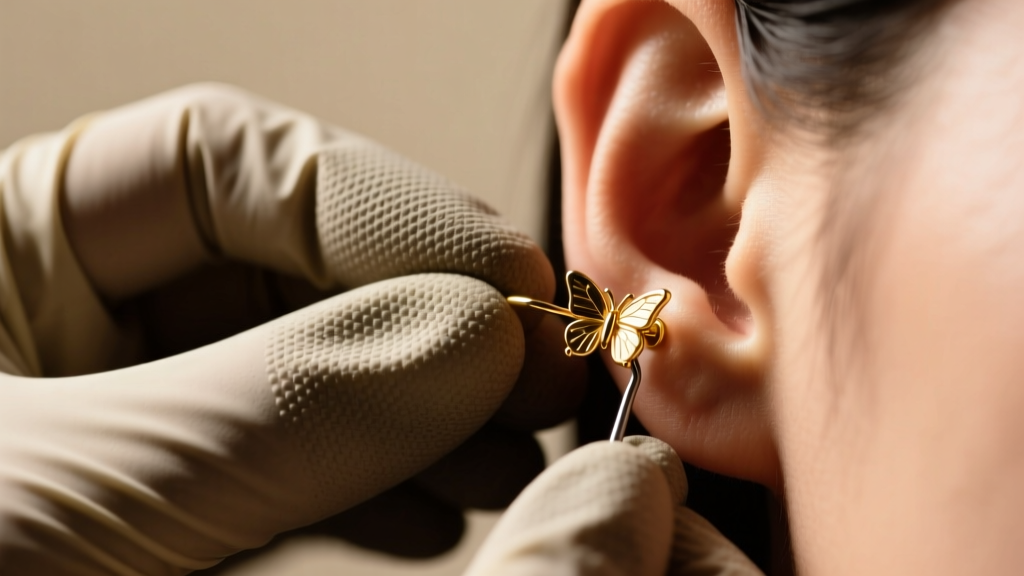
The most common reason people fail to remove a stuck back is a lack of torque and grip. Human skin simply cannot generate enough friction against smooth metal. Put on a pair of textured nitrile or latex medical gloves. The high-friction surface of the glove allows you to grip the tiny wings of the butterfly back firmly. Hold the front of the earring stud securely with your other hand (also gloved) and gently twist the back counter-clockwise while pulling outward. The twisting motion breaks the calcified sebum seal far more effectively than brute-force pulling.
The Ice Contraction Technique
If the metal is swollen due to oxidation or temperature changes, thermal contraction can save your earlobe. Wrap an ice cube in a thin paper towel and hold it against the earring post and butterfly back for 60 to 90 seconds. The rapid cooling causes the metal post to contract microscopically, often just enough to loosen the grip of the scrolls. Wipe the area dry immediately and attempt the rubber glove twist again.
The Dental Floss Lever Trick
For severely stuck backs where you cannot get a grip, take a piece of unwaxed dental floss. Wrap the floss tightly around the earring post, right between the earlobe and the butterfly back. Pull the floss taut and use a gentle sawing motion to work it into the gap. The floss acts as a microscopic wedge, breaking the seal of dead skin and oil while providing enough leverage to pop the clutch backward.
Why Your Butterfly Backs Keep Falling Out (And How to Stop It)
If your earring butterfly back keeps sliding off, the issue usually lies in the relationship between the post gauge and the notch depth. Standard stud earrings are typically manufactured in 20-gauge (0.8mm) or 18-gauge (1.0mm) thicknesses. The butterfly back is designed to snap into a tiny groove (notch) near the end of the post. If the notch is too shallow, or if the scrolls inside the clutch have lost their tension, the back will slide off with the slightest snag from a hairbrush or sweater.
| Post Gauge | Common Notch Depth | Clutch Tension Required | Failure Rate (Annual) |
|---|---|---|---|
| 22G (0.6mm) | 0.1mm | Very Low | High (Bends easily) |
| 20G (0.8mm) | 0.2mm | Moderate | Moderate |
| 18G (1.0mm) | 0.3mm | High | Low |
To troubleshoot this, examine the post under a magnifying glass. If the notch is worn smooth, the earring is compromised. You can temporarily increase the friction by wrapping a microscopic layer of PTFE (Teflon) tape around the post before sliding the back on, but the ultimate fix is to replace the earring or upgrade the backing system.
The Hidden Culprit: Contact Dermatitis and Earlobe Infections
A frequently overlooked problem with the earring butterfly back is its tendency to harbor bacteria and trigger allergic reactions. Because the butterfly back presses a flat, often concave metal surface directly against the back of the earlobe, it traps moisture and heat. This creates an ideal breeding ground for bacteria, leading to the foul odor commonly referred to as 'ear cheese.' According to the American Academy of Dermatology, nickel allergy is one of the most common causes of contact dermatitis, and cheap butterfly backs are notorious for containing high levels of nickel.
If you experience itching, redness, or weeping skin behind your earlobes, the friction back is likely the culprit. The Association of Professional Piercers (APP) strongly advises against using friction backs for healing piercings or sensitive ears, as the uneven pressure and poor airflow can cause hypertrophic scarring and prolonged irritation. Switching to implant-grade titanium (ASTM F-136) is non-negotiable if you suffer from metal sensitivities.
Upgrading Your Backs: Better Alternatives for Everyday Wear
If you are tired of the constant troubleshooting that comes with friction clutches, it is time to upgrade your jewelry mechanics. The jewelry industry has developed far superior securing mechanisms that eliminate the flaws of the traditional butterfly back.
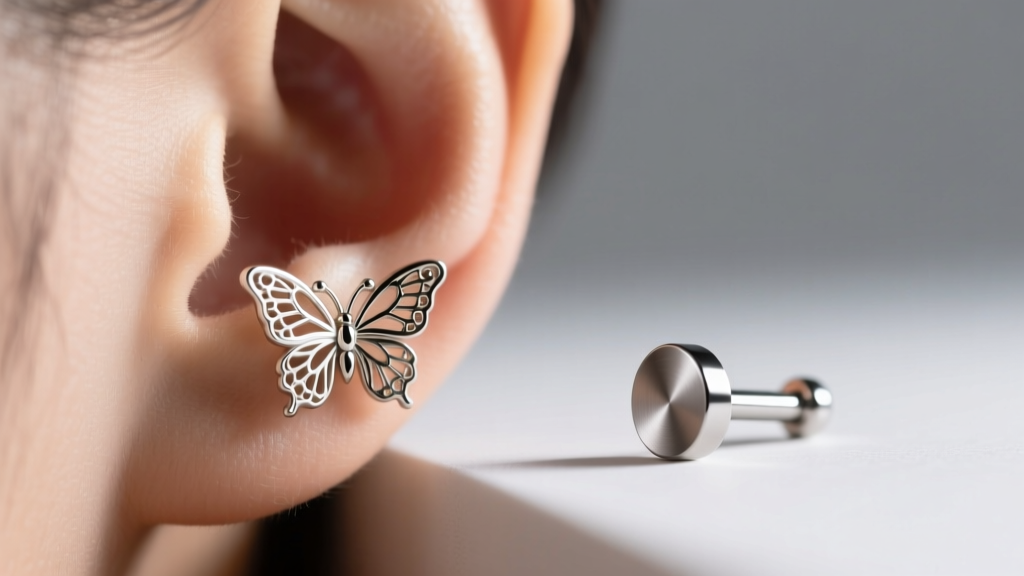
- Flat Backs (Labret Studs): Originally designed for cartilage and lip piercings, flat back studs feature a smooth, flat disc that sits flush against the back of the earlobe. They do not poke you while sleeping, they trap zero bacteria, and they are secured via internal threading or a push-fit pin mechanism that is vastly superior to friction scrolls.
- Screw Backs: These earring posts are threaded, and the back screws onto the post like a nut on a bolt. They are virtually impossible to lose and distribute pressure evenly across the earlobe. Look for internally threaded posts, where the screw mechanism is on the back, preventing damage to the piercing channel.
- Silicone O-Rings: If you have existing posts that won't stay secure, you can bypass the metal butterfly back entirely. Slipping a tiny, medical-grade silicone O-ring onto the post provides incredible grip, is completely hypoallergenic, and costs pennies to replace.
Final Verdict: When to Throw Away Your Friction Backs
The earring butterfly back is a relic of mass-produced jewelry that prioritizes manufacturing speed over wearer experience. If your clutch requires excessive force to push past the post notch, if the metal shows any signs of pitting or discoloration, or if it causes skin indentation, throw it away. For fine jewelry and daily-wear diamonds, always insist on screw backs or internally threaded flat backs. Your earlobes—and your peace of mind—will thank you. For more in-depth material science regarding body jewelry, refer to the National Center for Biotechnology Information (NCBI) database on contact dermatitis and metal alloys.


